
Cell-Type Prediction in Spatial Transcriptomics Data using Graph Neural Networks
in
Workshop: Machine Learning for Genomics Explorations (MLGenX)
Abstract
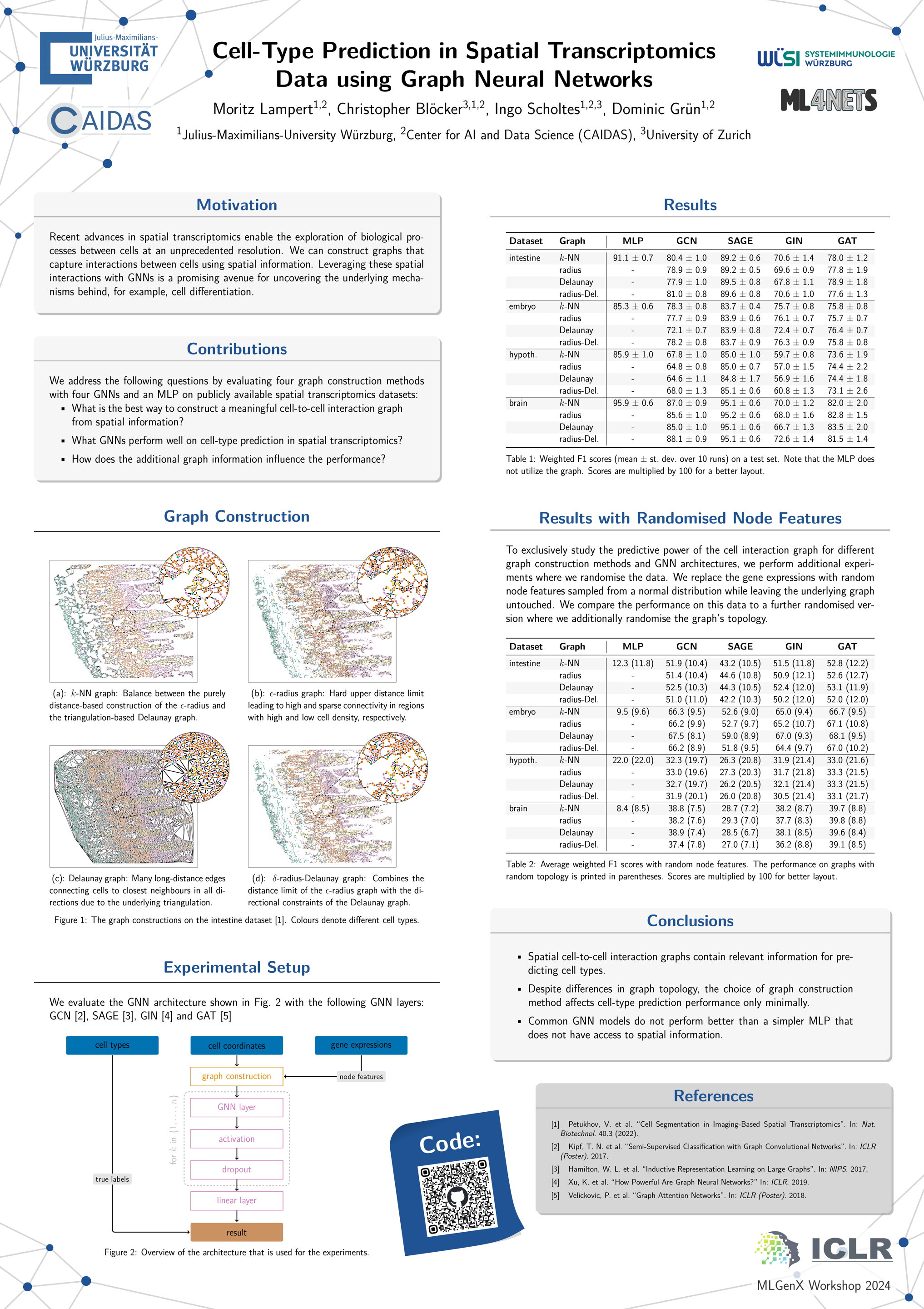
Recent advances in spatial transcriptomics enable the exploration of biological processes between cells at an unprecedented resolution.Leveraging spatial information allows us to construct cell-to-cell interaction graphs that describe possible communication between cells.Combining spatial interactions through graph neural networks (GNNs) with cells' gene expressions is a promising avenue for uncovering the underlying mechanisms behind, for example, cell differentiation.However, how to best construct a meaningful graph that captures relevant spatial information remains an open question.Moreover, what GNN architectures perform well on typical prediction tasks, such as cell-type prediction, is unclear.We address these questions by systematically evaluating several graph construction methods with common GNNs on four publicly available spatial transcriptomics datasets.Our results show that the spatial cell-to-cell interaction graphs contain relevant information for predicting cell types.Despite differences in graph topology, the choice of graph construction method affects cell-type prediction performance only minimally.Common GNN models do not perform better than a simpler multi-layer perceptron that does not have access to spatial information.