
Bridging Generalization Gap of Heterogeneous Federated Clients Using Generative Models
Abstract
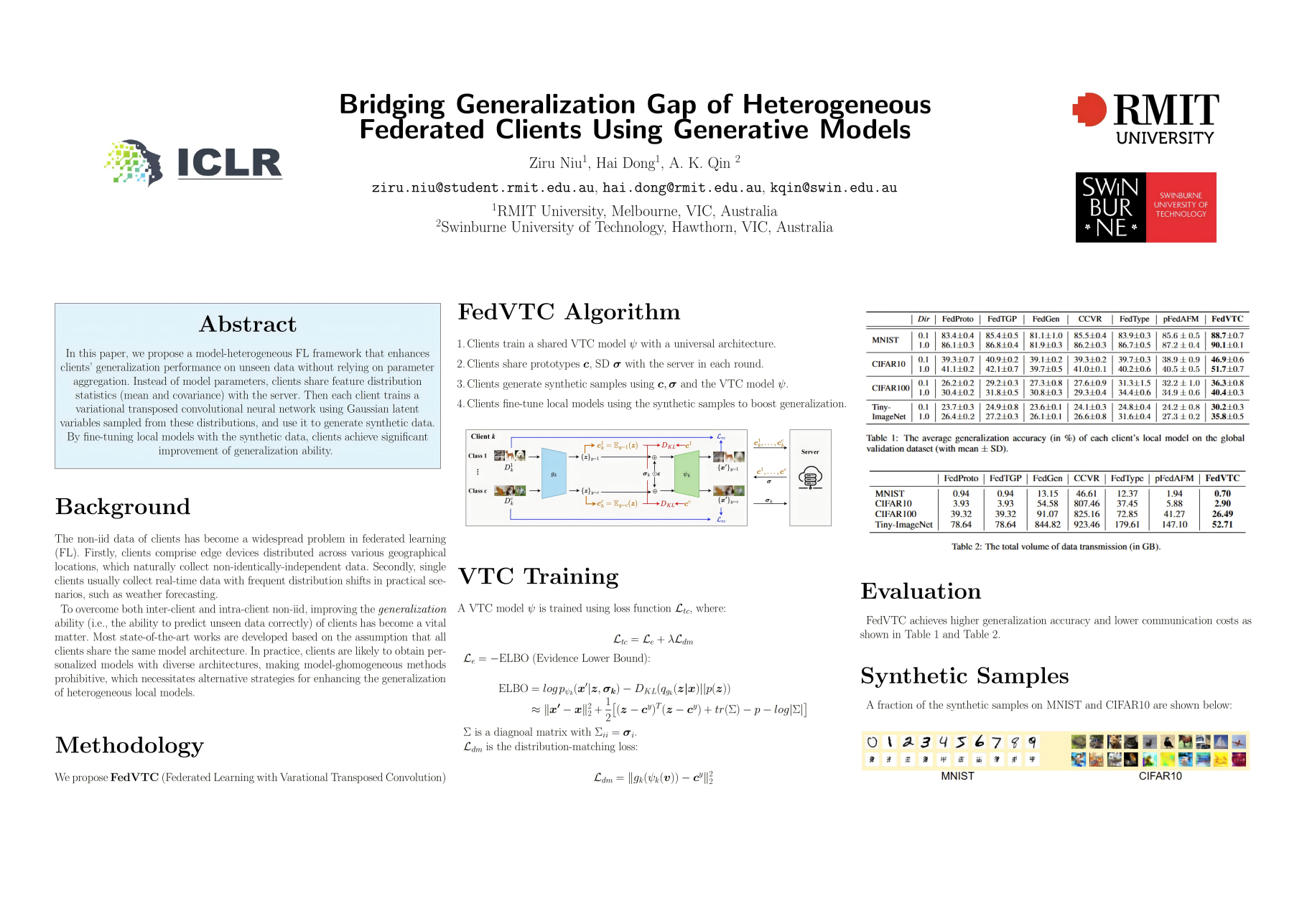
Federated Learning (FL) is a privacy-preserving machine learning framework facilitating collaborative training across distributed clients. However, its performance is often compromised by data heterogeneity among participants, which can result in local models with limited generalization capability. Traditional model-homogeneous approaches address this issue primarily by regularizing local training procedures or dynamically adjusting client weights during aggregation. Nevertheless, these methods become unsuitable in scenarios involving clients with heterogeneous model architectures. In this paper, we propose a model-heterogeneous FL framework that enhances clients’ generalization performance on unseen data without relying on parameter aggregation. Instead of model parameters, clients share feature distribution statistics (mean and covariance) with the server. Then each client trains a variational transposed convolutional neural network using Gaussian latent variables sampled from these distributions, and use it to generate synthetic data. By fine-tuning local models with the synthetic data, clients achieve significant improvement of generalization ability. Experimental results demonstrate that our approach not only attains higher generalization accuracy compared to existing model-heterogeneous FL frameworks, but also reduces communication costs and memory consumption.