
NextQuill: Causal Preference Modeling for Enhancing LLM Personalization
Abstract
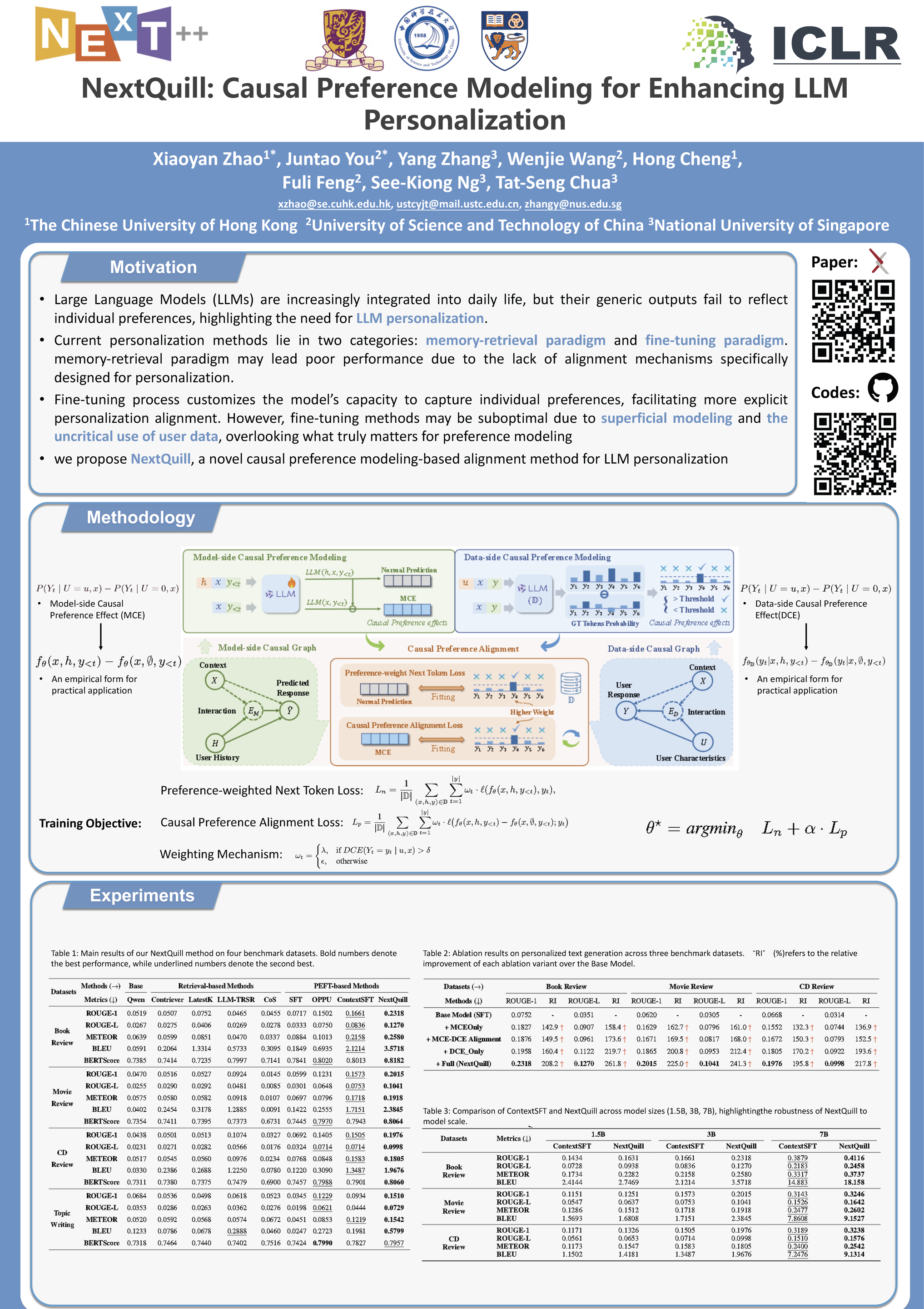
Personalizing large language models (LLMs) is increasingly important as they are progressively integrated into real-world applications to support users’ daily lives. However, existing approaches often fail to distinguish which components of response predictions by model and ground-truth response in training data truly reflect user preferences, resulting in shallow personalization alignment. In this paper, we introduce NextQuill, a novel LLM personalization alignment framework grounded in causal preference modeling. We approach personalization from a causal perspective, recognizing that model-predicted responses (model side) and user-written ground-truth responses (data side) are both outcomes shape by user history (characteristics) and other context factors. To better capture user preferences, we define causal preference effects as the causal effect of the user history/characteristics on outcomes from the model/data side. Building on this foundation, NextQuill introduces two complementary alignment strategies: (1) aligning model-side causal preference effects (on predictions) with those of ground-truth data, rather than indiscriminately aligning all predictions, and (2) emphasizing learning the preference-driven ground-truth tokens, identified via data-side causal preference effects, rather than treating all tokens equally. As such, NextQuill shifts the alignment process toward learning from causal preference effects, facilitating more effective and personalized LLM adaptation. Experiments on multiple personalization benchmarks demonstrate that NextQuill substantially improves personalization quality. Code is available at \url{https://github.com/juntaoyou/NextQuill}.