
KernelFusion: Zero-Shot Blind Super-Resolution via Patch Diffusion
Abstract
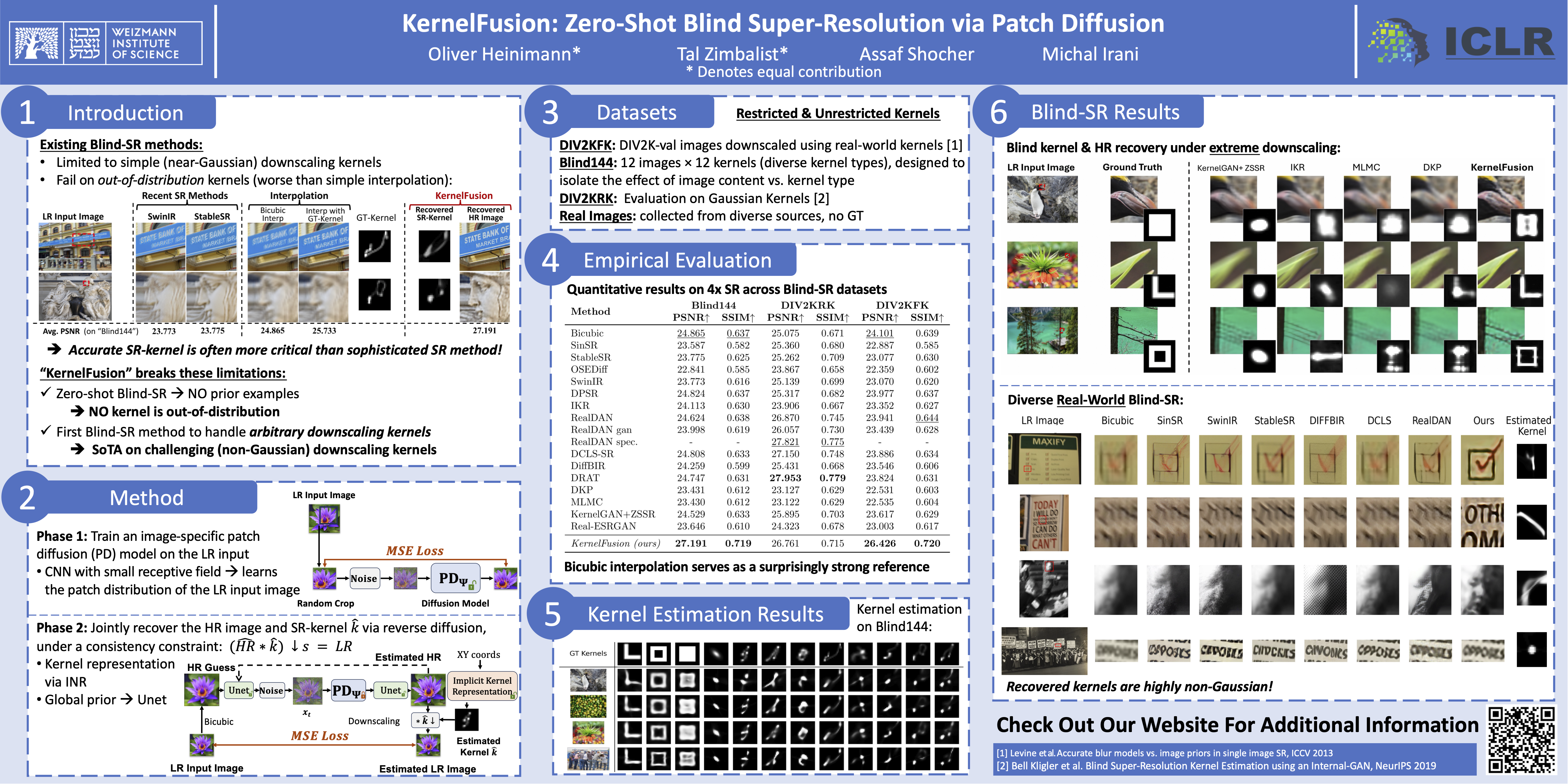
Traditional super-resolution (SR) methods assume an "ideal'' downscaling SR-kernel (e.g., bicubic downscaling) between the high-resolution (HR) image and the low-resolution (LR) image. Such methods fail once the LR images are generated differently. Current blind-SR methods aim to remove this assumption, but are still fundamentally restricted to rather simplistic downscaling SR-kernels (e.g., anisotropic Gaussian kernels), and fail on more complex (out of distribution) downscaling degradations. However, using the correct SR-kernel is often more important than using a sophisticated SR algorithm. In "KernelFusion'', we introduce a zero-shot diffusion-based method that uses an unrestricted kernel. Our method recovers the unique image-specific SR-kernel directly from the LR input image, while simultaneously recovering its corresponding HR image. KernelFusion exploits the principle that the correct SR-kernel is the one that maximizes patch similarity across different scales of the LR image. We first train an image-specific patch-based diffusion model on the single LR input image, capturing its unique internal patch statistics. We then reconstruct a larger HR image with the same learned patch distribution, while simultaneously recovering the correct downscaling SR-kernel that maintains this cross-scale relation between the HR and LR images. Empirical results demonstrate that KernelFusion handles complex downscaling degradations where existing Blind-SR methods fail, achieving robust kernel recovery and superior SR quality. By breaking free from predefined kernel assumptions and training distributions, KernelFusion establishes a new paradigm of zero-shot Blind-SR that can handle unrestricted, image-specific kernels previously thought impossible.