
GenDR: Lighten Generative Detail Restoration
Abstract
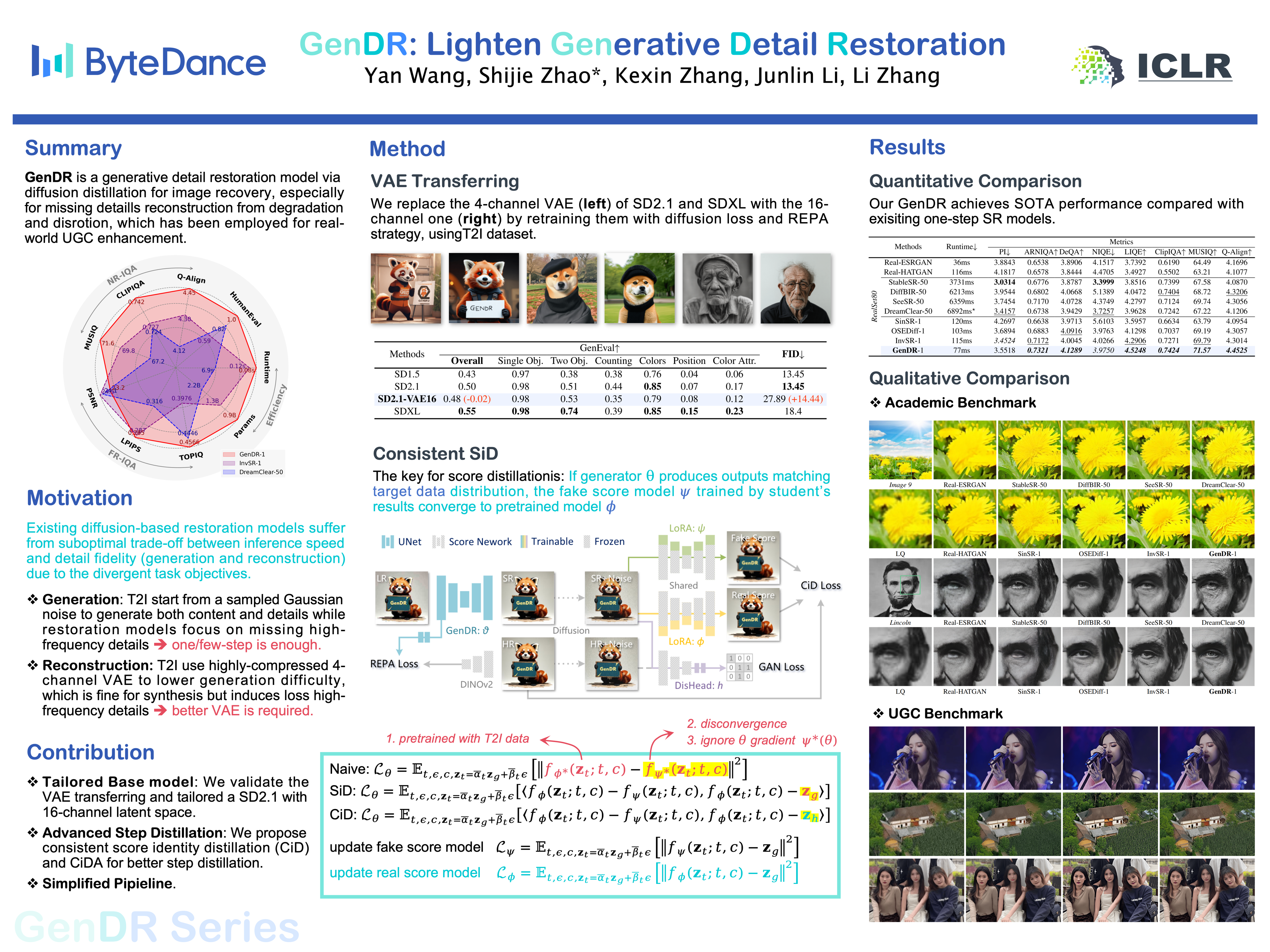
Although recent research applying text-to-image (T2I) diffusion models to real-world super-resolution (SR) has achieved remarkable progress, the misalignment of their targets leads to a suboptimal trade-off between inference speed and detail fidelity. Specifically, the T2I task requires multiple inference steps to synthesize images matching to prompts and reduces the latent dimension to lower generating difficulty. Contrariwise, SR can restore high-frequency details in fewer inference steps, but it necessitates a more reliable variational auto-encoder (VAE) to preserve input information. However, most diffusion-based SRs are multistep and use 4-channel VAEs, while existing models with 16-channel VAEs are overqualified diffusion transformers, e.g., FLUX (12B). To align the target, we present a one-step diffusion model for generative detail restoration, GenDR, distilled from a tailored diffusion model with a larger latent space. In detail, we train a new SD2.1-VAE16 (0.9B) via representation alignment to expand the latent space without increasing the model size. Regarding step distillation, we propose consistent score identity distillation (CiD) that incorporates SR task-specific loss into score distillation to leverage more SR priors and align the training target. Furthermore, we extend CiD with adversarial learning and representation alignment (CiDA) to enhance perceptual quality and accelerate training. We also polish the pipeline to achieve a more efficient inference. Experimental results demonstrate that GenDR achieves state-of-the-art performance in both quantitative metrics and visual fidelity.