
From atom to space: A region-based readout function for spatial properties of materials
Abstract
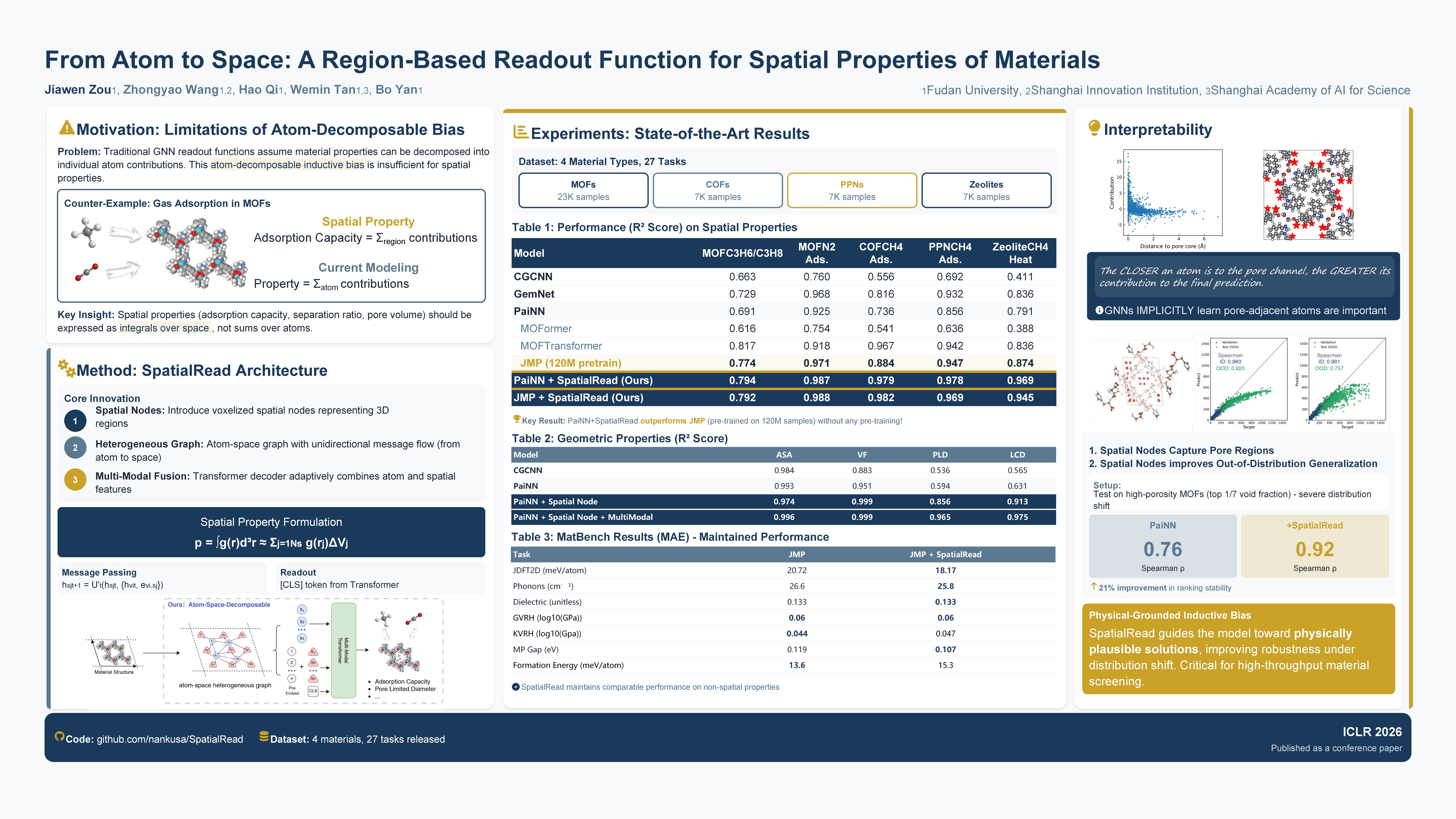
The message passing–readout framework has become the de facto standard of graph neural networks (GNNs) for material property prediction. However, most existing readout functions are built on an atom-decomposable inductive bias, i.e. the material-level property or feature can be reasonably assigned to contributions of individual atoms. This is a strong bias and may not hold for all properties, limiting the application scenarios (e.g. gas adsorption or separation of Metal Organic Frameworks, MOFs). In this work, we propose a region-based decomposition perspective, reformulating material properties as integrals over space and pooling contributions from spatial regions rather than atoms. Specifically, we propose a novel readout function named SpatialRead. SpatialRead introduces additional spatial nodes to represent a voxelized space, transforming the atomic isomorphic graph into a heterogeneous atom–space graph with unidirectional message flow from atoms to spatial nodes. To combine the two types of inductive bias, multimodal methods can be used to fuse the features of atoms the spatial nodes. Such a region-based readout function is especially suited for spatial properties such as gas adsorption capacity, separation ratio. Extensive experiments demonstrate that a simple PaiNN–Transformer-based SpatialRead trained from scratch outperforms state-of-the-art pre-trained foundation models on these special tasks. Our results highlight the importance of designing physically grounded readout functions tailored to the target property. The code and dataset can be found in github https://github.com/nankusa/SpatialRead.