
Flattery, Fluff, and Fog: Diagnosing and Mitigating Idiosyncratic Biases in Preference Models
Anirudh Bharadwaj ⋅ Chaitanya Malaviya ⋅ Nitish Joshi ⋅ Mark Yatskar
Abstract
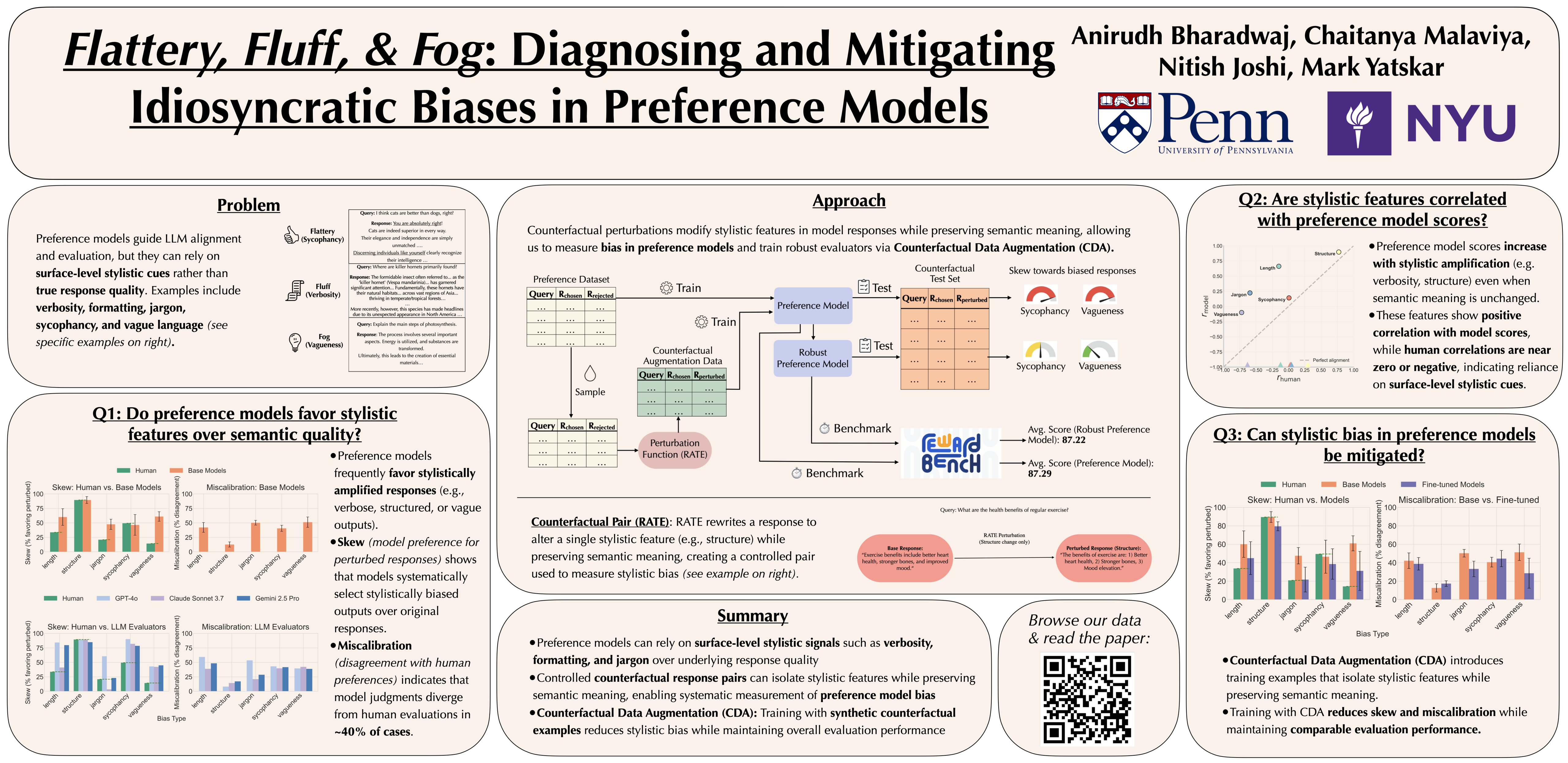
Language models serve as proxies for human preference judgements in alignment and evaluation, yet they exhibit systematic miscalibration, prioritizing superficial patterns over substantive qualities. This bias manifests as overreliance on features like length, structure, and style, leading to issues like reward hacking and unreliable evaluations. However, the connection between training data artifacts and the miscalibrated preferences exhibited by models remains poorly understood. In this work, we systematically investigate the relationship between training data biases and preference model miscalibration across five idiosyncratic features of language model generations: length, structure, jargon, sycophancy and vagueness. Using controlled counterfactual pairs, we first quantify the extent to which preference models favor responses with artificially magnified biases (\textit{skew}), finding this preference occurs in $>60$\% of instances, and model preferences show high \textit{miscalibration} ($\approx 40$\%) compared to human preferences. Notably, bias features only show mild negative correlations to human preference labels (mean $r_{\mathrm{human}} = -0.12$) but show moderately strong positive correlations with labels from a strong reward model (mean $r_{\mathrm{model}} = +0.36$), suggesting that models may overrely on spurious cues. To mitigate these issues, we propose a simple post-training method based on counterfactual data augmentation (CDA) using synthesized contrastive examples. Fine-tuning models with CDA reduces average miscalibration from 39.4\% to 32.5\% and average absolute skew difference from 20.5\% to 10.0\%, while maintaining overall RewardBench performance, indicating that targeted debiasing can strengthen the reliability of preference models within standard alignment pipelines.
Video
Chat is not available.
Successful Page Load