
Sequential Information Bottleneck Fusion: Towards Robust and Generalizable Multi-Modal Brain Tumor Segmentation
Abstract
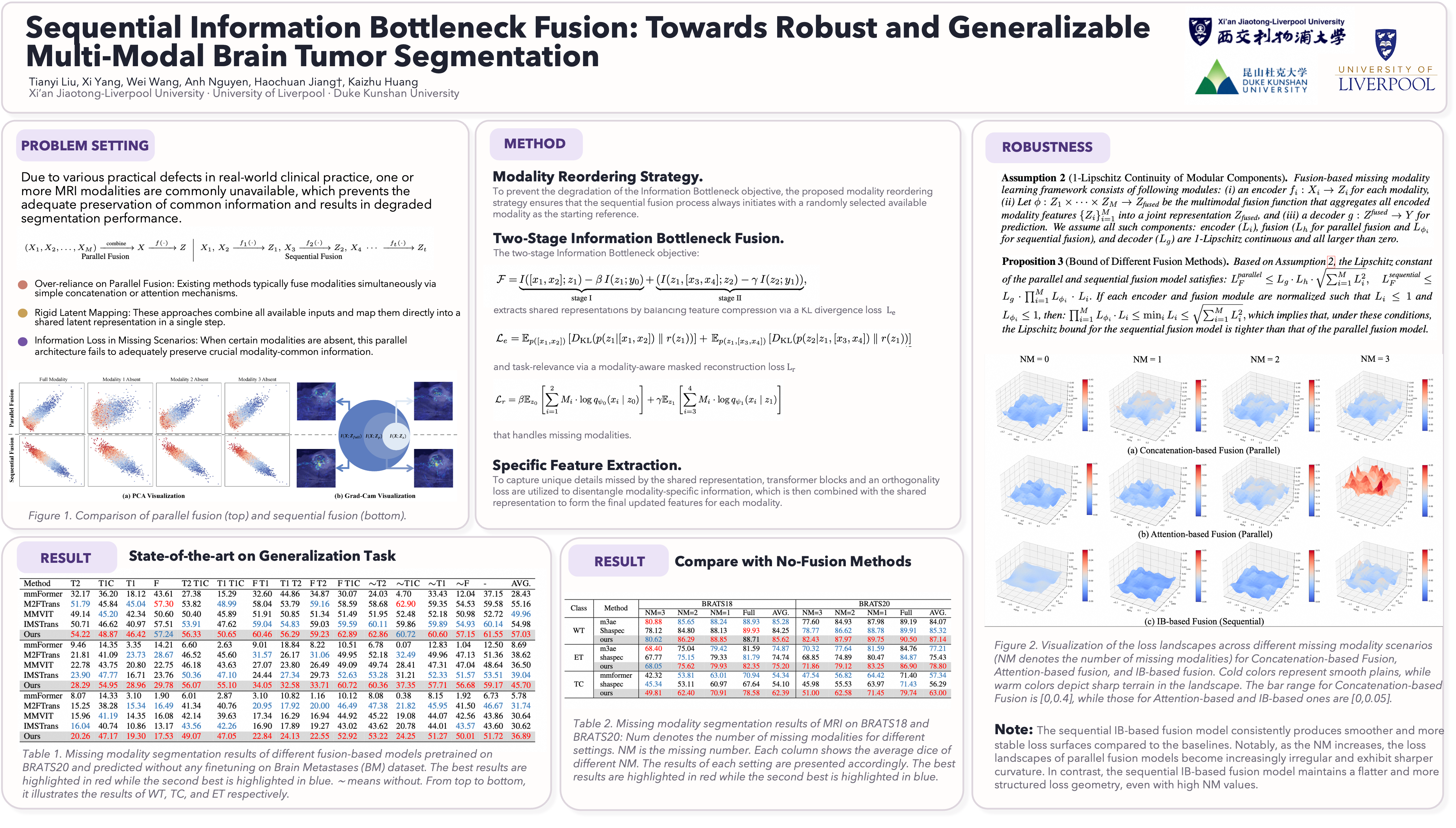
Brain tumor segmentation in multi-modal MRIs poses significant challenges when one or more modalities are missing. Recent approaches commonly employ parallel fusion strategies; however, these methods often risk losing crucial shared information across modalities, which can degrade segmentation performance. In this paper, we advocate leveraging sequential information bottleneck fusion to effectively preserve shared information across modalities. From an information-theoretic perspective, sequential fusion not only produces more robust fused representations in missing-data scenarios but also achieves a tighter generalization upper bound compared to parallel fusion approaches. Building on this principle, we propose the Sequential Multi-modal Segmentation Network (SMSN), which integrates an Information-Bottleneck Fusion Module (IBFM). The IBFM sequentially extracts modality-common features while reconstructing modality-specific features through a dedicated feature extraction module. Extensive experiments on the BRATS18 and BRATS20 glioma datasets demonstrate that SMSN consistently outperforms traditional parallel fusion-based baselines, achieving exceptional robustness in diverse missing-modality settings. Furthermore, SMSN exhibits superior cross-domain generalization, as evidenced by its ability to transfer a trained model from BRATS20 to a brain metastasis dataset without fine-tuning. To ensure reproducibility, the code of the SMSN is provided in the supplementary file.