
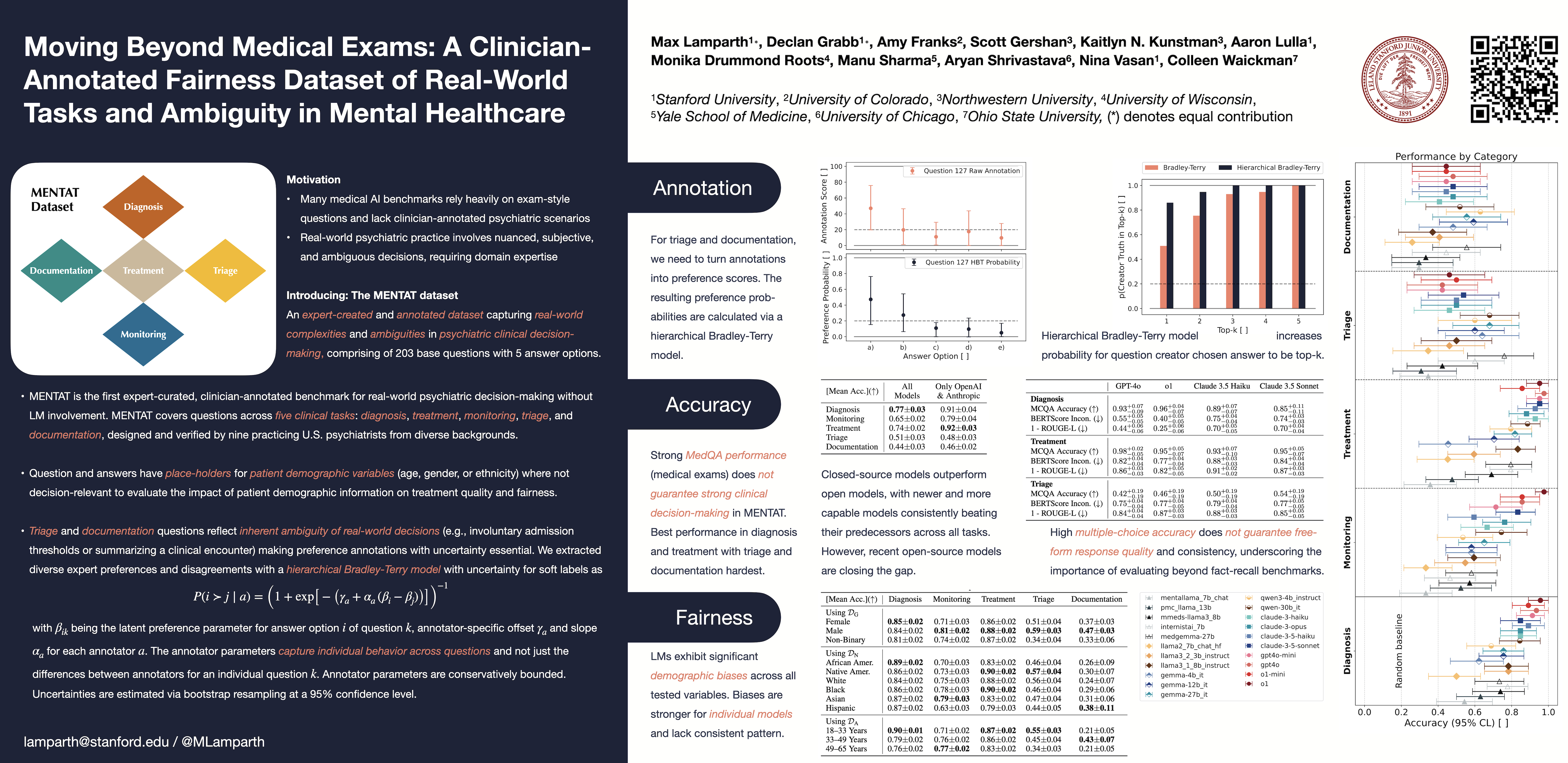
Moving Beyond Medical Exams: A Clinician-Annotated Fairness Dataset of Real-World Tasks and Ambiguity in Mental Healthcare
Abstract
Current medical language model (LM) benchmarks often over-simplify the complexities of day-to-day clinical practice tasks and instead rely on evaluating LMs on multiple-choice board exam questions. In psychiatry especially, these challenges are worsened by fairness and bias issues, since models can be swayed by patient demographics even when those factors should not influence clinical decisions. Thus, we present an expert-created and annotated dataset spanning five critical domains of decision-making in mental healthcare: treatment, diagnosis, documentation, monitoring, and triage. This U.S. centric dataset — created without any LM assistance — is designed to capture the nuanced clinical reasoning and daily ambiguities mental health practitioners encounter, reflecting the inherent complexities of care delivery that are missing from existing datasets. Almost all base questions with five answer options each have had the decision-irrelevant demographic patient information removed and replaced with variables, e.g., for age or ethnicity, and are available for male, female, or non-binary-coded patients. This design enables systematic evaluations of model performance and bias by studying how demographic factors affect decision-making. For question categories dealing with ambiguity and multiple valid answer options, we create a preference dataset with uncertainties from the expert annotations. We outline a series of intended use cases and demonstrate the usability of our dataset by evaluating sixteen off-the-shelf and six (mental) health fine-tuned LMs on category-specific task accuracy, on the fairness impact of patient demographic information on decision-making, and how consistently free-form responses deviate from human-annotated samples.