
Bayesian Ensemble for Sequential Decision-Making
Abstract
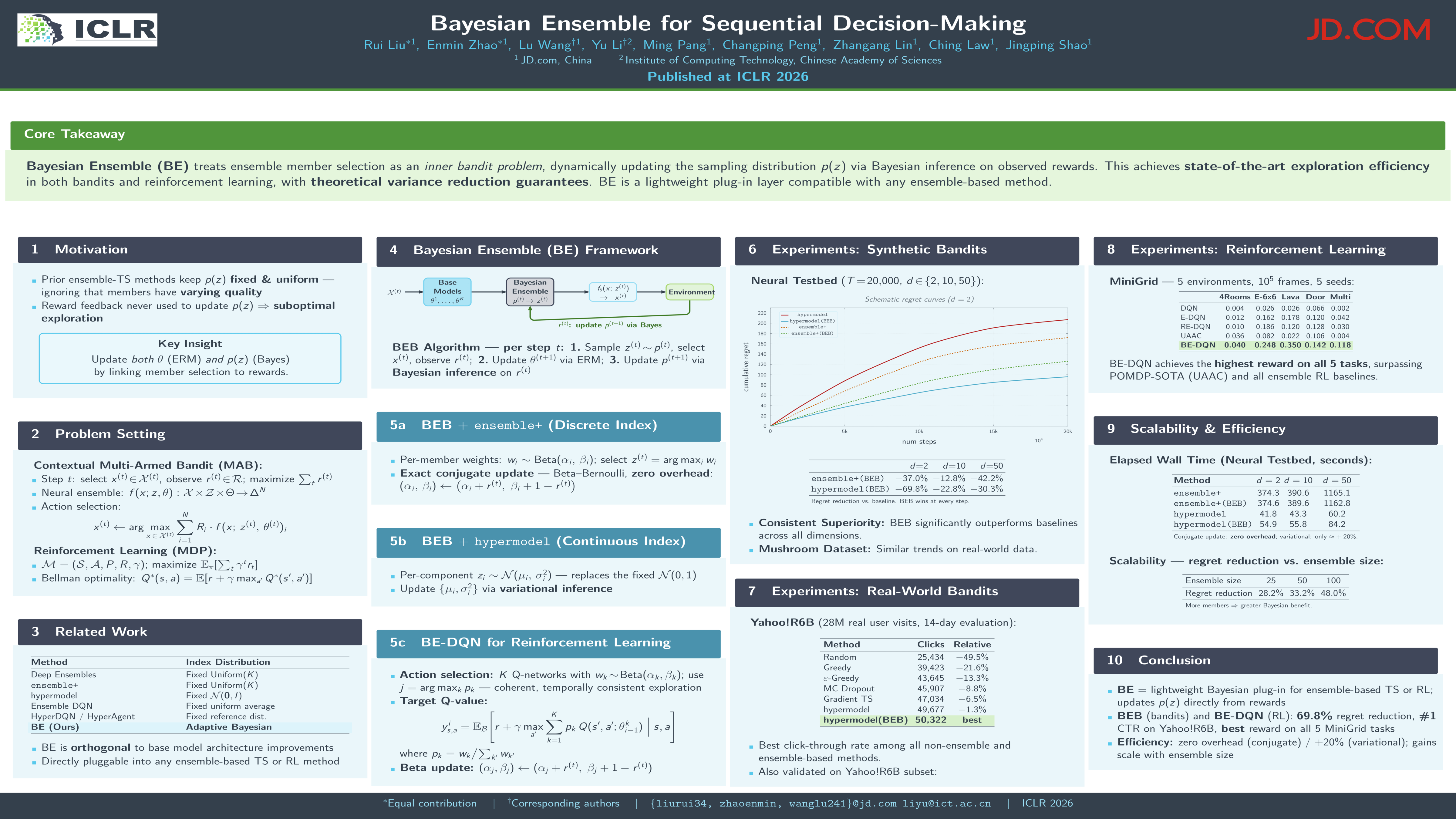
Ensemble learning is a practical family of methods for uncertainty modeling, particularly useful for sequential decision-making problems like recommendation systems and reinforcement learning tasks. The posterior on likelihood parameters is approximated by sampling an ensemble member from a predetermined index distribution, with the ensemble’s diversity reflecting the degree of uncertainty. In this paper, we propose Bayesian Ensemble (BE), a lightweight yet principled Bayesian layer atop existing ensembles. BE treats the selection of an ensemble member as a bandit problem in itself, dynamically updating a sampling distribution over members via Bayesian inference on observed rewards. This contrasts with prior works that rely on fixed, uniform sampling. We extend this framework to both bandit learning and reinforcement learning, introducing Bayesian Ensemble Bandit and Bayesian Ensemble Deep Q-Network for diverse decision-making problems. Extensive experiments on both synthetic and real-world environments demonstrate the effectiveness and efficiency of BE.