
Generation then Reconstruction: Accelerating Masked Autoregressive Models via Two-Stage Sampling
Abstract
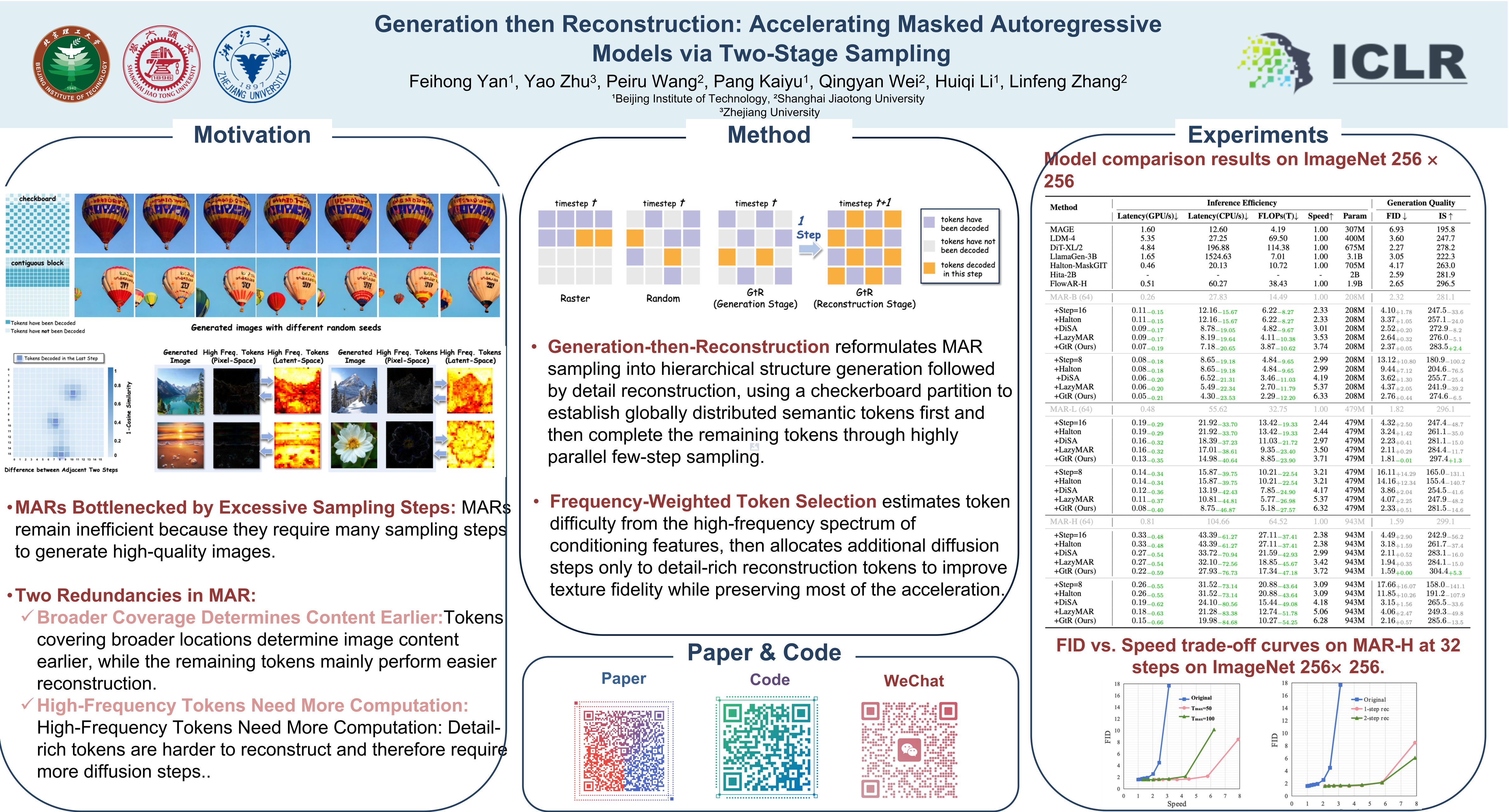
Masked Autoregressive (MAR) models promise better efficiency in visual generation than continuous autoregressive (AR) models for the ability of parallel generation, yet their acceleration potential remains constrained by the modeling complexity of spatially correlated visual tokens in a single step. To address this limitation, we introduce Generation then Reconstruction (GtR), a training-free hierarchical sampling strategy that decomposes generation into two stages: structure generation establishing global semantic scaffolding, followed by detail reconstruction efficiently completing remaining tokens. Assuming that it is more difficult to create an image from scratch than to complement images based on a basic image framework, GtR is designed to achieve acceleration by computing the reconstruction stage quickly while maintaining the generation quality by computing the generation stage slowly. Moreover, observing that tokens on the details of an image often carry more semantic information than tokens in the salient regions, we further propose Frequency-Weighted Token Selection (FTS) to offer more computation budget to tokens on image details, which are localized based on the energy of high frequency information. Extensive experiments on ImageNet class-conditional and text-to-image generation demonstrate 3.72X speedup on MAR-H while maintaining comparable quality (e.g., FID: 1.59, IS: 304.4 vs. original 1.59, 299.1), substantially outperforming existing acceleration methods across various model scales and generation tasks. Our codes will be released in https://github.com/feihongyan1/GtR.