
Bayesian Evidence-Driven Prototype Evolution for Federated Domain Adaptation
Abstract
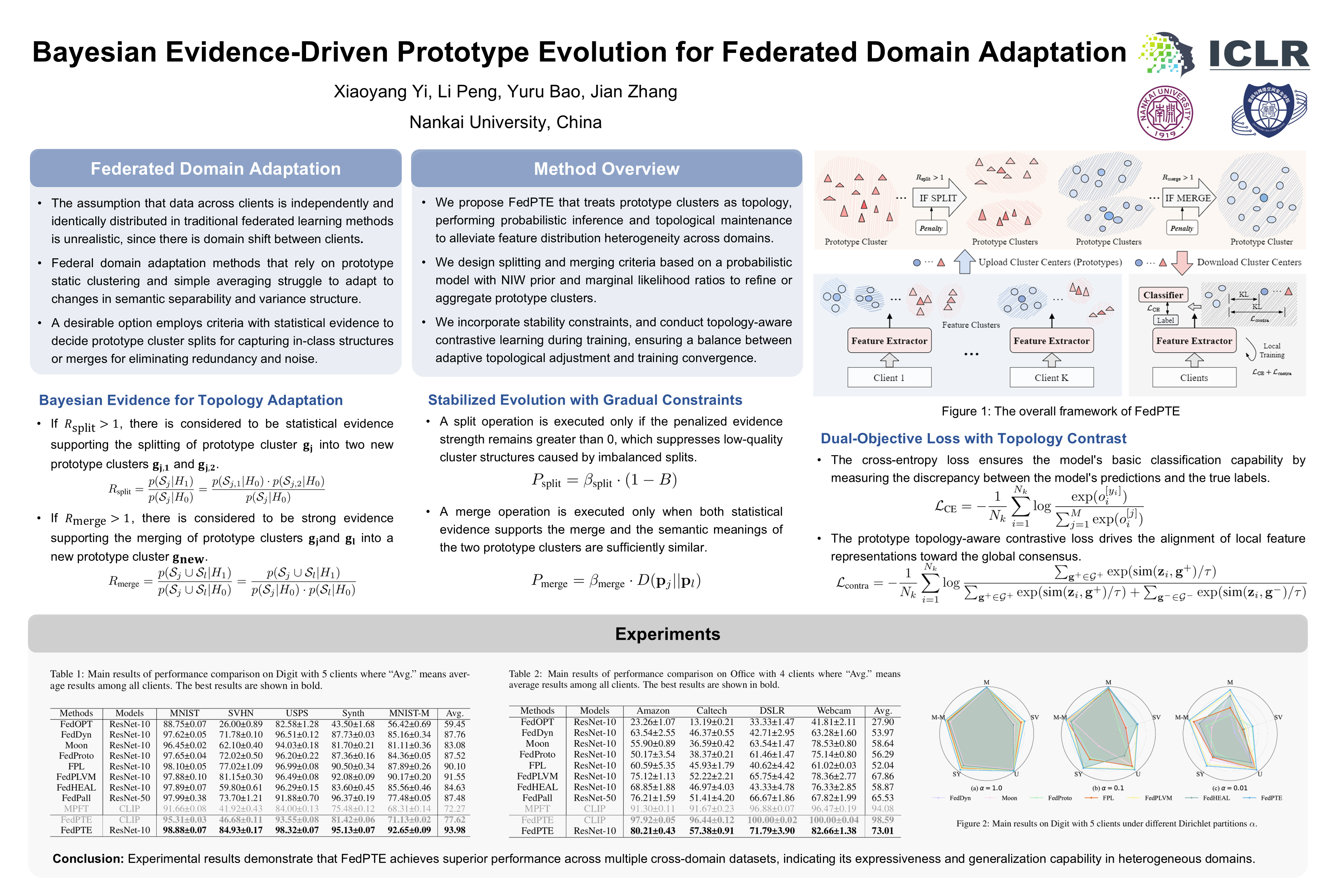
Federated learning (FL), as a privacy-preserving distributed machine learning paradigm, enables clients to collaboratively train a global model without sharing local data. However, in real-world scenarios, domain shift caused by different source clients leads to structural discrepancies in the feature space, resulting in performance degradation of the global model. Although existing prototype-based FL methods offer improvements in cross-domain feature alignment, they still struggle to adapt to dynamic semantic structures and fail to continuously respond to the changing semantic separability and variance structure during training. To address this, we propose FedPTE, an FL framework with prototype topology evolution. Specifically, FedPTE treats prototype clusters as variable topological units, employing Bayesian Gaussian Mixture Models and marginal likelihood ratios on the server to perform probabilistic inference, which enables adaptive structural adjustments. Meanwhile, FedPTE introduces a stability constraint mechanism to balance the adaptability of topological evolution and training stability. By conducting prototype topology-aware contrastive learning on clients, it enhances the discriminability and cross-domain consistency of features. Experimental results demonstrate that FedPTE achieves superior performance across multiple cross-domain datasets, showcasing its strong expressiveness and generalization capability in heterogeneous domains.