
Uni-NTFM: A Unified Foundation Model for EEG Signal Representation Learning
Abstract
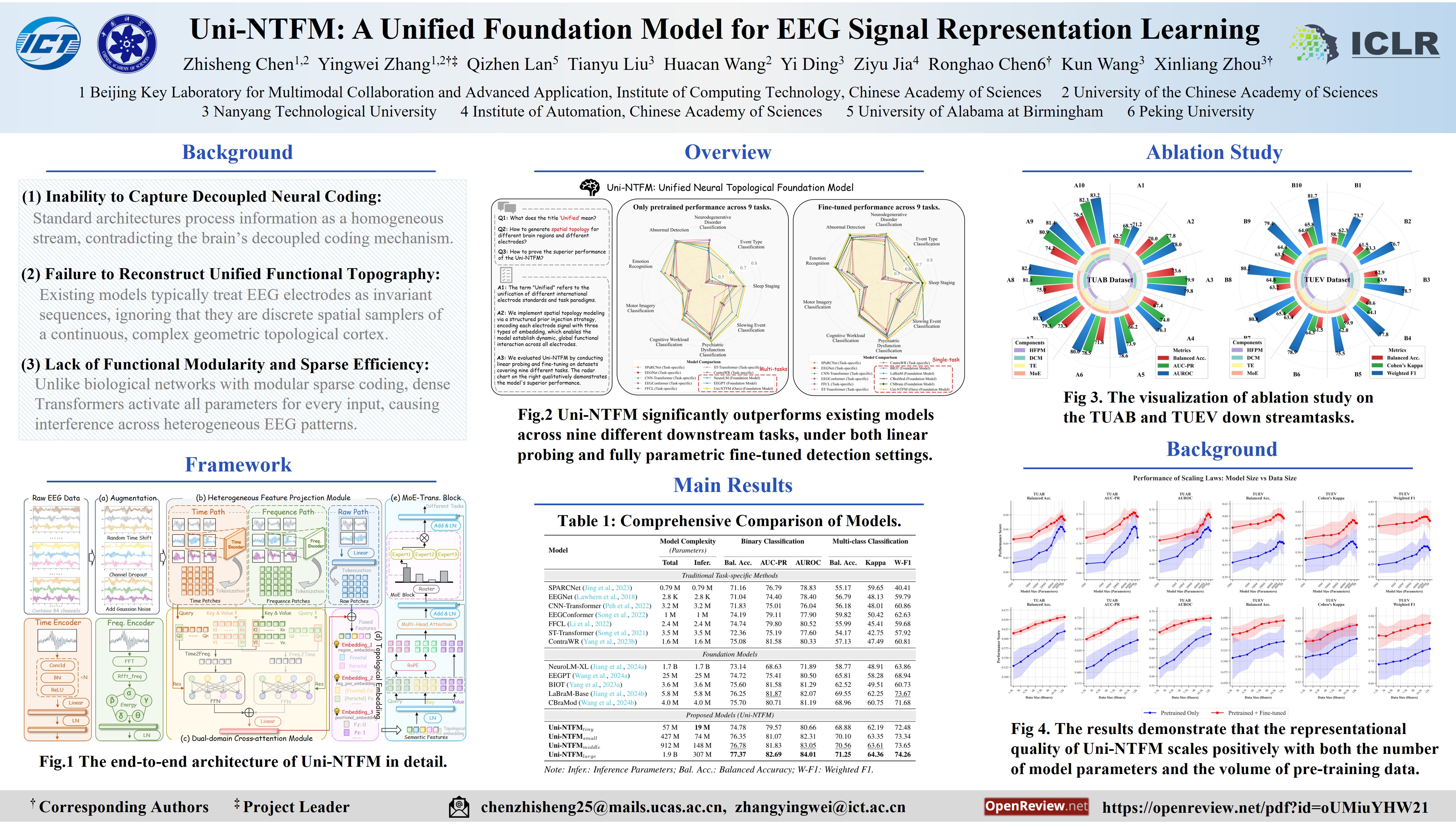
Current foundation models for electroencephalography (EEG) rely on architectures adapted from computer vision or natural language processing, typically treating neural signals as pixel grids or token sequences. This approach overlooks that the neural activity is activated by diverse sparse coding across a complex geometric topological cortex. Inspired by biological neural mechanisms, we propose the Unified Neural Topological Foundation Model (Uni-NTFM), an architecture rooted in three core neuroscience principles. In detail, to align with the brain's decoupled coding mechanism, we design the Heterogeneous Feature Projection Module. This module simultaneously encodes both time-domain non-stationary transients and frequency-domain steady-state rhythms, ensuring high quality in both waveform morphology and spectral rhythms. Moreover, we introduce a Topological Embedding mechanism to inject structured spatial priors and align different sensor configurations onto a unified latent functional topography, effectively reconstructing the geometry of brain regions. Furthermore, we achieve functional modularization and sparse coding efficiency of biological networks by constructing the Mixture-of-Experts Transformer network. This dynamic routing mechanism assigns different signal patterns and tasks to specialized neural subnetworks, and effectively preventing task interference while increasing the model capacity to record-breaking 1.9 billion parameters. Uni-NTFM is pre-trained on a diverse corpus comprising 28,000 hours of EEG data, and outperforms existing models across nine distinct downstream tasks under both linear probing and fine-tuning settings, demonstrating that aligning model architecture with neural mechanisms is significant to learn universal representations and achieve generalizable brain decoding.} Our code is available at \url{https://anonymous.4open.science/r/Uni-NTFM-0924}