
Learning Hierarchical and Geometry-Aware Graph Representations for Text-to-CAD
Abstract
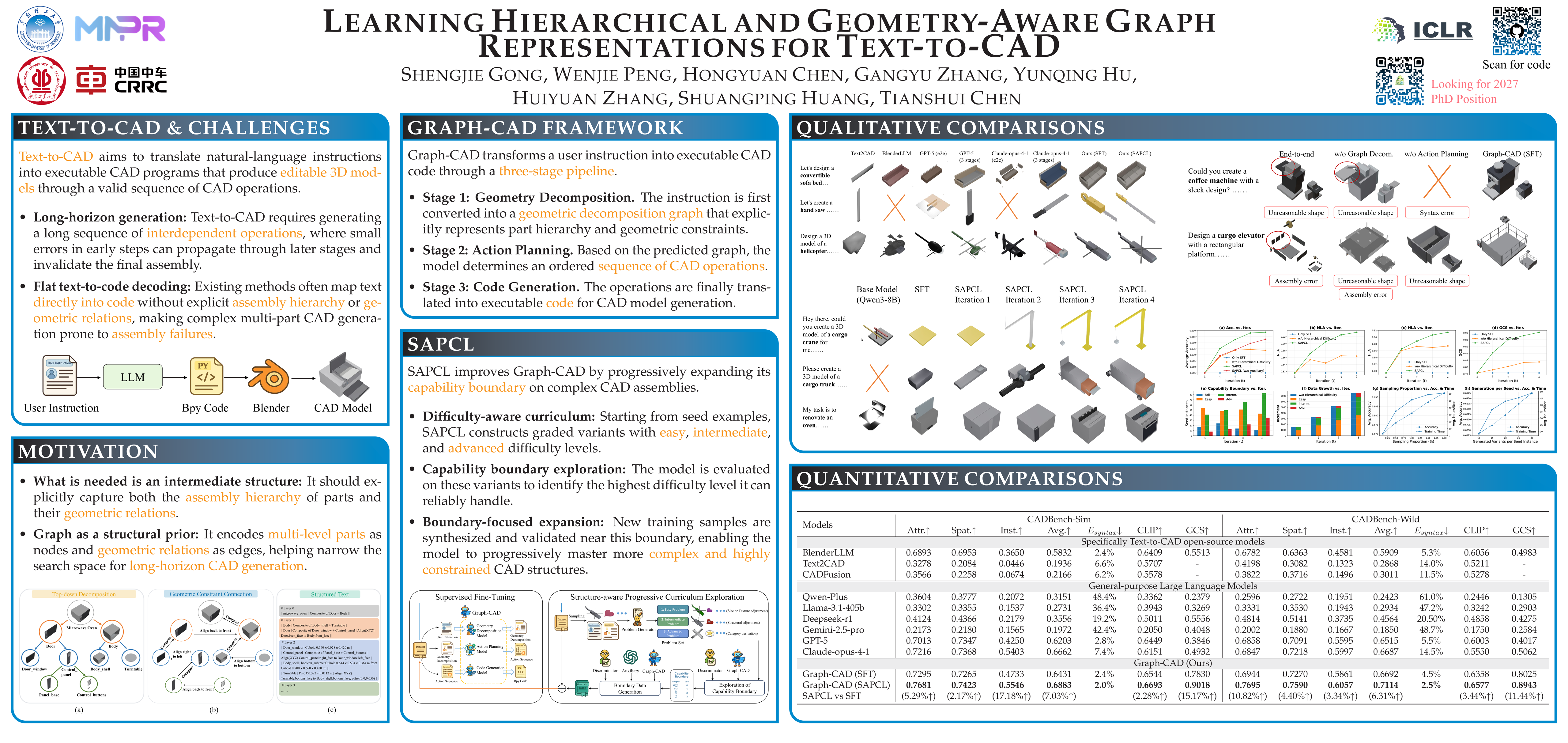
Text-to-CAD code generation is a long-horizon task, requiring the translation of instructions into a long sequence of interdependent operations. This process is exceptionally fragile, as minor early errors can propagate through the sequence and ultimately invalidate an entire complex assembly. Existing methods typically decode instructions directly into executable code (e.g., bpy) without an explicit representation of assembly hierarchy or geometric constraints. This flat decoding strategy vastly expands the search space, amplifying local errors and leading to cascading failures in contextual operations. We address this gap by learning an intermediate representation: a hierarchical and geometry-aware graph. The graph represents an assembly-based decomposition, with multi-level nodes modeling the product's parts and components, and edges defining the explicit geometric constraints between them. Rather than mapping text directly to code, our graph paradigm first predicts high-level structure and constraints, then conditions the sequencing of operations and program generation, thereby narrowing the search space and improving both geometric fidelity and constraint satisfaction. Furthermore, we introduce a structure-aware progressive curriculum learning mechanism to enhance the model's ability to generate sophisticated decomposition graphs, allowing it to handle more complex assemblies. The mechanism constructs graded tasks via controlled edits to object structure, probes the model’s capability boundary, and synthesizes boundary examples for subsequent training rounds. We also introduce a 12K-instruction dataset annotated with instructions, geometric decomposition graphs, action sequences, and bpy code, together with metrics for node- and hierarchy-level graph accuracy and a measure of constraint satisfaction. Extensive experiments show that our approach outperforms existing methods in terms of both geometric fidelity and accurate fulfillment of geometric constraints.