
Bures-Isotropy Alignment: Manifold Learning of Generalized Category Discovery
Abstract
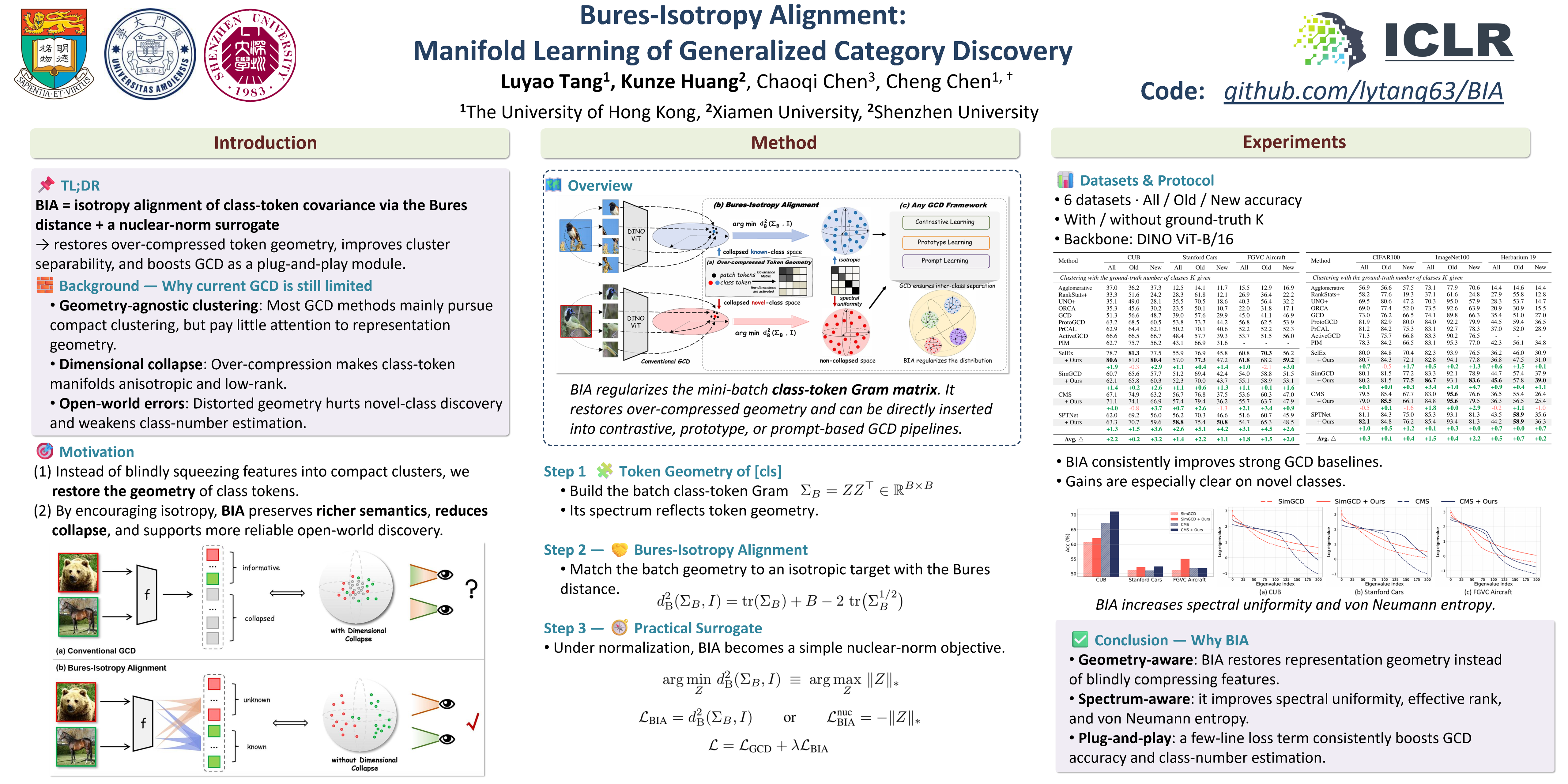
Generalized Category Discovery (GCD) seeks to discover categories by clustering unlabeled samples that mix known and novel classes. While the prevailing recipe enforces compact clustering, this pursuit is largely blind to representation geometry: it over-compresses token manifolds, distorts eigen-structure, and yields brittle feature distributions that undermine discovery. We argue that GCD requires not more compression, but geometric restoration of an over-flattened feature space. Drawing inspiration from quantum information science, which similarly pursues representational completeness, we introduce Bures-Isotropy Alignment (BIA), which optimizes the mini-batch class-token Gram toward an isotropic prior by minimizing the Bures distance. Under a mild trace constraint, BIA admits a practical surrogate equivalent to maximizing the nuclear norm of stacked class tokens, thereby promoting isotropic, non-collapsed subspaces without altering architectures. The induced isotropy homogenizes the eigen-spectrum and raises the von Neumann entropy, improving both cluster separability and class-number estimation. BIA is plug-and-play, implemented in a few lines on unlabeled batches, and generally boosts strong GCD baselines on coarse- and fine-grained benchmarks, improving overall accuracy and reducing errors in the estimation of class-number. By restoring the geometry of token manifolds rather than compressing them blindly, BIA supplies compactness for known classes and cohesive emergence for novel ones, advancing robust open-world discovery. Code is available at github.com/lytang63/BIA.