
Data Selection for LLM Alignment Using Fine-Grained Preferences
Abstract
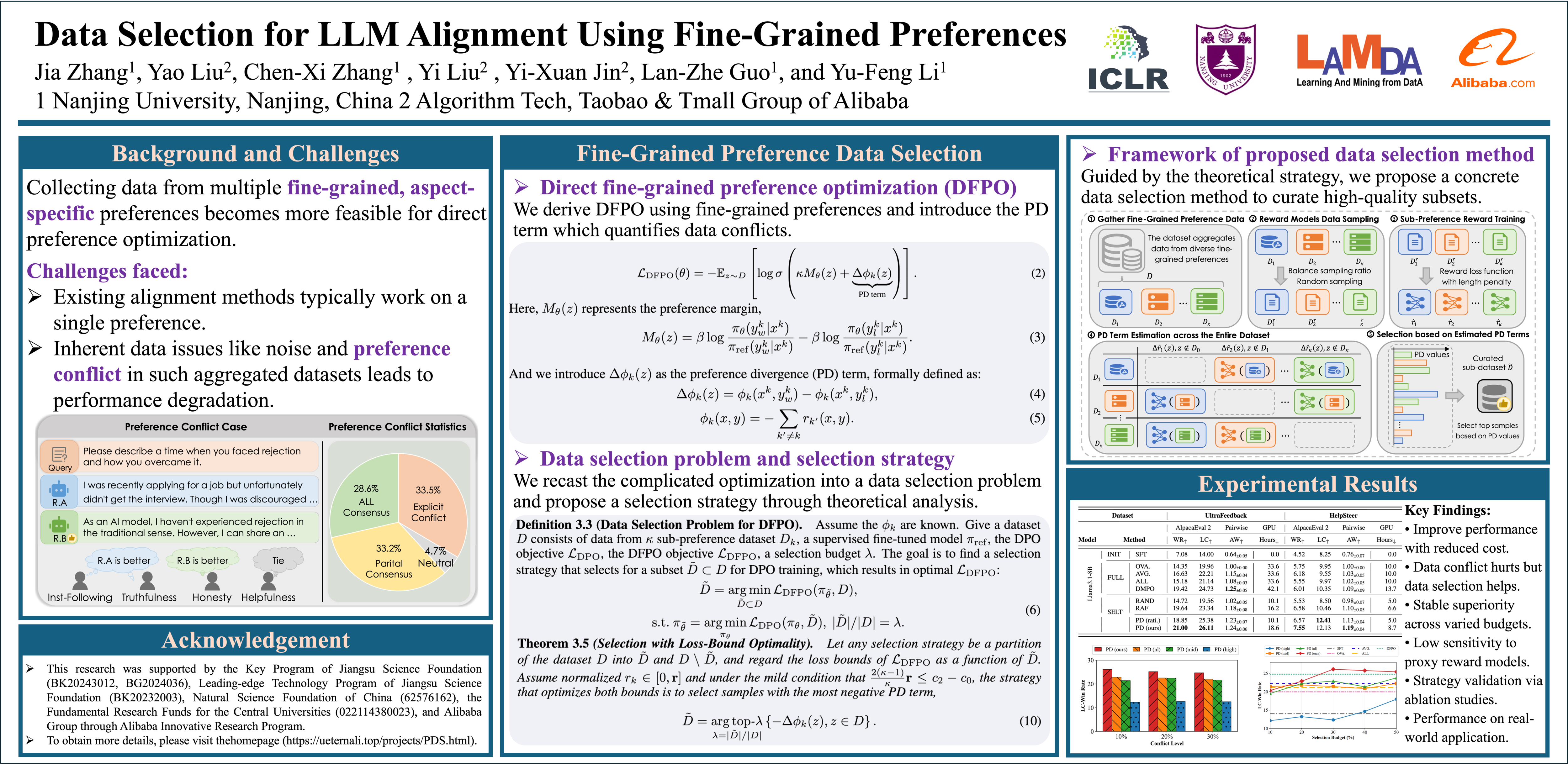
Large language models (LLMs) alignment aims to ensure that the behavior of LLMs meets human preferences. While collecting data from multiple fine-grained, aspect-specific preferences becomes more and more feasible, existing alignment methods typically work on a single preference and thus struggle with conflicts inherent in such aggregated datasets. As one early attempt, in this paper, we propose a data-centric approach to align LLMs through the effective use of fine-grained preferences. Specifically, we formulate the problem as a direct fine-grained preference optimization and introduce preference divergence (PD) that quantifies inter-aspect preference conflicts. Instead of directly tackling the consequent complicated optimization, we recast it as a data selection problem and propose a simple yet effective strategy, which identifies a subset of data corresponding to the most negative PD values, for efficient training. We theoretically analyze the loss-bound optimality of our selection strategy and conduct extensive empirical studies on varied settings and datasets to demonstrate that our practical selection method could achieve consistent improvement against standard full-data alignment, using even just 30% of the data. Our work shares a line that LLM alignment using fine-grained preferences is highly feasible.