
Ultra-Fast Language Generation via Discrete Diffusion Divergence Instruct
Haoyang Zheng ⋅ Xinyang Liu ⋅ Xiangrui Kong ⋅ Nan Jiang ⋅ Zheyuan Hu ⋅ Weijian Luo ⋅ Wei Deng ⋅ Guang Lin
Abstract
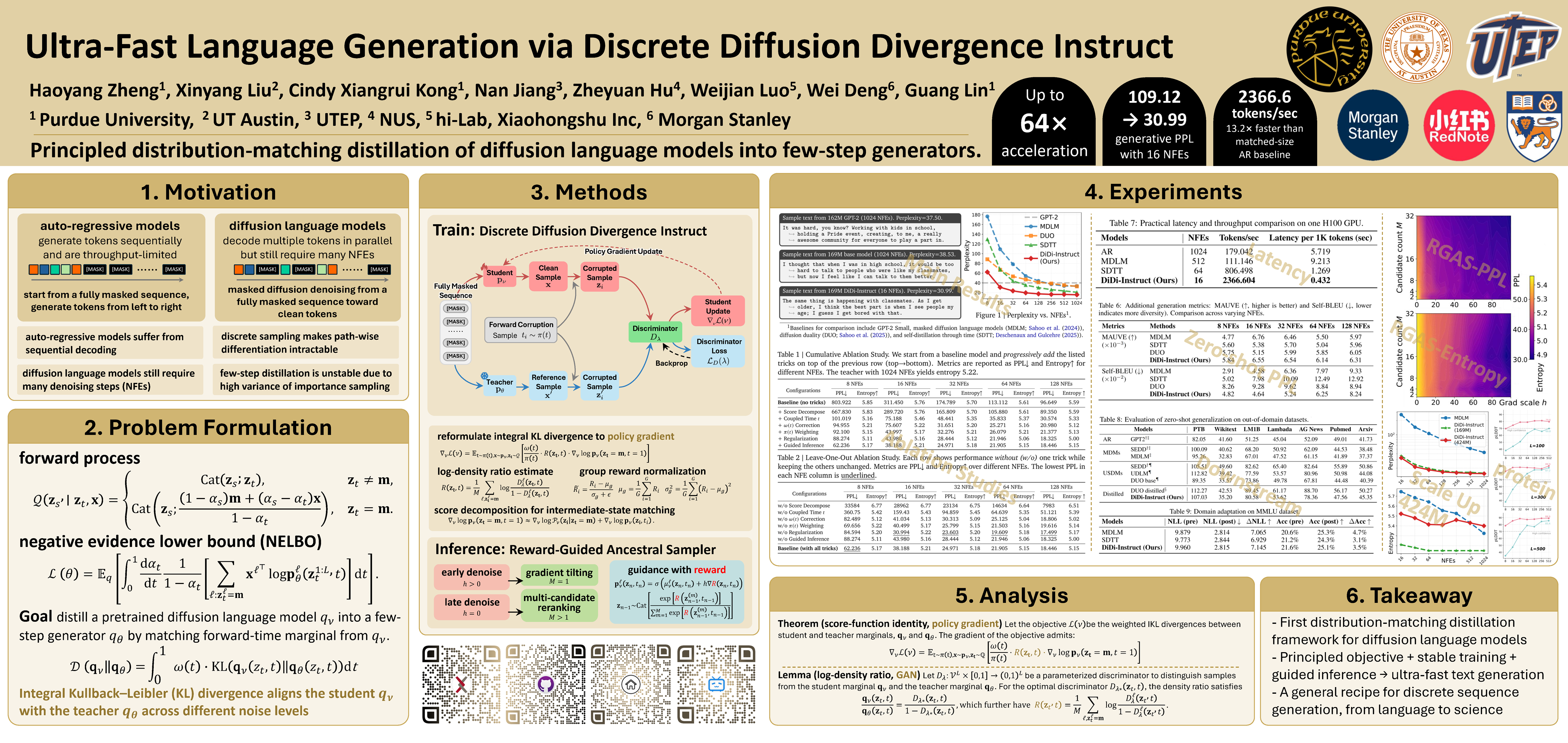
Fast and high-quality language generation is the holy grail that people pursue in the age of AI. In this work, we introduce **Di**screte **Di**ffusion Divergence **Instruct** (**DiDi-Instruct**), a training-based method that initializes from a pre-trained diffusion large language model (dLLM) and distills a few-step student for fast generation. The model distilled with DiDi-Instruct matches or surpasses its dLLM teacher and the GPT-2 baseline while providing up to **64$\times$ acceleration**. The theoretical foundation of DiDi-Instruct is a novel framework based on integral KL-divergence minimization, which leads to a practical training algorithm. We further introduce *grouped reward normalization, intermediate-state matching, and the reward-guided ancestral sampler* to improve *training stability, model coverage, and inference quality*. On the OpenWebText benchmark, DiDi-Instruct achieves perplexity ranging from 62.2 (8 NFEs) to 18.4 (128 NFEs), outperforming prior accelerated dLLMs and the GPT-2 baseline. These gains incur a negligible entropy loss (around $1$%) and reduce additional training wall-clock time by **more than $20\times$** compared to competing dLLM distillation methods. We further validate the robustness and effectiveness of DiDi-Instruct through extensive ablation studies, model scaling, downstream task evaluations, and unconditional protein sequence generation. In conclusion, DiDi-Instruct enables efficient and effective distillation for language generation in the blink of an eye.
Video
Chat is not available.
Successful Page Load