
Inheriting Generalizable Knowledge from LLMs to Diverse Vertical Tasks
Abstract
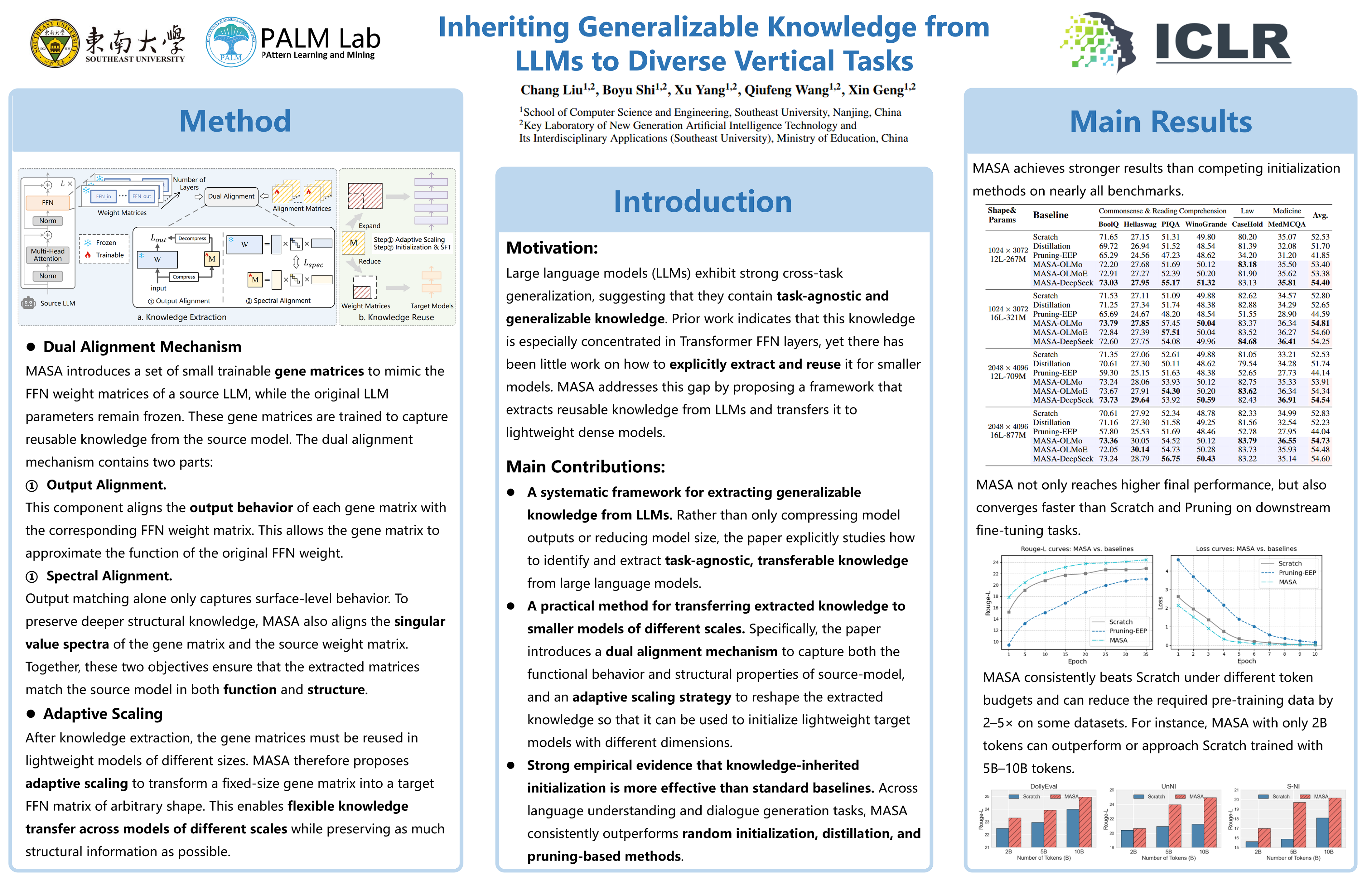
Large language models (LLMs) have demonstrated remarkable generalization across diverse tasks, suggesting the existence of task-agnostic, generalizable knowledge encoded within them. However, how to systematically extract and evaluate this knowledge remains unexplored. In this work, we innovatively propose MASA (Matrix-level Alignment and Scalable Adaptation), a unified framework for extracting and transferring generalizable knowledge from LLMs. MASA first introduces a lightweight set of gene matrices trained with a dual alignment strategy, combining output alignment and spectral alignment, to capture the generalizable knowledge encoded in the feed-forward networks (FFNs) of LLM. It then employs scalable adaptation to flexibly reshape these gene matrices to match the parameter dimensions of lightweight dense models of various sizes, enabling direct initialization of their FFN layers. To evaluate the inherited knowledge, we measure the downstream performance of lightweight models initialized with MASA across language understanding and dialogue generation tasks spanning diverse vertical domains. Experiments on both dense and Mixture-of-Experts (MoE) source LLMs show that MASA consistently outperforms baselines such as random initialization, pruning, and distillation, yielding lightweight models that achieve stronger performance, require less pre-training data, and converge faster. These results establish MASA as an effective and general framework for extracting and leveraging the generalizable knowledge within LLMs.