
Convergence of Muon with Newton-Schulz
Gyu Yeol Kim ⋅ Min-hwan Oh
Abstract
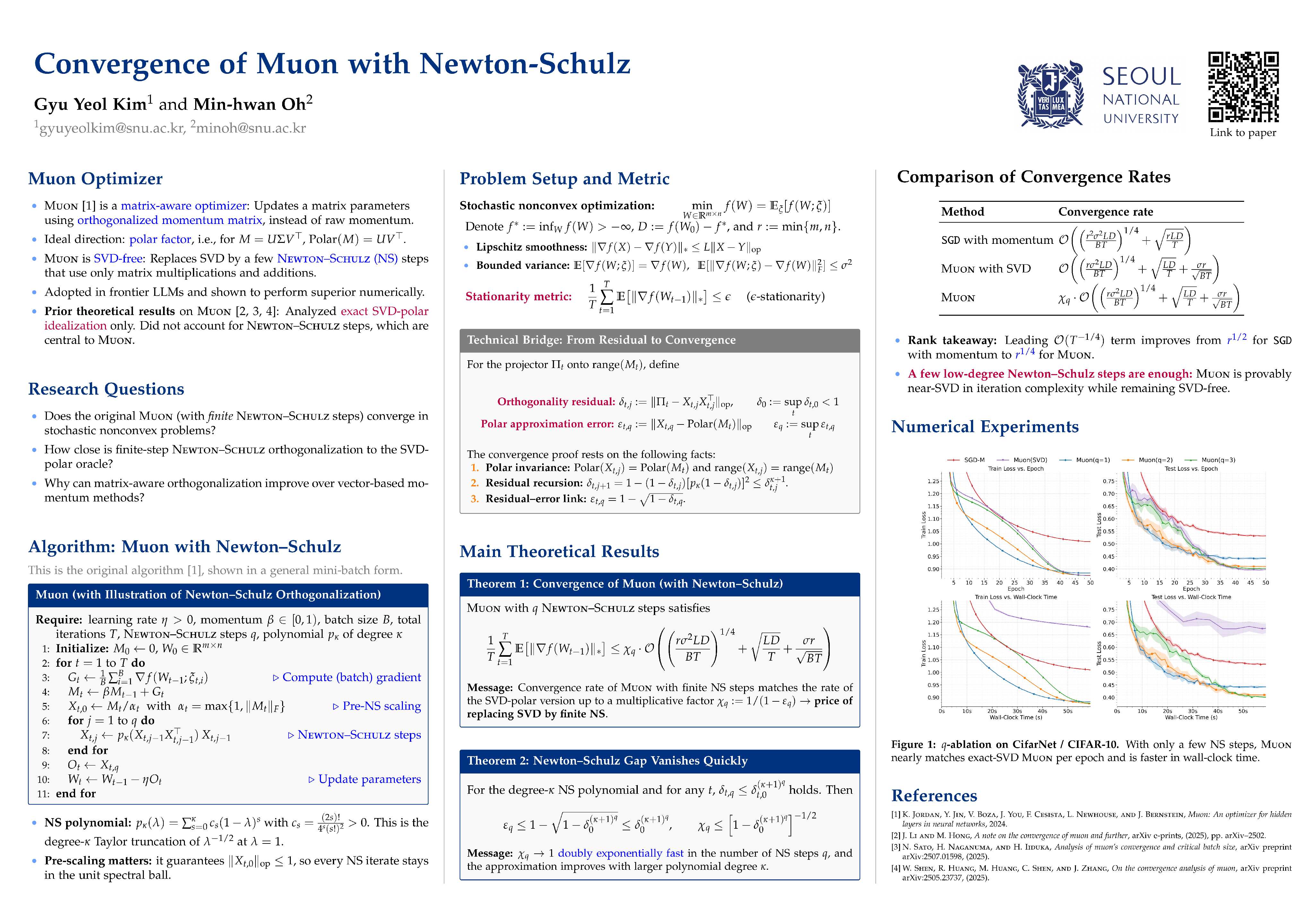
We analyze Muon as originally proposed, using the momentum orthogonalization with a few Newton-Schulz steps. The prior theoretical results replace this key step in Muon with an exact SVD-based polar factor. We prove that Muon with Newton-Schulz converges to a stationary point with the same rate as the SVD-polar idealization, up to a constant factor for given the number of Newton-Schulz steps $q$. We further analyze this constant factor, and prove that it converges to 1 doubly exponentially in $q$ and improves with the degree of a polynomial used in Newton-Schulz for approximating the orthogonalization direction. We also prove that Muon improves the rank dependence compared to its vector-based counterpart, SGD with momentum. Our results explain why Muon with a few low-degree Newton-Schulz steps matches exact-polar (SVD) behavior at much faster wall-clock time, and explain how much momentum matrix orthogonalization via Newton-Schulz benefits over the vector-based optimizer. Overall, our theory justifies the practical Newton-Schulz design of Muon, narrowing its practice–theory gap.
Video
Chat is not available.
Successful Page Load