
Robust Preference Alignment via Directional Neighborhood Consensus
Abstract
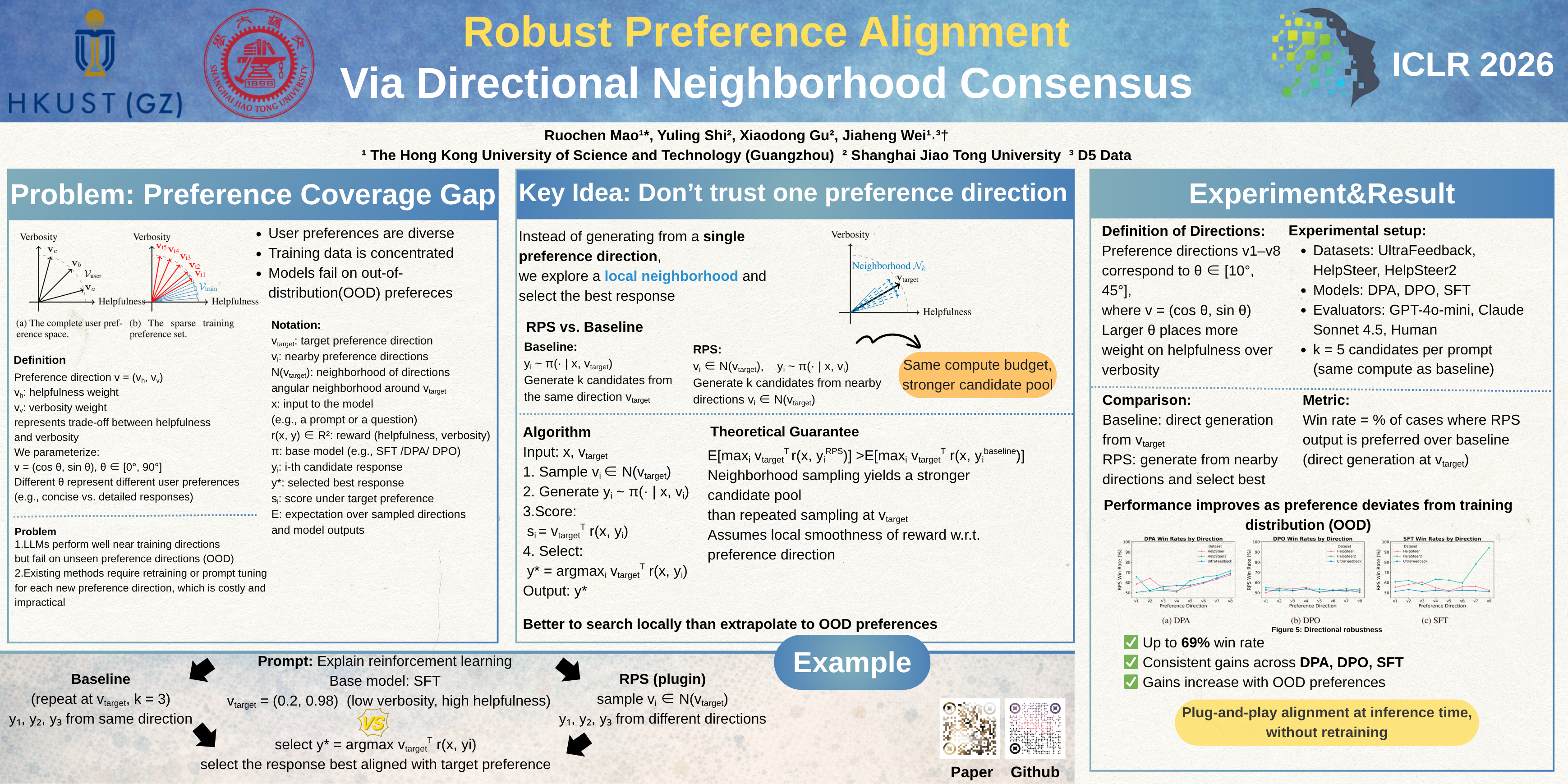
Aligning large language models with human preferences is critical for creating reliable and controllable AI systems. A human preference can be visualized as a high-dimensional vector where different directions represent trade-offs between desired attributes (e.g., helpfulness vs. verbosity). Yet, because the training data often reflects dominant, average preferences, LLMs tend to perform well on com- mon requests but falls short in specific, individual needs. This mismatch creates a preference coverage gap. Existing methods often address this through costly retraining, which may not be generalized to the full spectrum of diverse preferences. This brittleness means that when a user’s request reflects a nuanced preference deviating from the training data’s central tendency, model performance can degrade unpredictably. To address this challenge, we introduce Robust Preference Selection (RPS), a post-hoc, training-free method by leveraging directional neighborhood consensus. Instead of forcing a model to generate a response from a single, highly specific preference, RPS samples multiple responses from a local neighborhood of related preferences to create a superior candidate pool. It then selects the re- sponse that best aligns with the user’s original intent. We provide a theoretical framework showing that, under mild conditions where (i) nearby preference direc- tions correspond to better-trained regions of the model and (ii) the reward-model scores change smoothly with small angular changes in the preference vector, our neighborhood generation strategy yields a higher expected best score than a strong baseline that also samples multiple candidates. Comprehensive experiments across three distinct alignment paradigms (DPA, DPO, and SFT) demonstrate that RPS consistently improves robustness against this baseline, achieving win rates of up to 69% on challenging preferences from under-represented regions of the space without any model retraining. Our work presents a practical, theoretically-grounded solution for enhancing the reliability of preference-aligned models.