
Seeing Across Views: Benchmarking Spatial Reasoning of Vision-Language Models in Robotic Scenes
Abstract
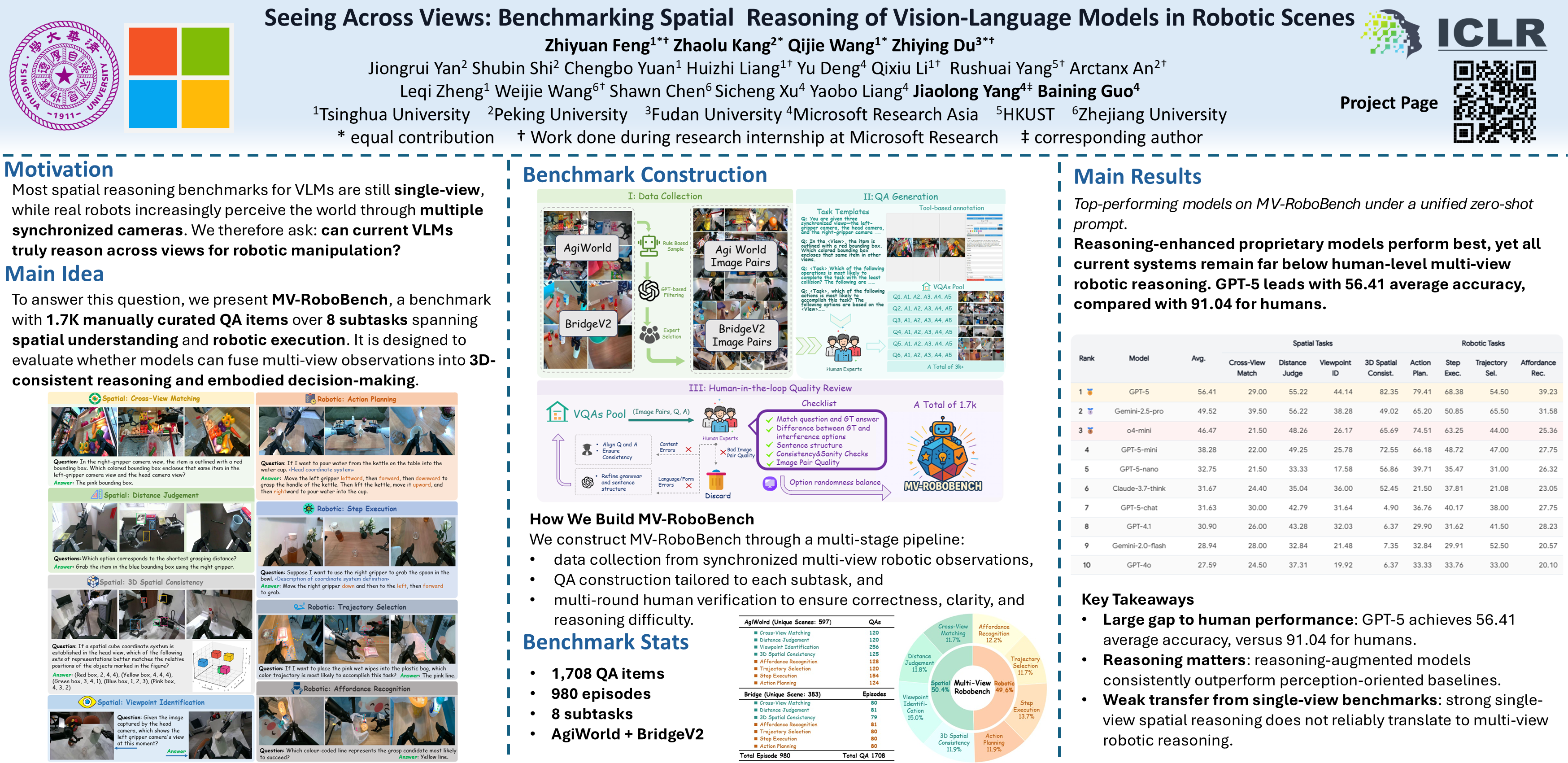
Vision-language models (VLMs) are essential to Embodied AI, enabling robots to perceive, reason, and act in complex environments. They also serve as the foundation for the recent Vision-Language-Action (VLA) models. Yet most evaluations of VLMs focus on single-view settings, leaving their ability to integrate multi-view information underexplored. At the same time, multi-camera setups are increasingly standard in robotic platforms, as they provide complementary perspectives to mitigate occlusion and depth ambiguity. Whether VLMs can effectively leverage such multi-view inputs for robotic reasoning therefore remains an open question. To bridge this gap, we introduce \textbf{MV-RoboBench}, a benchmark specifically designed to evaluate the multi-view spatial reasoning capabilities of VLMs in robotic manipulation. MV-RoboBench consists of 1.7k manually curated QA items across eight subtasks, divided into two primary categories: spatial understanding and robotic execution. We evaluate a diverse set of existing VLMs, including both open-source and closed-source models, along with enhanced versions incorporating Chain-of-Thought (CoT)-inspired techniques. The results show that state-of-the-art models remain far below human performance, underscoring the substantial challenges VLMs face in multi-view robotic perception. Additionally, our analysis uncovers two key findings: (i) spatial intelligence and robotic task execution are positively correlated in multi-view robotic scenarios; and (ii) strong performance on existing general-purpose single-view spatial understanding benchmarks does not reliably translate to success in the robotic spatial tasks assessed by our benchmark. We release MV-RoboBench as an open resource to foster progress in spatially grounded VLMs and VLAs, providing not only data but also a standardized evaluation protocol for multi-view embodied reasoning.