
Anchor Frame Bridging for Coherent First-Last Frame Video Generation
Abstract
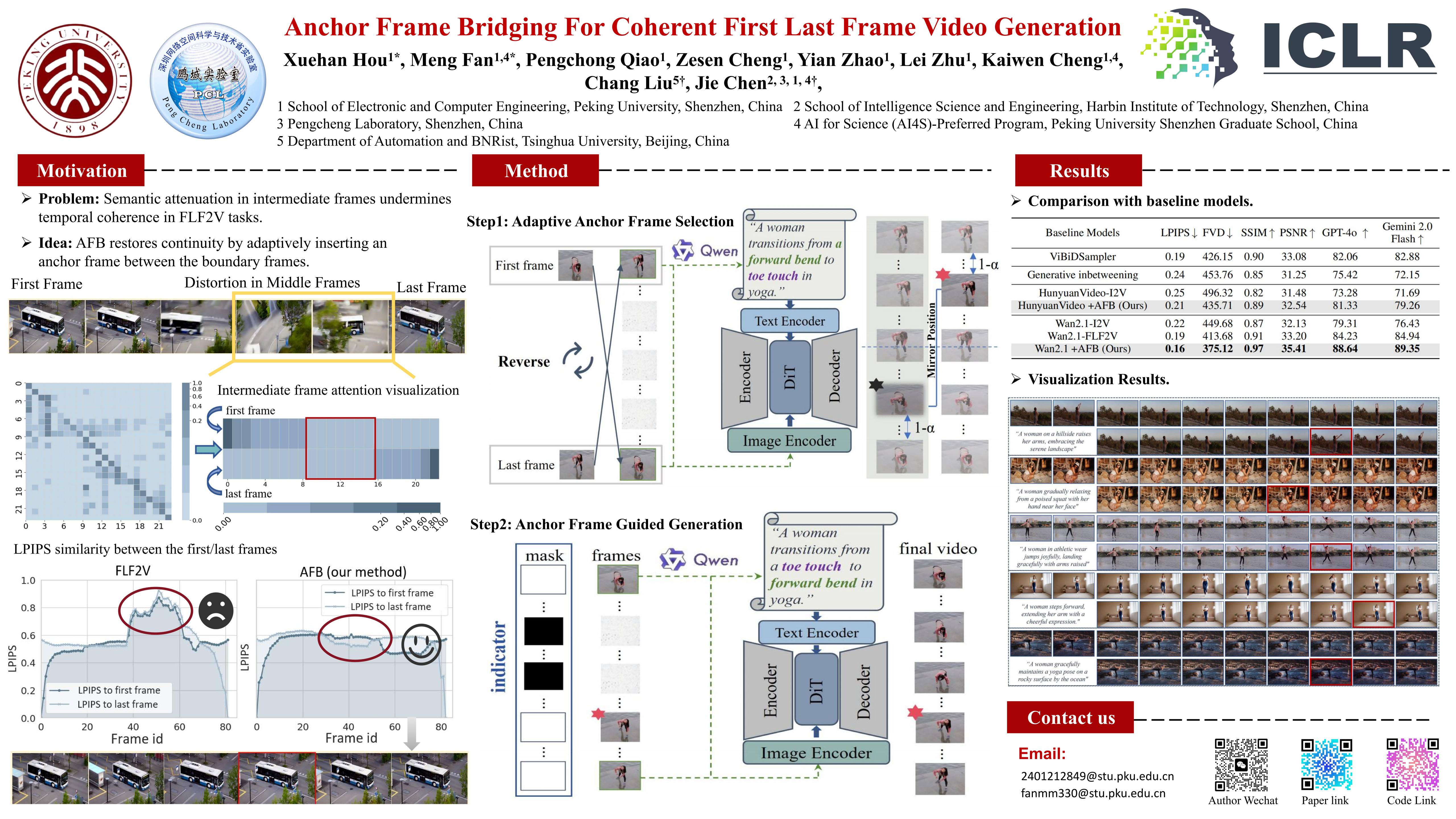
First-last frame video generation has recently gained significant attention. It enables coherent motion generation between specified first and last frames. However, this approach suffers from semantic degradation in intermediate frames, causing scene distortion and subject deformation that undermine temporal consistency. To address this issue, we introduce Anchor Frame Bridging (AFB), a novel plug-and-play method that explicitly bridges semantic continuity from boundary frames to intermediate frames, offering training-free adaptability and generalizability. By adaptively interpolating anchor frames at temporally critical locations exhibiting maximal semantic discontinuities, our approach effectively mitigates semantic drift in intermediate frames. Specifically, we propose an adaptive anchor frame selection module, which generates text-aligned candidate frames via frame order reversal and selects anchors based on semantic continuity. Subsequently, we develop anchor frame guided generation, which leverages the selected anchor frames to guide semantic propagation across intermediate frames, ensuring consistent boundary semantics and preserving temporal coherence throughout the video sequence. The final video is synthesized using the first frame, last frame, selected anchor frames, and the text prompt. The results demonstrate that our method significantly enhances the temporal consistency and overall quality of generated videos. Specifically, when applied to the Wan2.1-I2V model, it yields improvements of 16.58\% in FVD and 10.21\% in PSNR. The codes are provided in the supplementary material.