
KLAS: Using Similarity to Stitch Neural Networks for Improved Accuracy-Efficiency Tradeoffs
Debopam Sanyal ⋅ Anantharaman Iyer ⋅ Alind Khare ⋅ Trisha Jain ⋅ Akshay Jajoo ⋅ Myungjin Lee ⋅ James Kerce ⋅ Alexey Tumanov
Abstract
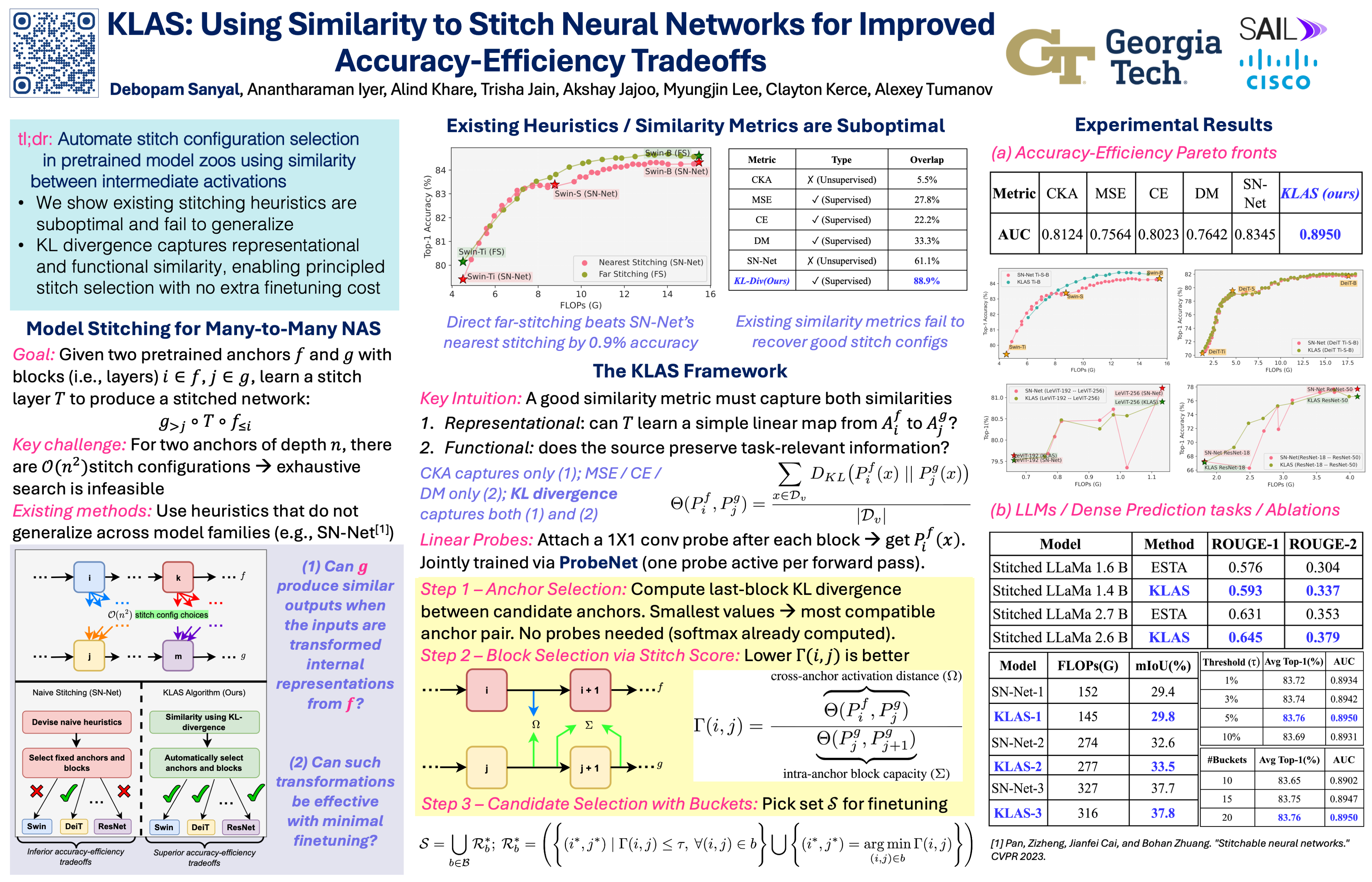
Given the wide range of deployment targets, flexible model selection is essential for optimizing performance within a given compute budget. Recent work demonstrates that stitching pretrained models within a model family enables cost-effective interpolation of the accuracy-efficiency tradeoff space. Stitching transforms intermediate activations from one pretrained model into another, producing a new interpolated stitched network. Such networks provide a pool of deployment options along the accuracy-efficiency spectrum. However, existing stitching approaches often yield suboptimal tradeoffs and lack generalizability, as they primarily rely on heuristics to select stitch configurations. We argue that constructing improved accuracy-efficiency tradeoffs requires explicitly capturing and leveraging the similarity between pretrained models being stitched. To this end, we introduce KLAS, a novel stitch selection framework that automates and generalizes stitch selection across model families by leveraging KL divergence between intermediate representations. KLAS identifies the most promising binary stitches from the $\mathcal{O}(k^2n^2)$ possibilities for $k$ pretrained models of depth $n$. Through comprehensive experiments, we demonstrate that KLAS improves the accuracy-efficiency curve of stitched models at the same finetuning cost as baselines. KLAS achieves up to $1.21\%$ higher ImageNet-1K top-1 accuracy at the same computational cost, or maintains accuracy with a $1.33\times$ reduction in FLOPs.
Video
Chat is not available.
Successful Page Load