
SecP-Tuning: Efficient Privacy-Preserving Prompt Tuning for Large Language Models via MPC
Jinglong Luo ⋅ Zhuo Zhang ⋅ Yehong Zhang ⋅ Shiyu Liu ⋅ Ye Dong ⋅ HUI WANG ⋅ Yue Yu ⋅ Xun Zhou ⋅ Zenglin Xu
Abstract
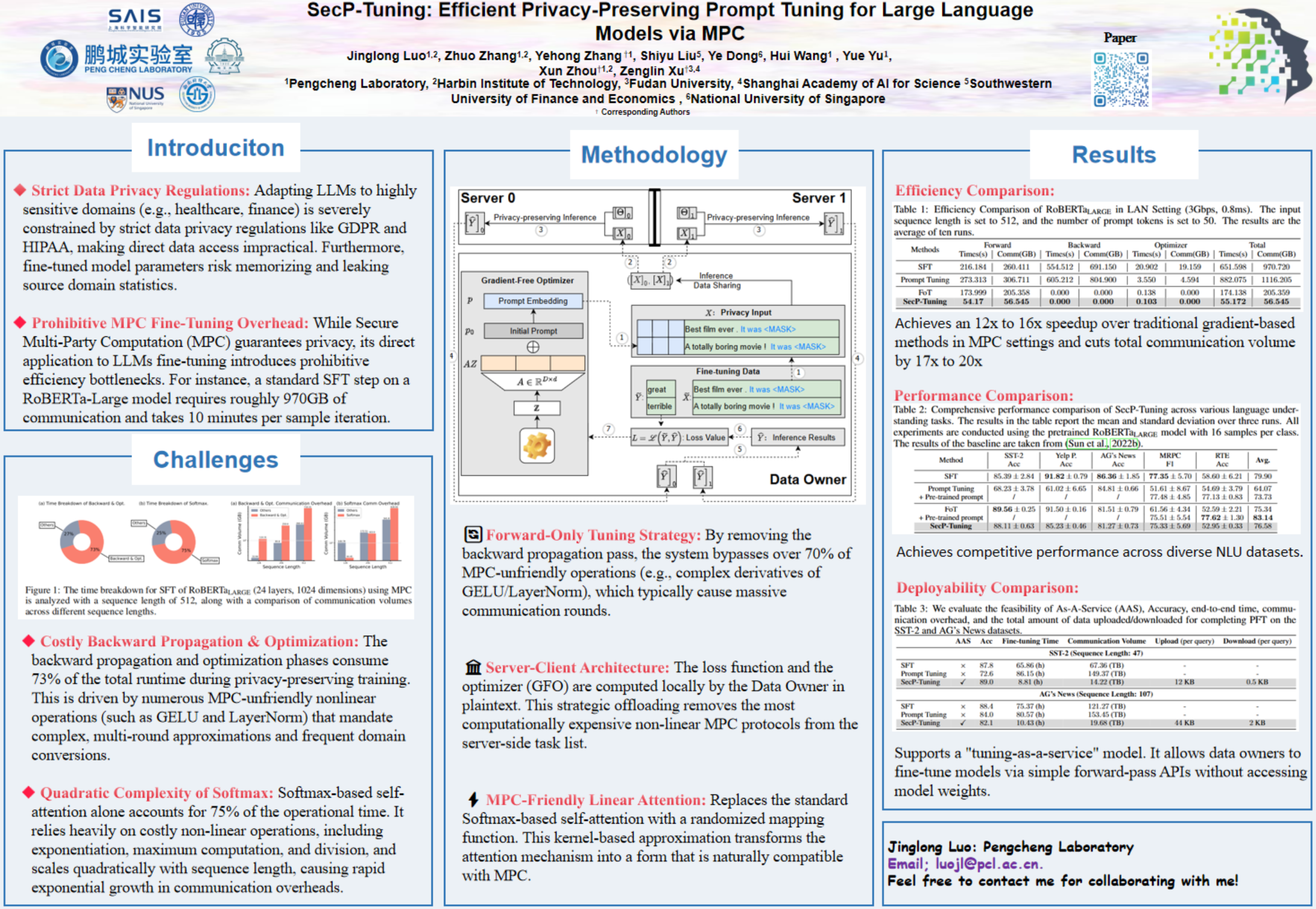
Large Language Models (LLMs) have revolutionized numerous fields, yet their adaptation to specialized tasks in privacy-sensitive domains such as healthcare and finance remains constrained due to the scarcity of accessible training data caused by stringent privacy requirements. Secure Multi-party Computation (MPC)-based privacy-preserving machine learning provides theoretical guarantees for the privacy of model parameters and data. However, its application to LLMs has been predominantly limited to inference, as fine-tuning introduces significant efficiency challenges, particularly in backward propagation, optimizer, and self-attention operations. To address these challenges, we propose SecP-Tuning, the MPC-based framework designed for efficient, privacy-preserving prompt tuning of LLMs. SecP-Tuning innovatively integrates Forward-only Tuning through the ''data owner-server interaction" paradigm, effectively removing the need for privacy-preserving computations in backward propagation and optimization processes. Furthermore, it devises an efficient privacy-preserving Random Feature Attention, effectively mitigating the computational complexity of softmax-based self-attention and circumventing MPC-incompatible nonlinear operations. Experimental results demonstrate that, compared to full-Parameter Supervised Fine-Tuning and gradient-based prompt tuning, SecP-Tuning achieves approximately 12$\times$ and 16$\times$ end-to-end acceleration, as well as 17$\times$ and 20$\times$ reductions in communication overhead, respectively. Moreover, it delivers performance comparable to gradient-based methods across multiple few-shot tasks. Additionally, the ''black-box/API-style" privacy-preserving tuning paradigm of SecP-Tuning effectively avoids memory leakage risks caused by gradient/parameter transmission, thereby striking an optimal balance between privacy, efficiency, performance, and deployability.
Video
Chat is not available.
Successful Page Load