
Decomposition of Concept-Level Rules in Visual Scenes
Abstract
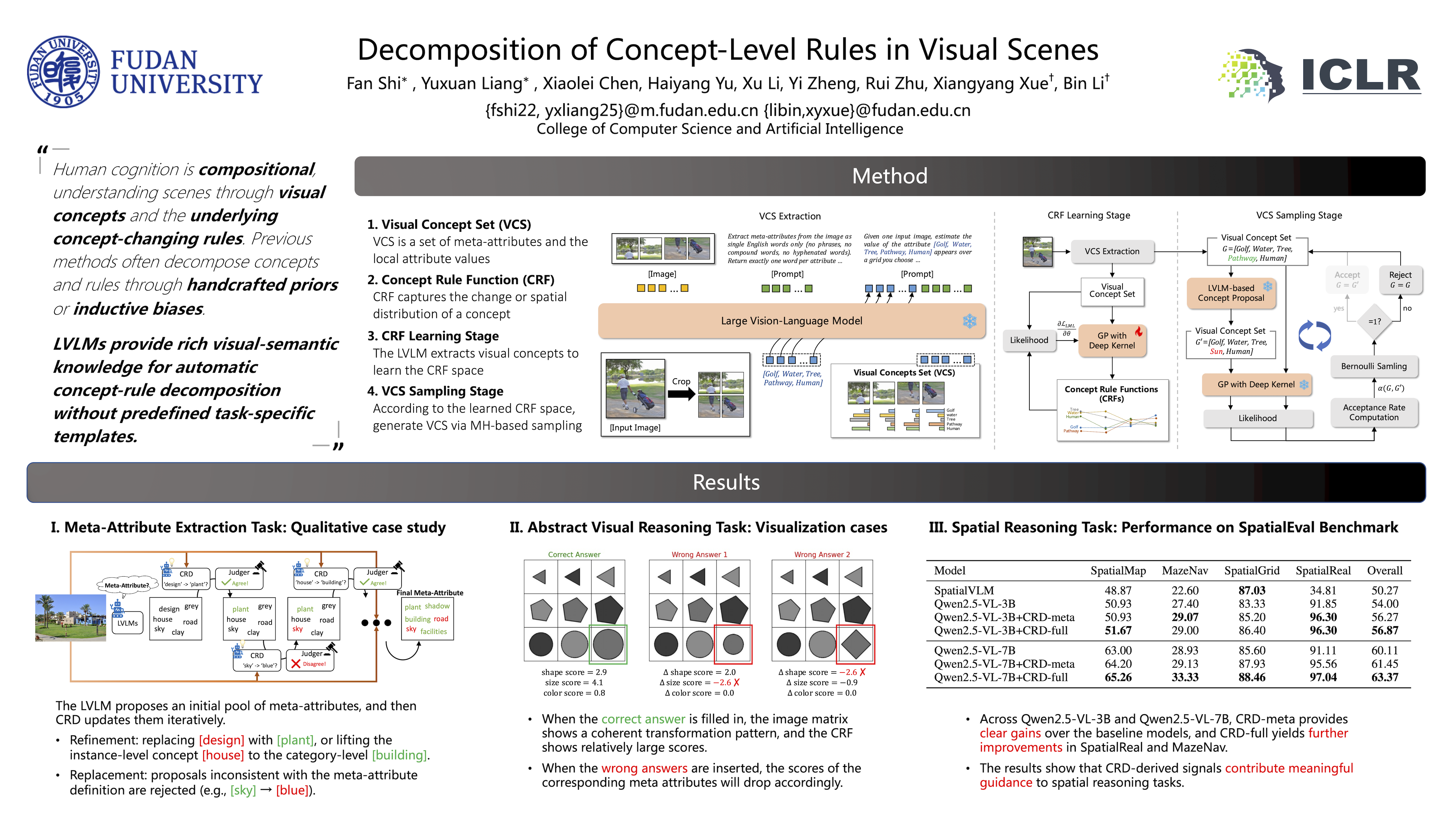
Human cognition is compositional, and one can parse a visual scene into independent concepts and the corresponding concept-changing rules. By contrast, many vision-language systems process images holistically, with limited support for explicit decomposition. Previous methods of decomposing concepts and rules often rely on hand-crafted inductive biases or human-designed priors. We introduce a Concept-Rule Decomposition (CRD) framework to decompose concept-level rules with Large Vision-Language Models (LVLMs), which explains visual input by leveraging LVLM-extracted concepts and the rules governing their variation. The proposed method operates in two stages: (1) a pretrained LVLM proposes visual concepts and concept values, which are employed to instantiate a space of concept rule functions that model concept changes and spatial distributions; (2) an iterative process to select a concise set of concepts that best account for the input according to the rule function. We evaluate CRD on an abstract visual reasoning benchmark, a spatial reasoning benchmark, and a real-world image caption dataset. Across both settings, our approach outperforms baseline models while improving interpretability by explicitly revealing underlying concepts and compositional rules, advancing explainable and generalizable visual reasoning.