
Fair Decision Utility in Human-AI Collaboration: Interpretable Confidence Adjustment for Humans with Cognitive Disparities
Abstract
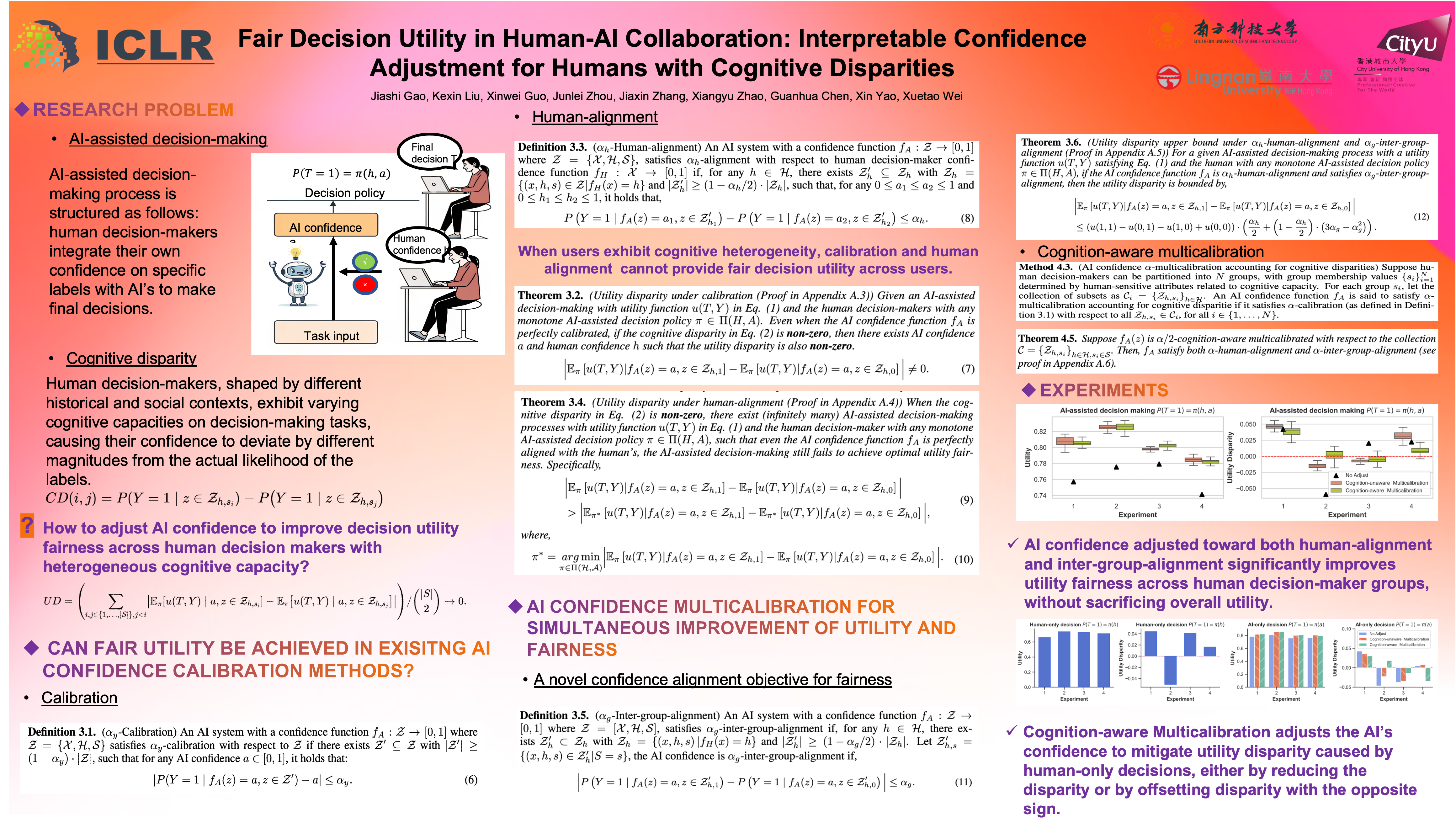
In AI-assisted decision-making, human decision-makers finalize decisions by taking into account both their human confidence and AI confidence regarding specific outcomes. In practice, they often exhibit heterogeneous cognitive capacities, causing their confidence to deviate, sometimes significantly, from the actual label likelihood. We theoretically demonstrate that existing AI confidence adjustment objectives, such as calibration and human-alignment, are insufficient to ensure fair utility across groups of decision-makers with varying cognitive capacities. Such unfairness may raise concerns about social welfare and may erode human trust in AI systems. To address this issue, we introduce a new concept in AI confidence adjustment: inter-group-alignment. By theoretically bounding the utility disparity between human decision-maker groups as a function of human-alignment level and inter-group-alignment level, we establish an interpretable fairness-aware objective for AI confidence adjustment. Our analysis suggests that achieving utility fairness in AI-assisted decision-making requires both human-alignment and inter-group-alignment. Building on these objectives, we propose a multicalibration-based AI confidence adjustment approach tailored to scenarios involving human decision-makers with heterogeneous cognitive capacities. We further provide theoretical justification showing that our method constitutes a sufficient condition for achieving both human-alignment and inter-group-alignment. We validate our theoretical findings through extensive experiments on four real-world tasks. The results demonstrate that AI confidence adjusted toward both human-alignment and inter-group-alignment significantly improves utility fairness across human decision-maker groups, without sacrificing overall utility. The implementation code is available at https://github.com/WEILaboratory/AI-Ethics-Safety-PaperCode/tree/main/Fair_HAI (ICLR2026).