
Neural Synchrony Between Socially Interacting Language Models
Abstract
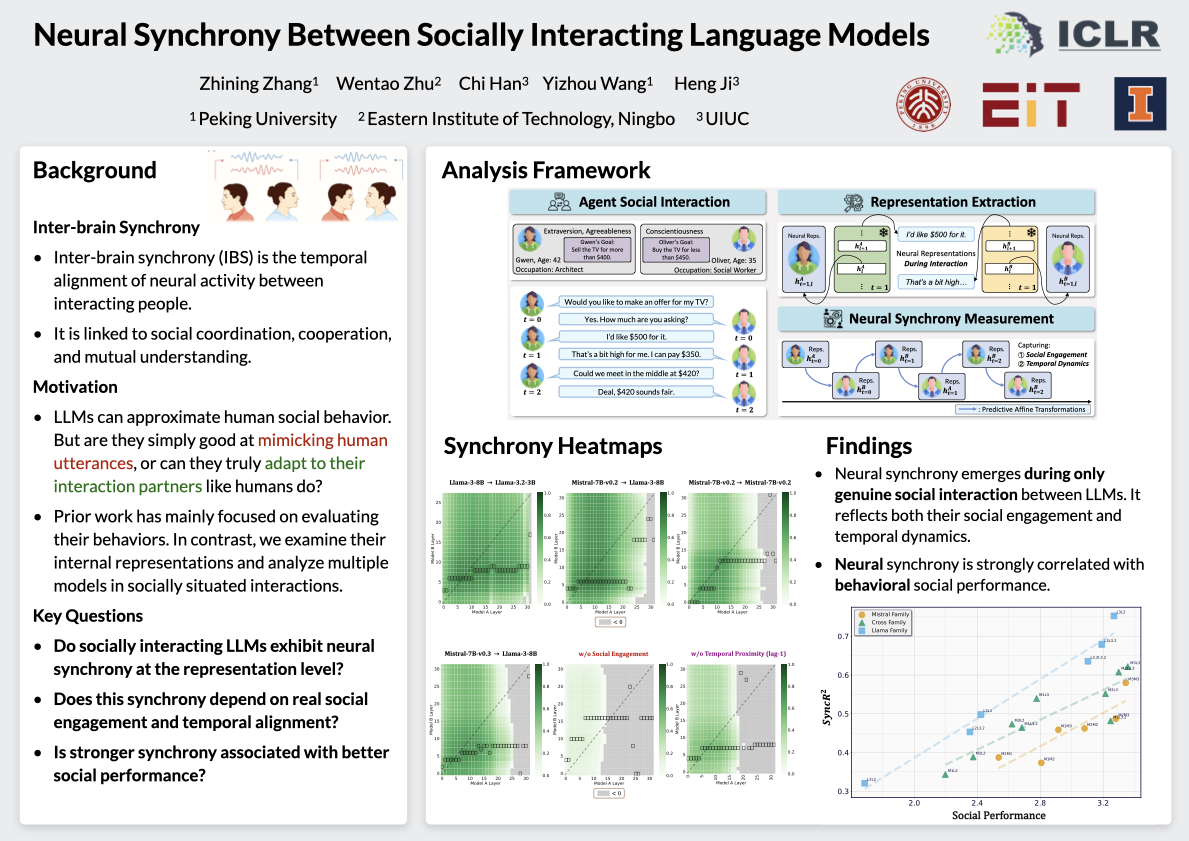
Neuroscience has uncovered a fundamental mechanism of our social nature: human brain activity becomes synchronized with others in many social contexts involving interaction. Traditionally, social minds have been regarded as an exclusive property of living beings. Although large language models (LLMs) are widely accepted as powerful approximations of human behavior, with multi-LLM system being extensively explored to enhance their capabilities, it remains controversial whether they can be meaningfully compared to human social minds. In this work, we explore neural synchrony between socially interacting LLMs as an empirical evidence for this debate. Specifically, we introduce neural synchrony during social simulations as a novel proxy for analyzing the sociality of LLMs at the representational level. Through carefully designed experiments, we demonstrate that it reliably reflects both social engagement and temporal alignment in their interactions. Our findings indicate that neural synchrony between LLMs is strongly correlated with their social performance, highlighting an important link between neural synchrony and the social behaviors of LLMs. Our work offers a new perspective to examine the "social minds" of LLMs, highlighting surprising parallels in the internal dynamics that underlie human and LLM social interaction.