
FlowNIB: An Information Bottleneck Analysis of Bidirectional vs. Unidirectional Language Models
Abstract
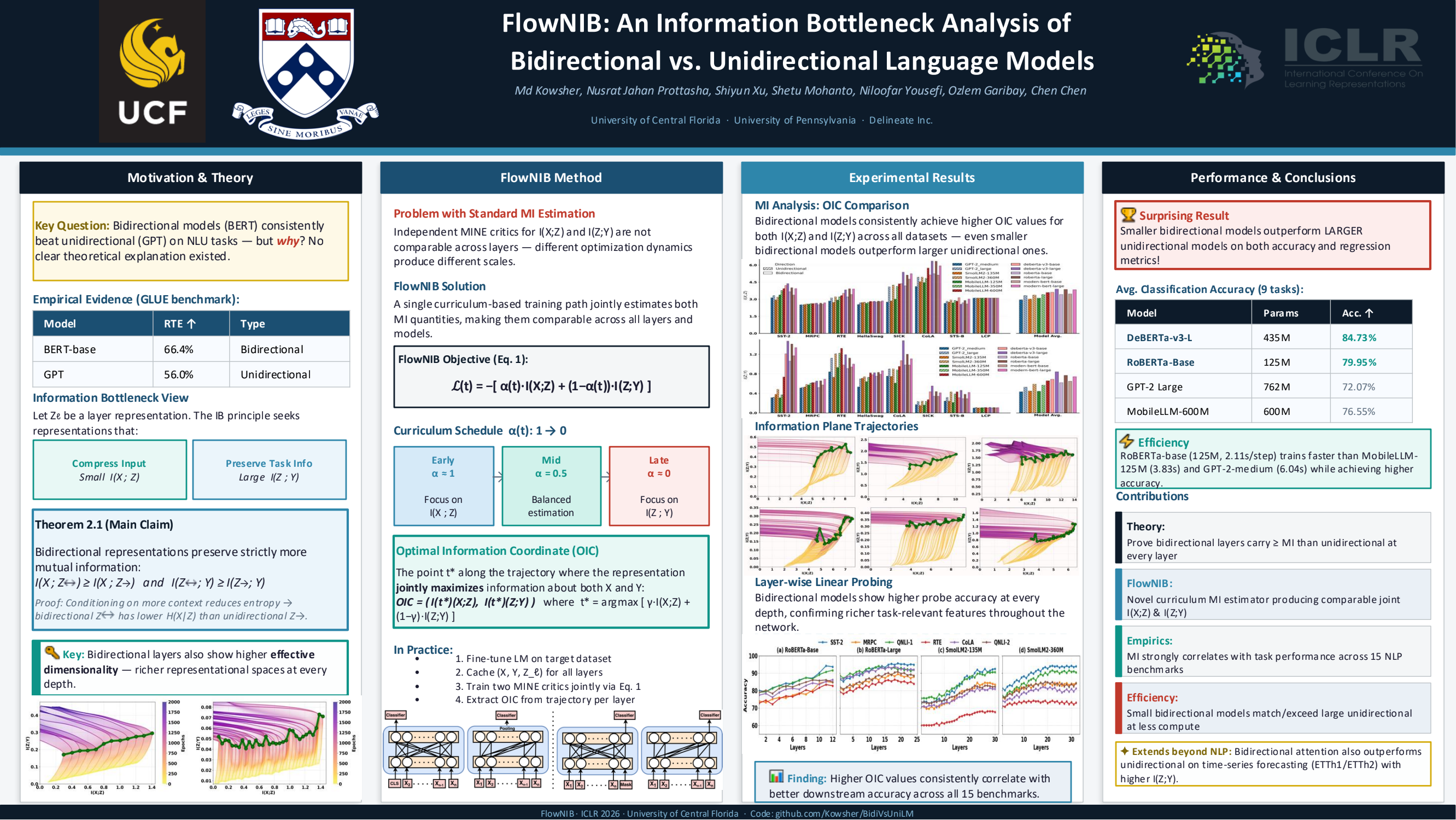
Bidirectional language models (LMs) consistently show stronger context understanding than unidirectional models, yet the theoretical reason remains unclear. We present a simple information bottleneck (IB) perspective: bidirectional representations preserve more mutual information (MI) about both the input and the target, yielding richer features for downstream tasks. We adopt a layer–wise view and hypothesize that, at comparable capacity, bidirectional layers retain more useful signal than unidirectional ones. To test this claim empirically, we present Flow Neural Information Bottleneck (FlowNIB), a lightweight, post-hoc framework capable of estimating comparable mutual information values for individual layers in LMs, quantifying how much mutual information each layer carries about the input and target. FlowNIB takes three inputs—(i) the original LM’s inputs/dataset, (ii) ground–truth labels, and (iii) layer activations—simultaneously estimates the mutual information for both the input–layer and layer–label pairs. Empirically, bidirectional LM layers exhibit higher mutual information than similar—and even larger—unidirectional LMs. As a result, bidirectional LMs outperform unidirectional LMs across extensive experiments on NLU benchmarks (e.g., GLUE), commonsense reasoning, and regression tasks, demonstrating superior context understanding.