
NDAD: Negative-Direction Aware Decoding for Large Language Models via Controllable Hallucination Signal Injection
Abstract
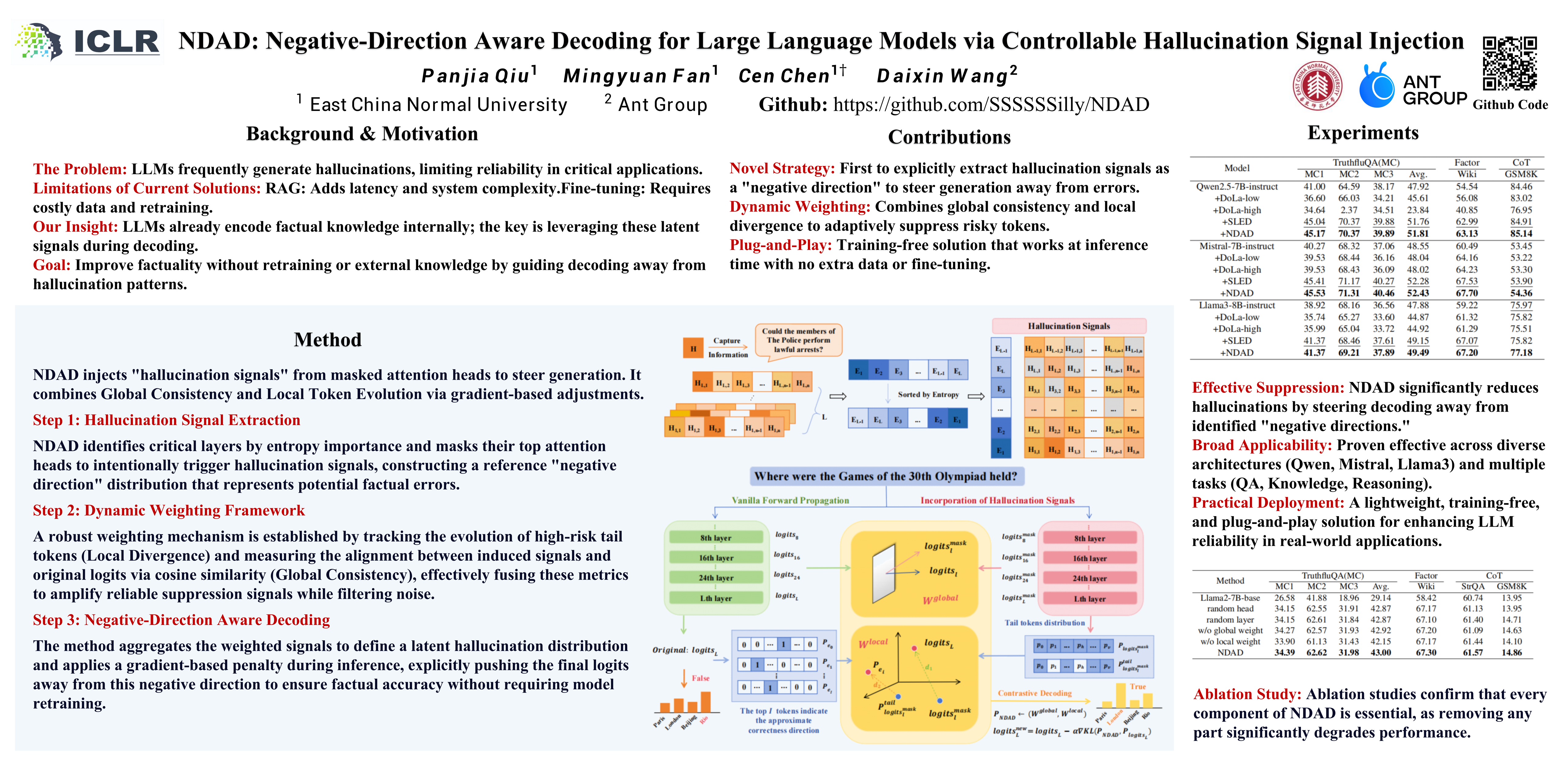
Large language models (LLMs) have recently achieved impressive progress in knowledge-intensive and reasoning tasks. However, their tendency to produce fabricated or factually inconsistent content remains a fundamental challenge to their practical deployment. To address this issue, we propose Negative-Direction Aware Decoding (NDAD), a novel decoding method that identifies and exploits hallucination signals as repulsive directions in the model’s representation space, thereby improving factual adherence without retraining. Specifically, NDAD elicits hallucination-leaning signals by selectively masking critical attention heads, which exposes unstable hypotheses that the model would otherwise amplify during generation. To regulate the influence of these signals, NDAD employs two complementary weights: a global alignment weight measuring how well the induced signal aligns with the layer’s native activations (thus quantifying its referential utility) and a local weight estimating whether low-probability tokens in the masked distribution are likely to evolve toward the final output. Based on the weights, we derive a latent hallucination distribution that serves as the negative direction. A lightweight gradient-descent step then subtracts mass from hallucination-prone regions of the output distribution, adjusting the final logits while preserving the model’s high-confidence predictions. Extensive experiments across multiple LLMs and diverse benchmark datasets demonstrate that NDAD consistently enhances factual reliability without requiring additional training or external knowledge.