
Controllable Sequence Editing for Biological and Clinical Trajectories
Abstract
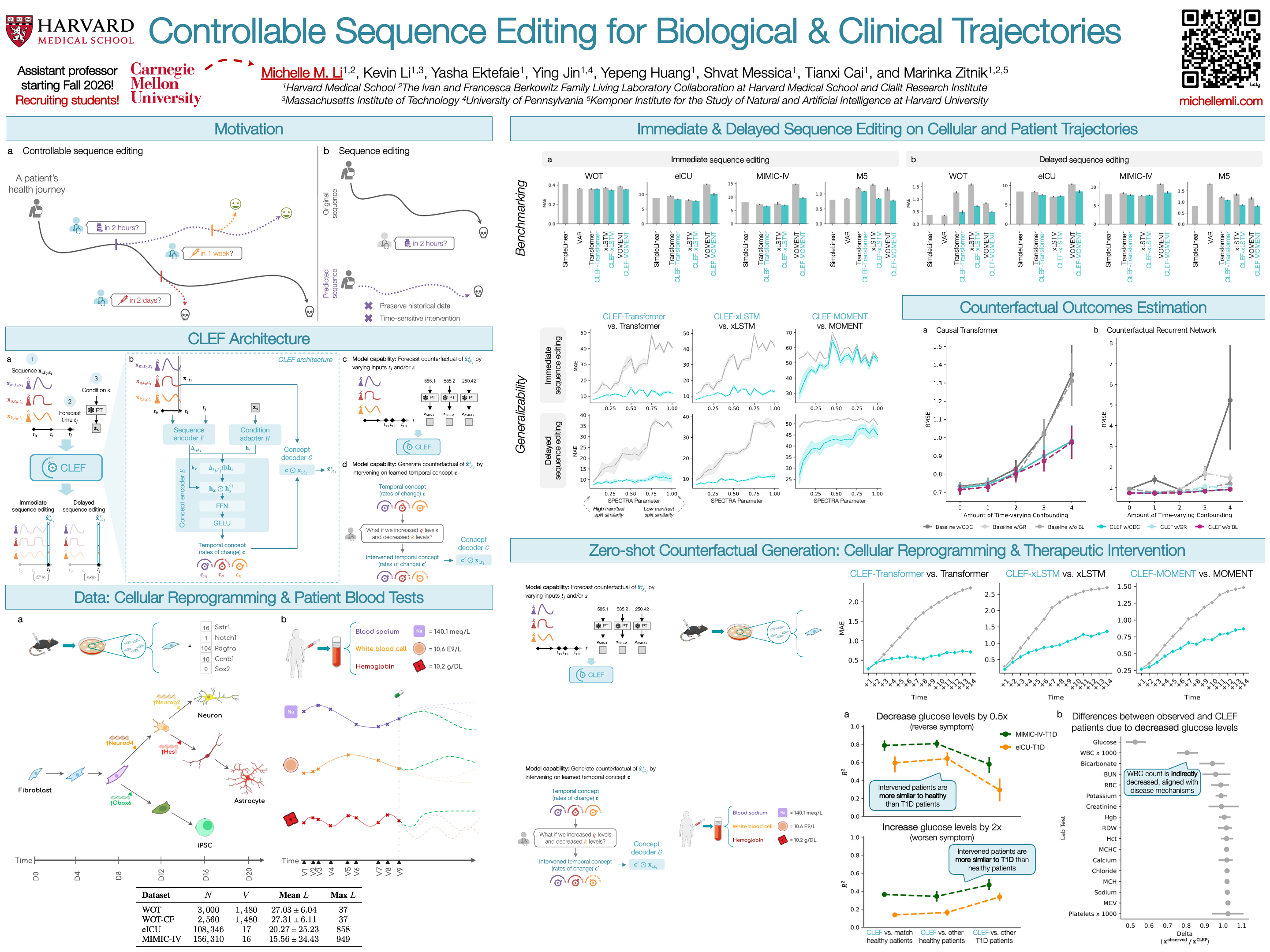
Conditional generation models for longitudinal sequences can produce new or modified trajectories given a conditioning input. However, they often lack control over when the condition should take effect (timing) and which variables it should influence (scope). Most methods either operate only on univariate sequences or assume that the condition alters all variables and time steps. In scientific and clinical settings, interventions instead begin at a specific moment, such as the time of drug administration or surgery, and influence only a subset of measurements while the rest of the trajectory remains unchanged. CLEF learns temporal concepts that encode how and when a condition alters future sequence evolution. These concepts allow CLEF to apply targeted edits to the affected time steps and variables while preserving the rest of the sequence. We evaluate CLEF on 8 datasets spanning cellular reprogramming, patient health, and sales, comparing against 9 state-of-the-art baselines. CLEF improves immediate sequence editing accuracy by 16.28% (MAE) on average against their non-CLEF counterparts. Unlike prior models, CLEF enables one-step conditional generation at arbitrary future times, outperforming their non-CLEF counterparts in delayed sequence editing by 26.73% (MAE) on average. We test CLEF under counterfactual inference assumptions and show up to 62.84% (MAE) improvement on zero-shot conditional generation of counterfactual trajectories. In a case study of patients with type 1 diabetes mellitus, CLEF identifies clinical interventions that generate realistic counterfactual trajectories shifted toward healthier outcomes.