
Unveiling the Mechanism of Continuous Representation Full-Waveform Inversion: A Wave Based Neural Tangent Kernel Framework
Abstract
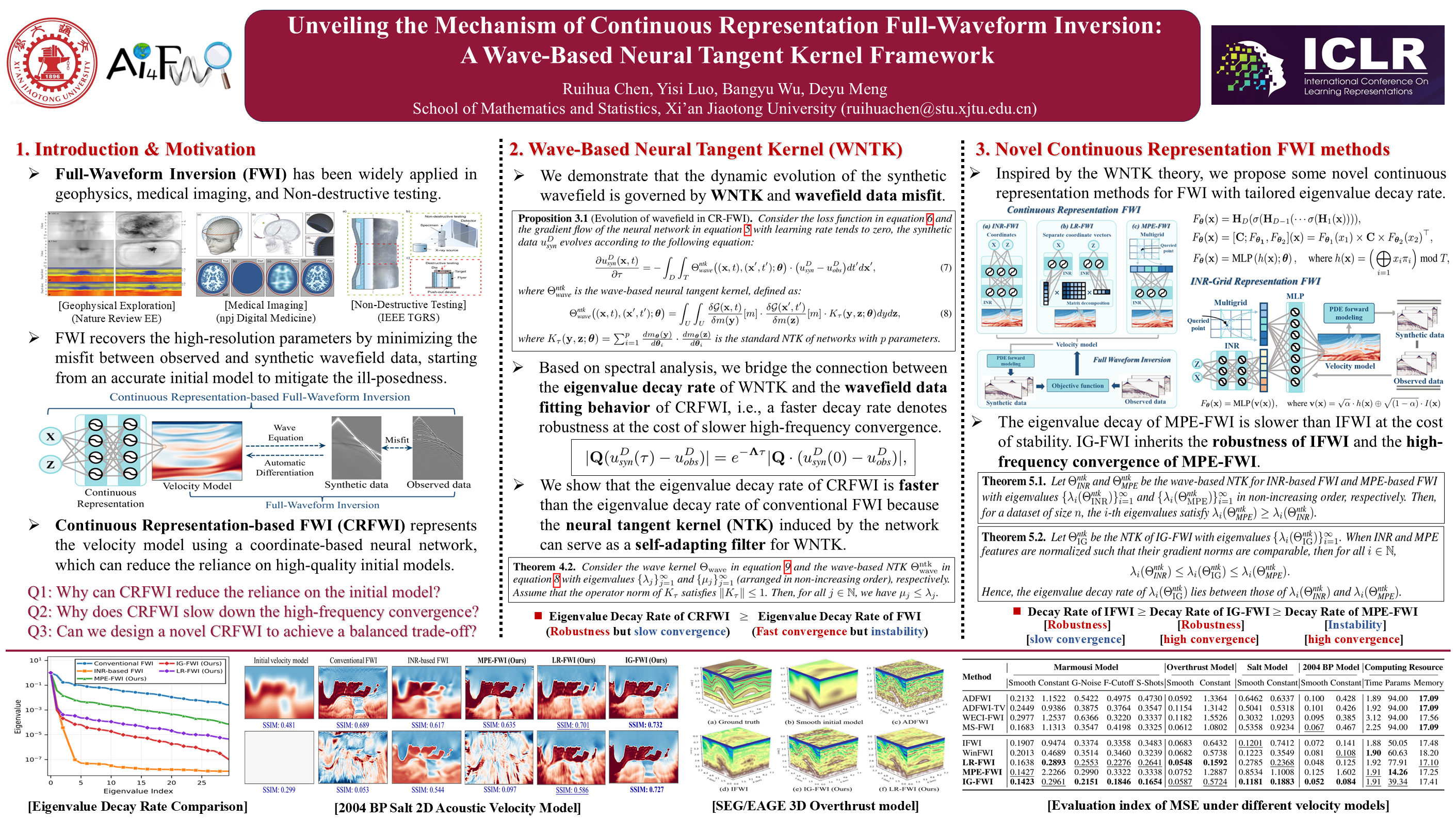
Full-waveform inversion (FWI) estimates physical parameters in the wave equation from limited measurements and has been widely applied in geophysical exploration, medical imaging, and non-destructive testing. Conventional FWI methods are limited by their notorious sensitivity to the accuracy of the initial models. Recent progress in continuous representation FWI (CR-FWI) demonstrates that representing parameter models with a coordinate-based neural network, such as implicit neural representation (INR), can mitigate the dependence on initial models. However, its underlying mechanism remains unclear, and INR-based FWI shows slower high-frequency convergence. In this work, we investigate the general CR-FWI framework and develop a unified theoretical understanding by extending the neural tangent kernel (NTK) for FWI to establish a wave-based NTK framework. Unlike standard NTK, our analysis reveals that wave-based NTK is not constant, both at initialization and during training, due to the inherent nonlinearity of FWI. We further show that the eigenvalue decay behavior of the wave-based NTK can explain why CR-FWI alleviates the dependency on initial models and shows slower high-frequency convergence. Building on these insights, we propose several CR-FWI methods with tailored eigenvalue decay properties for FWI, including a novel hybrid representation combining INR and multi-resolution grid (termed IG-FWI) that achieves a more balanced trade-off between robustness and high-frequency convergence rate. Applications in geophysical exploration on Marmousi, 2D SEG/EAGE Salt and Overthrust, 2004 BP model, and the more realistic 2014 Chevron models show the superior performance of our proposed methods compared to conventional FWI and existing INR-based FWI methods.