
Advancing Universal Deep Learning for Electronic-Structure Hamiltonian Prediction of Materials
Shi Yin ⋅ Zujian Dai ⋅ Xinyang Pan ⋅ Lixin He
Abstract
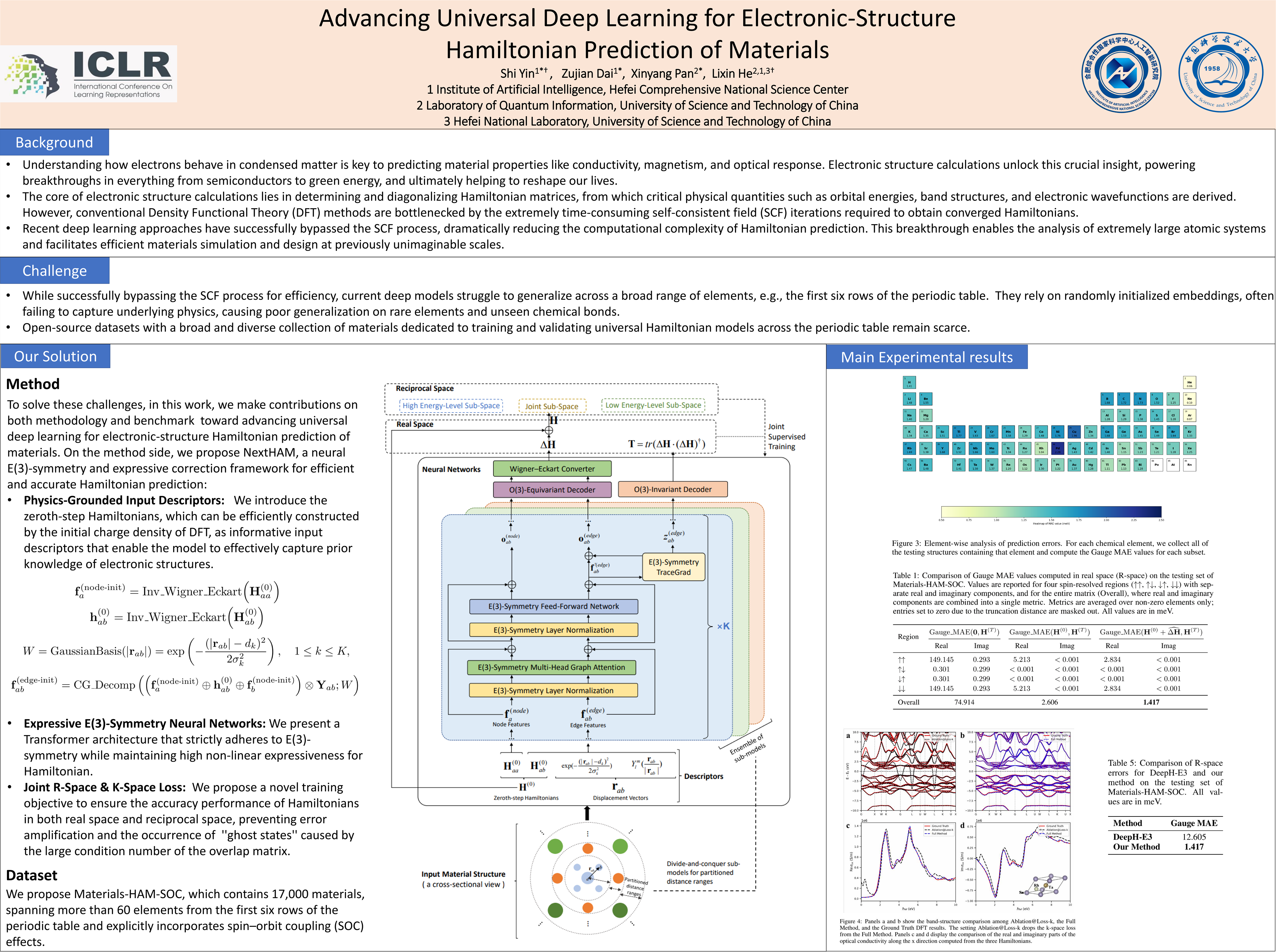
Deep learning methods for electronic-structure Hamiltonian prediction have offered significant computational efficiency advantages over traditional density functional theory (DFT), yet the diversity of atomic types, structural patterns, and the high-dimensional complexity of Hamiltonians pose substantial challenges to the generalization performance. In this work, we contribute on both the methodology and dataset sides to advance universal deep learning paradigm for Hamiltonian prediction. On the method side, we propose NextHAM, a neural E(3)-symmetry and expressive correction method for efficient and generalizable materials electronic-structure Hamiltonian prediction. First, we introduce the zeroth-step Hamiltonians, which can be efficiently constructed by the initial charge density of DFT, as informative input descriptors that enable the model to effectively capture prior knowledge of electronic structures. Second, we present a neural Transformer architecture with strict E(3)-symmetry and high non-linear expressiveness for Hamiltonian prediction. Third, we propose a novel training objective to ensure the accuracy performance of Hamiltonians in both real space and reciprocal space, preventing error amplification and the occurrence of ``ghost states'' caused by the large condition number of the overlap matrix. On the dataset side, we curate a broad-coverage large benchmark, namely Materials-HAM-SOC, comprising $17,000$ material structures spanning more than $60$ elements from six rows of the periodic table and explicitly incorporating spin–orbit coupling (SOC) effects, providing high-quality data resources for training and evaluation. Comprehensive experimental results demonstrate that NextHAM achieves excellent accuracy in predicting Hamiltonians and band structures, with spin-off-diagonal blocks reaching the accuracy of sub-$\mu$eV scale. These results establish NextHAM as a universal and highly accurate deep learning model for electronic-structure prediction, delivering DFT-level precision with dramatically improved computational efficiency.
Video
Chat is not available.
Successful Page Load