
Preserving Forgery Artifacts: AI-Generated Video Detection at Native Scale
Abstract
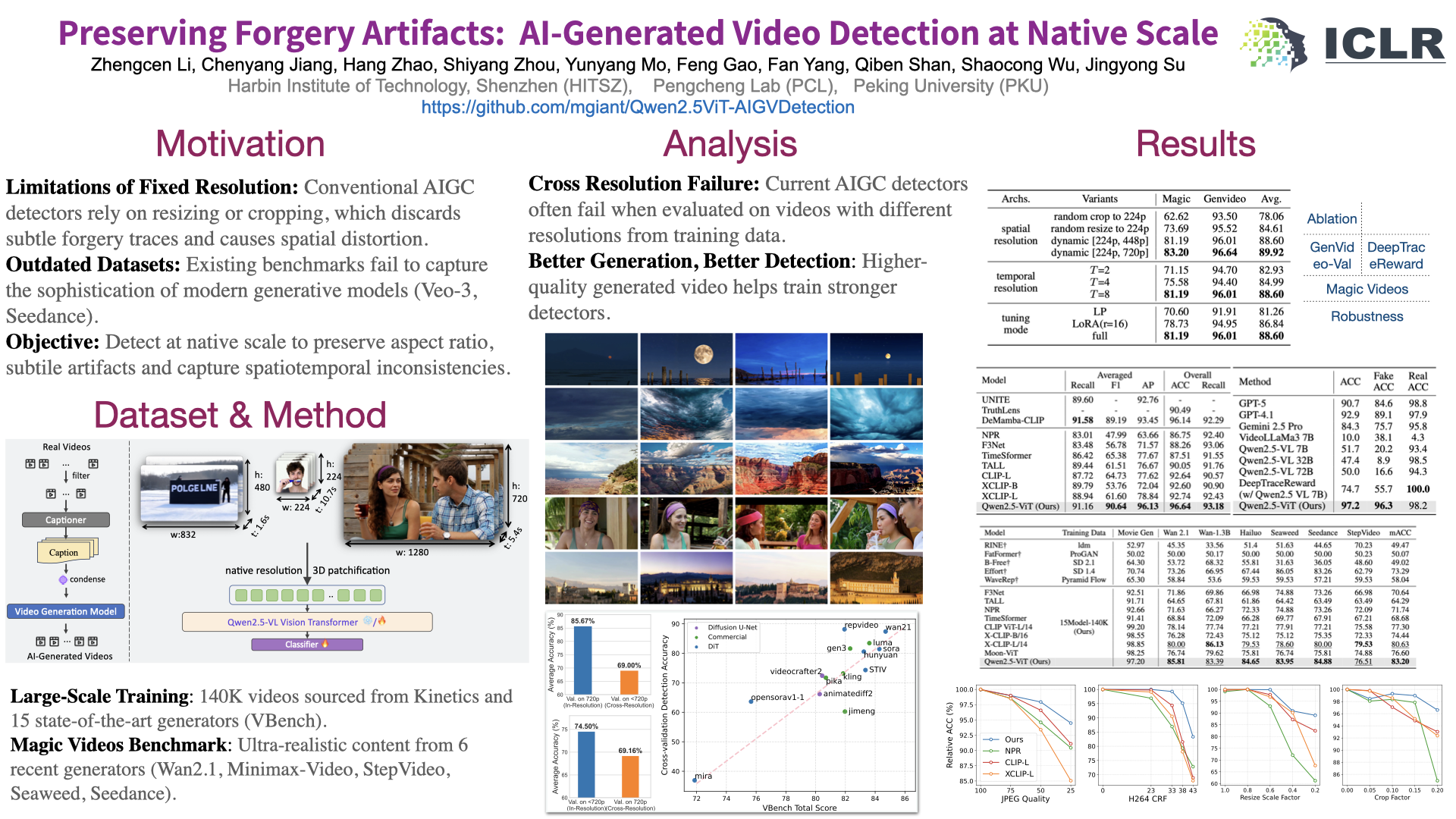
The rapid advancement of video generation models has enabled the creation of highly realistic synthetic media, raising significant societal concerns regarding the spread of misinformation. However, current detection methods suffer from critical limitations. They rely on preprocessing operations like fixed-resolution resizing and cropping. These operations not only discard subtle, high-frequency forgery traces but also cause spatial distortion and significant information loss. Furthermore, existing methods are often trained and evaluated on outdated datasets that fail to capture the sophistication of modern generative models. To address these challenges, we introduce a comprehensive dataset and a novel detection framework. First, we curate a large-scale dataset of over 140K videos from 15 state-of-the-art open-source and commercial generators, along with Magic Videos benchmark designed specifically for evaluating ultra-realistic synthetic content. In addition, we propose a novel detection framework built on the Qwen2.5-VL Vision Transformer, which operates natively at variable spatial resolutions and temporal durations. This native-scale approach effectively preserves the high-frequency artifacts and spatiotemporal inconsistencies typically lost during conventional preprocessing. Extensive experiments demonstrate that our method achieves superior performance across multiple benchmarks, underscoring the critical importance of native-scale processing and establishing a robust new baseline for AI-generated video detection.