
Ambig-SWE: Interactive Agents to Overcome Underspecificity in Software Engineering
Abstract
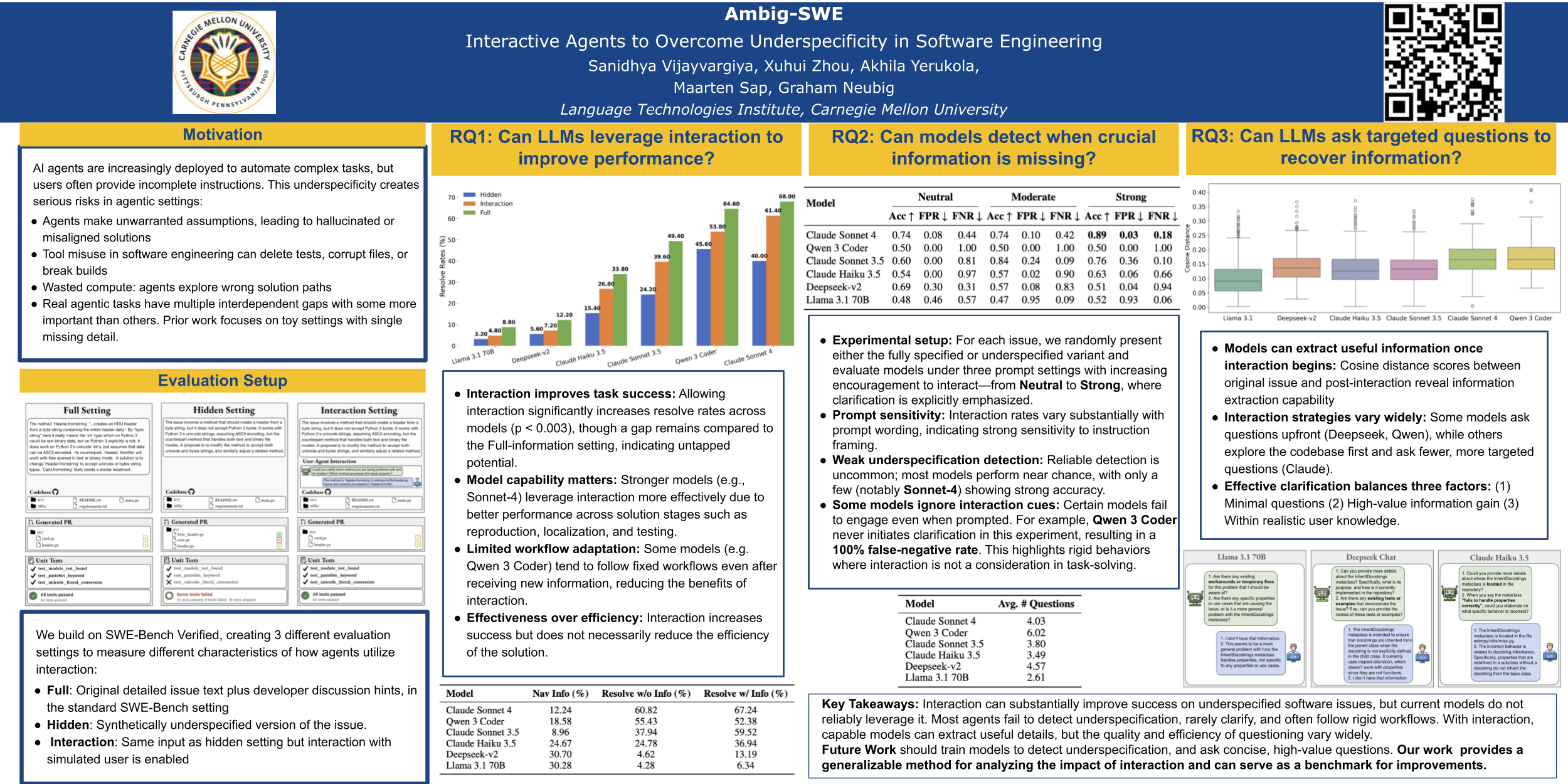
AI agents are increasingly being deployed to automate tasks, often based on underspecified user instructions. Making unwarranted assumptions to compensate for the missing information and failing to ask clarifying questions can lead to suboptimal outcomes, safety risks due to tool misuse, and wasted computational resources. In this work, we study the ability of LLM agents to handle underspecified instructions in interactive code generation settings by evaluating proprietary and open-weight models on their performance across three key steps: (a) detecting underspecificity, (b) asking targeted clarification questions, and (c) leveraging the interaction to improve performance in underspecified scenarios. Our findings reveal that models struggle to distinguish between well-specified and underspecified instructions. However, when models interact for underspecified inputs, they effectively obtain vital information from the user leading to significant improvements in performance, up to 74\% over the non-interactive settings, underscoring the value of effective interaction. Our study highlights critical gaps in how current state-of-the-art models handle missing information in complex software engineering tasks and structures the evaluation into distinct steps to enable targeted improvements.