
Interference-Isolated Elastic Weight Consolidation and Knowledge Calibration for Incremental Object Detection
Abstract
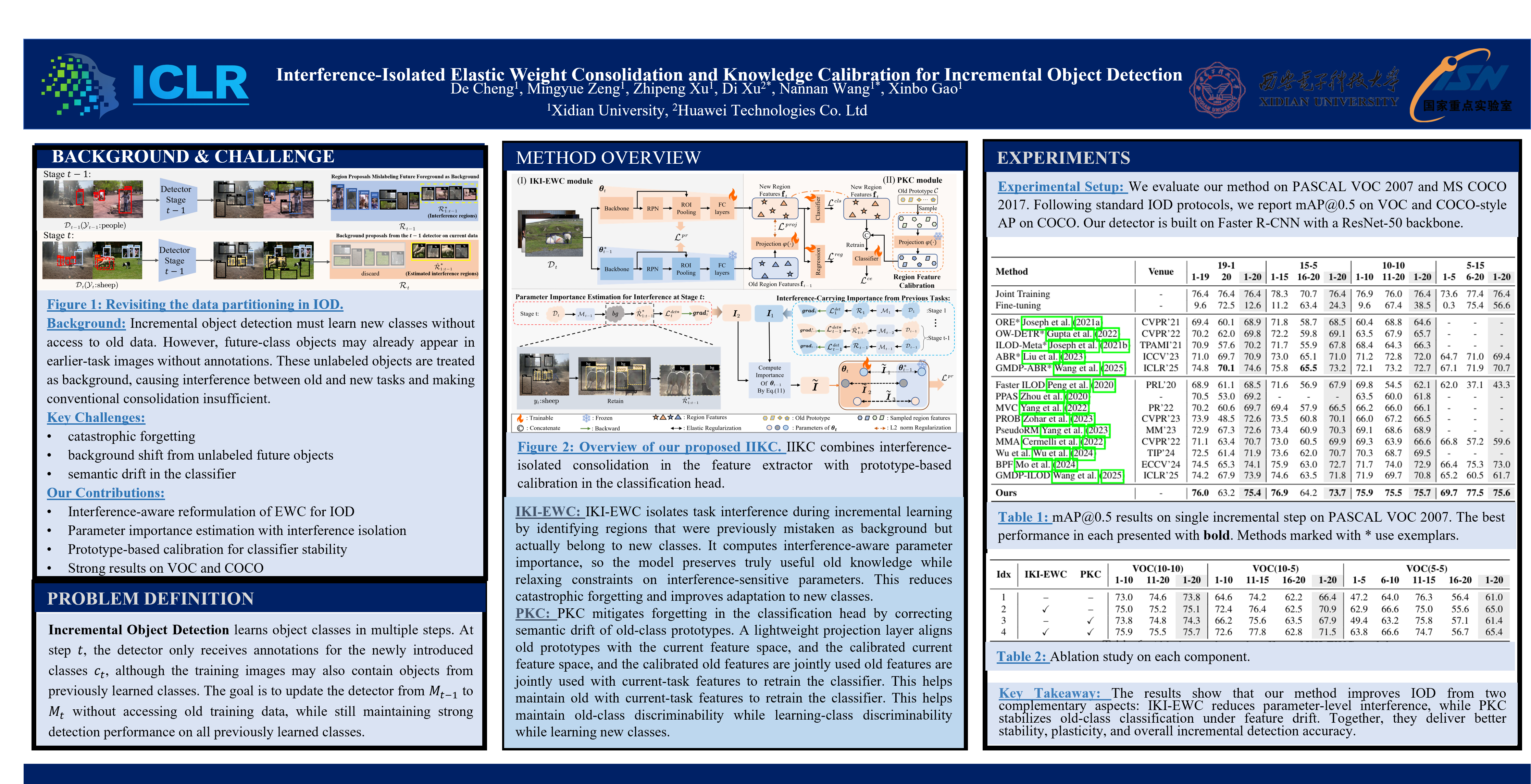
Incremental Object Detection (IOD) enables AI systems to continuously learn new object classes over time while retaining knowledge of previously learned categories. This capability is essential for adapting to dynamic environments without forgetting prior information. Although existing IOD methods have made progress in mitigating catastrophic forgetting, they usually lack explicit and quantitative modeling of information conflicts during knowledge preservation, making task boundaries ambiguous. Such conflicts often stem from the fact that a single image can contain objects belonging to previous, present, and future tasks, where unlabeled past and future objects are often mistakenly treated as background. In this paper, we propose a novel approach grounded in Elastic Weight Consolidation (EWC) to alleviate conflict knowledge preservation caused by task interference. Specifically, we introduce the Interference Knowledge Isolated Elastic Weight Consolidation (IKI-EWC) framework for IOD, which leverages the mispredictions of the old detector on new task data to estimate task conflicts and suppresses them at the parameter level. By reformulating the Bayesian posterior of model parameters, we derive a mathematical relationship between previously learned knowledge and interference knowledge, enabling targeted elimination of conflicts during model weight updates. In addition, we also propose a prototype-based knowledge calibration (PKC) mechanism to further preserve old knowledge during the training of the objector's classification head. This method employs a learnable projection layer to compensate semantic drift in old class prototypes, and then jointly trains the classification head using both calibrated prototypes and current task features, thereby mitigating forgetting caused by classifier updates. Extensive experiments on PASCAL VOC and MS-COCO benchmarks demonstrate the effectiveness of the proposed method, outperforming state-of-the-art approaches in various settings.