
Flatness Guided Test-Time Adaptation for Vision-Language Models
Abstract
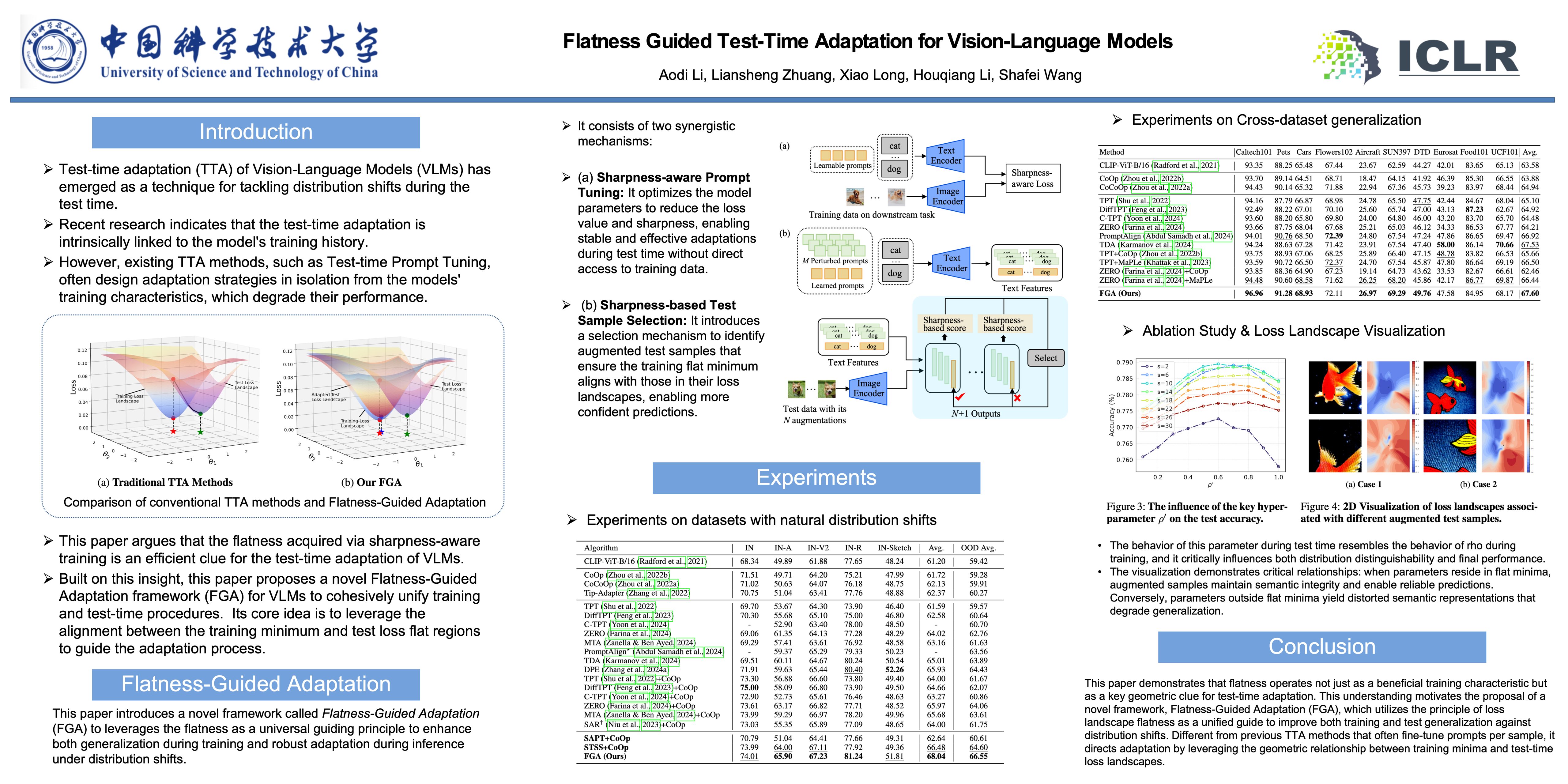
Test-time adaptation (TTA) of Vision-Language Models (VLMs) has emerged as a technique for tackling distribution shifts during the test time. Recent research indicates that the test-time adaptation is intrinsically linked to the model's training history. However, existing TTA methods, such as Test-time Prompt Tuning, often design adaptation strategies in isolation from the models' training characteristics, which degrade their performance. This paper argues that the flatness acquired via sharpness-aware training is an efficient clue for the test-time adaptation of VLMs. Built on this insight, this paper proposes a novel Flatness-Guided Adaptation framework (FGA) for VLMs to cohesively unify training and test-time procedures. Its core idea is to leverage the alignment between the training minimum and test loss flat regions to guide the adaptation process. Specifically, our FGA consists of a prompt-tuning stage and a test-time adaptation stage. In the tuning stage, a Sharpness-Aware Prompt Tuning method is utilized to identify the training flat minimum, offering a geometric clue of flatness for subsequent adaptation. In the test stage, a Sharpness-based Test Sample Selection approach is proposed to ensure the alignment of flat minima between the training and each augmented test sample's loss landscape. In comparison to existing TTA methods, our FGA avoids the expensive prompt parameter updates during test time, and substantially reduces the computation overhead. Extensive experiments on both domain generalization and cross-dataset benchmarks demonstrate that our FGA achieves superior performance over prevalent TTA methods. Notably, when employing a ViT-B/16 image encoder, FGA even outperforms TPT+CoOp by an average of 4.88\% across all four ImageNet out-of-domain variants.