
Following the Navigation: Enhancing Small Language Models Contextual Reasoning with LLM Guidance
Abstract
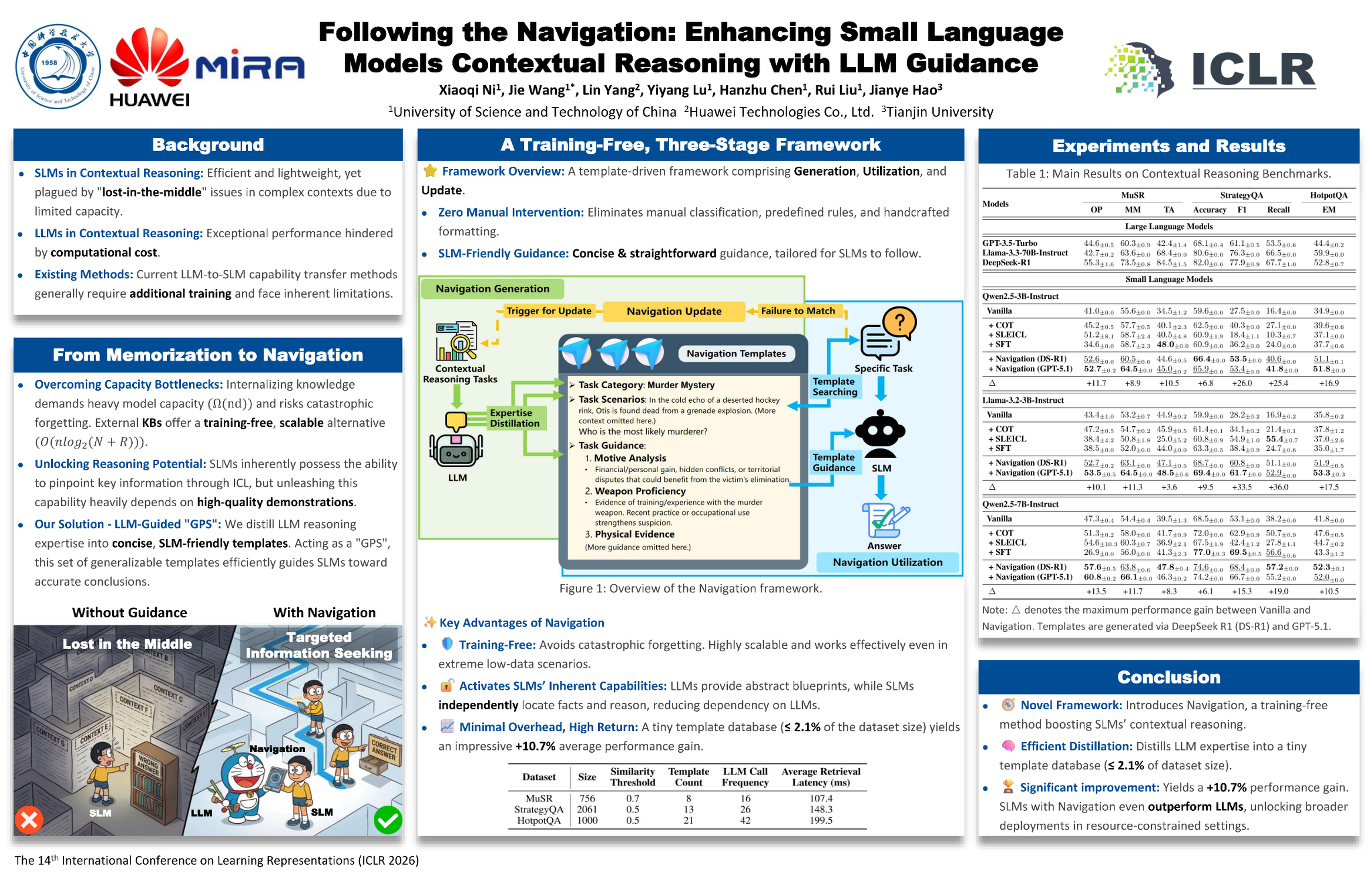
Large language models (LLMs), such as OpenAI o1 and DeepSeek-R1, excel in contextual reasoning by leveraging extensive world knowledge and deep contextual understanding. However, their high computational costs limit deployment in resource-constrained settings. Conversely, small language models (SLMs) are more computationally efficient but often struggle with contextual reasoning due to limited parameter capacity and challenges like catastrophic forgetting. Existing enhancement methods for SLMs—such as knowledge distillation and data synthesis—still depend on additional training and face inherent limitations. To address this, we propose Navigation, a novel training-free framework that improves SLMs’ contextual reasoning by distilling LLM-derived contextual processing expertise into generalizable navigation templates. These templates, stored in a scalable Navigation database, guide SLMs through a three-stage process—Generation, Utilization, and Update—to locate and process critical information within complex contexts. Experiments demonstrate that our approach yields an average 10.7\% accuracy gain with a template count equivalent to no more than 2.1\% of the dataset size, enabling models such as Qwen2.5-3B-Instruct and Llama-3.2-3B-Instruct to outperform GPT-3.5-Turbo on diverse contextual reasoning tasks.