
The Matthew Effect of AI Programming Assistants: A Hidden Bias in Software Evolution
Abstract
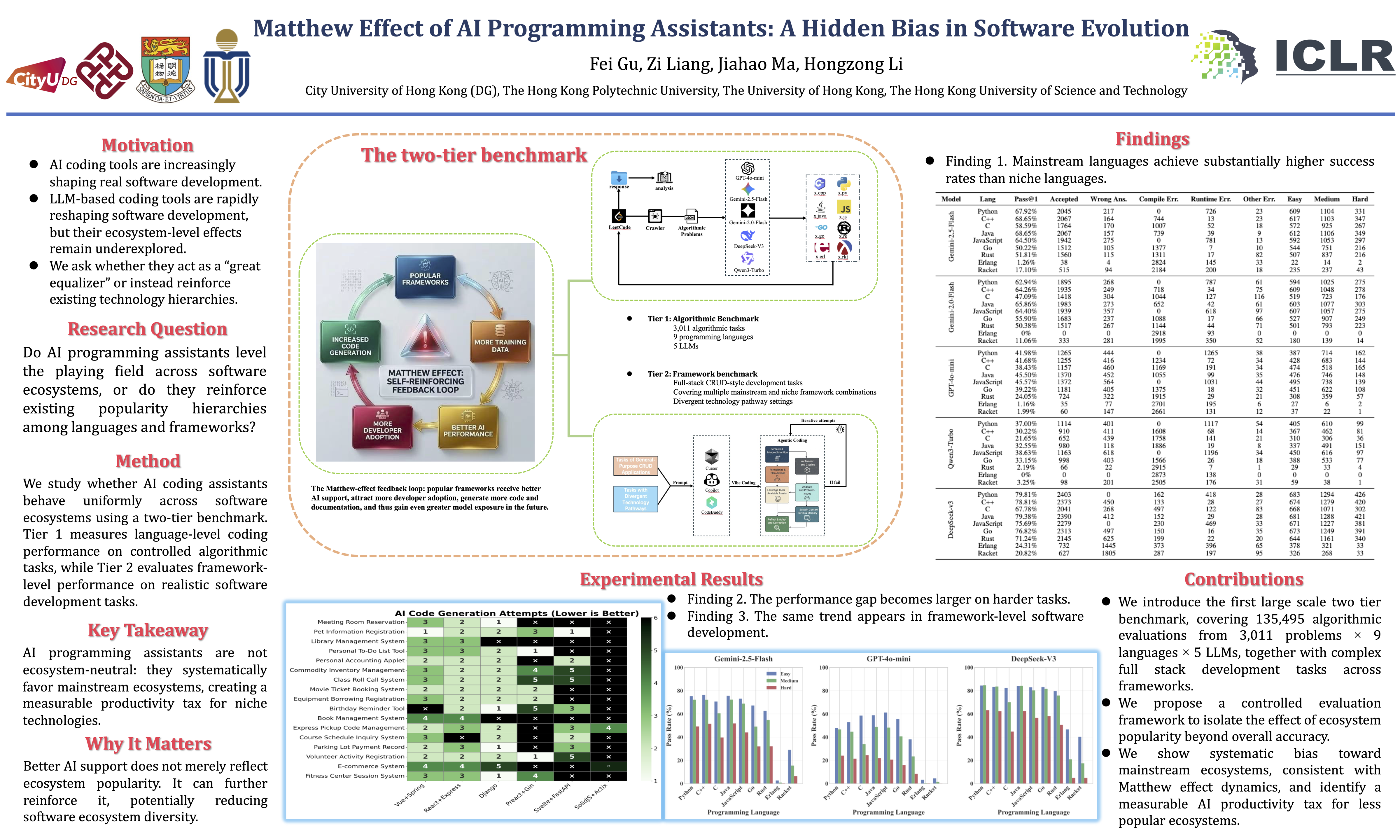
AI-assisted programming is rapidly reshaping software development, with large language models (LLMs) enabling new paradigms such as vibe coding and agentic coding. While prior works have focused on prompt design and code generation quality, the broader impact of LLM-driven development on the iterative dynamics of software engineering remains underexplored. In this paper, we conduct large-scale experiments on thousands of algorithmic programming tasks and hundreds of framework selection tasks to systematically investigate how AI-assisted programming interacts with the software ecosystem. Our analysis quantifies a substantial performance asymmetry: mainstream languages and frameworks achieve significantly higher success rates than niche ones. This disparity suggests a feedback loop consistent with the Matthew Effect, where data-rich ecosystems gain superior AI support. While not the sole driver of adoption, current models introduce a non-negligible productivity friction for niche technologies, representing a hidden bias in software evolution.