
SPWOOD: Sparse Partial Weakly-Supervised Oriented Object Detection
Abstract
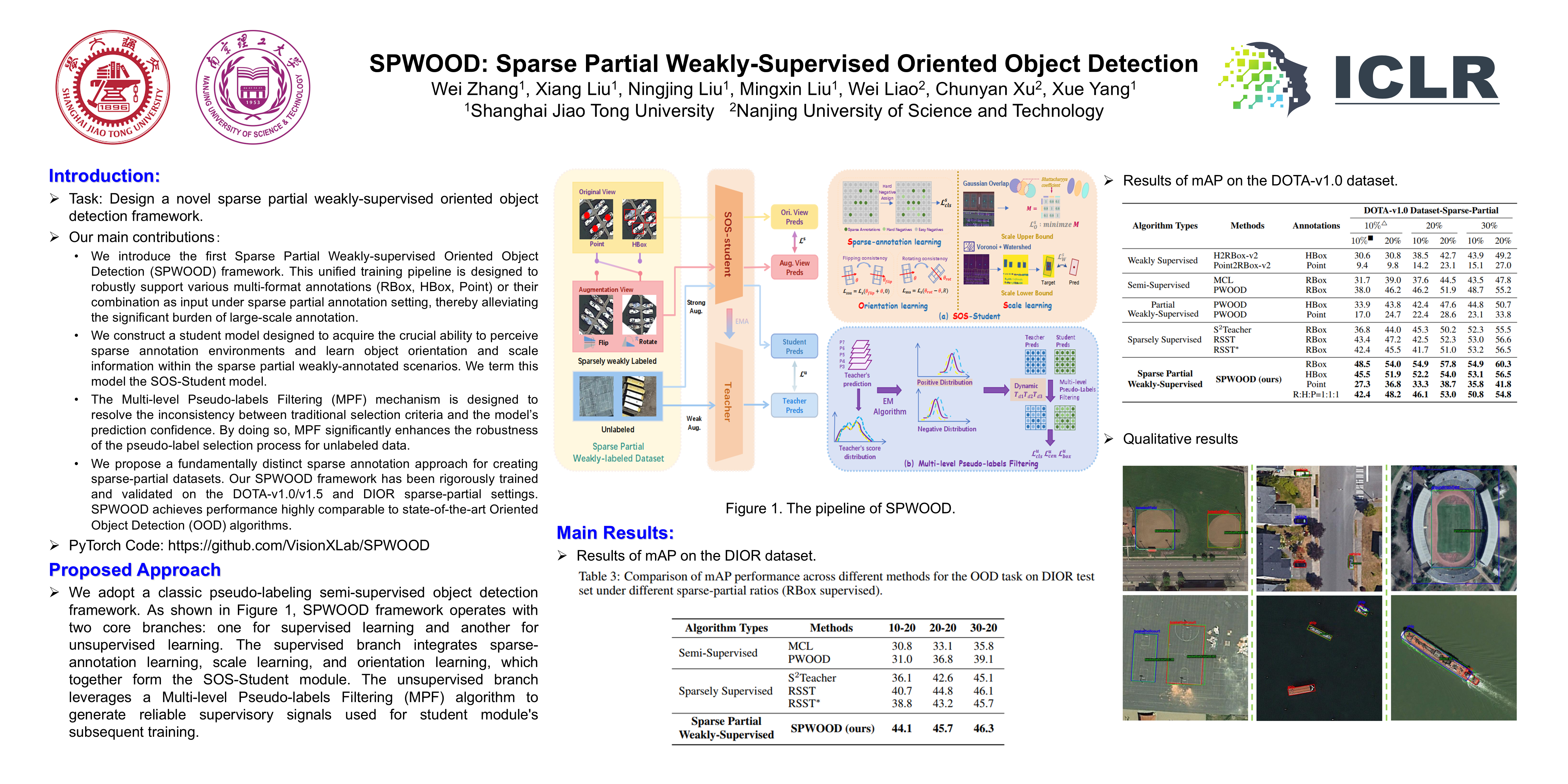
A consistent trend throughout the research of oriented object detection (OOD) has been the pursuit of maintaining comparable performance with fewer and weaker annotations. This is particularly crucial in the remote sensing domain, where the dense object distribution and a wide variety of categories contribute to prohibitively high costs. Based on the supervision level, existing OOD algorithms can be broadly grouped into fully supervised, semi-supervised, and weakly supervised methods. Within the scope of this work, we further categorize them to include sparsely supervised and partially weakly-supervised methods. To address the challenges of large-scale labeling, we introduce the first Sparse Partial Weakly-Supervised Oriented Object Detection (SPWOOD) framework, designed to efficiently leverage only a few sparse weakly-labeled data and plenty of unlabeled data. Our framework incorporates three key innovations: (1) We design a Sparse-annotation-Orientation-and-Scale-aware Student (SOS-Student) model to separate unlabeled objects from the background in a sparsely-labeled setting, and learn orientation and scale information from orientation-agnostic or scale-agnostic weak annotations. (2) We construct a novel Multi-level Pseudo-label Filtering (MPF) strategy that leverages the distribution of model predictions, which is informed by the model’s multi-layer predictions. (3) We propose a unique sparse partitioning approach, ensuring equal treatment for each category. Extensive experiments on the DOTA-v1.0 and v1.5 datasets show that SPWOOD framework achieves a significant performance gain over traditional OOD methods mentioned above, offering a highly cost-effective solution.