
Station2Radar: Query‑Conditioned Gaussian Splatting for Precipitation Field
Abstract
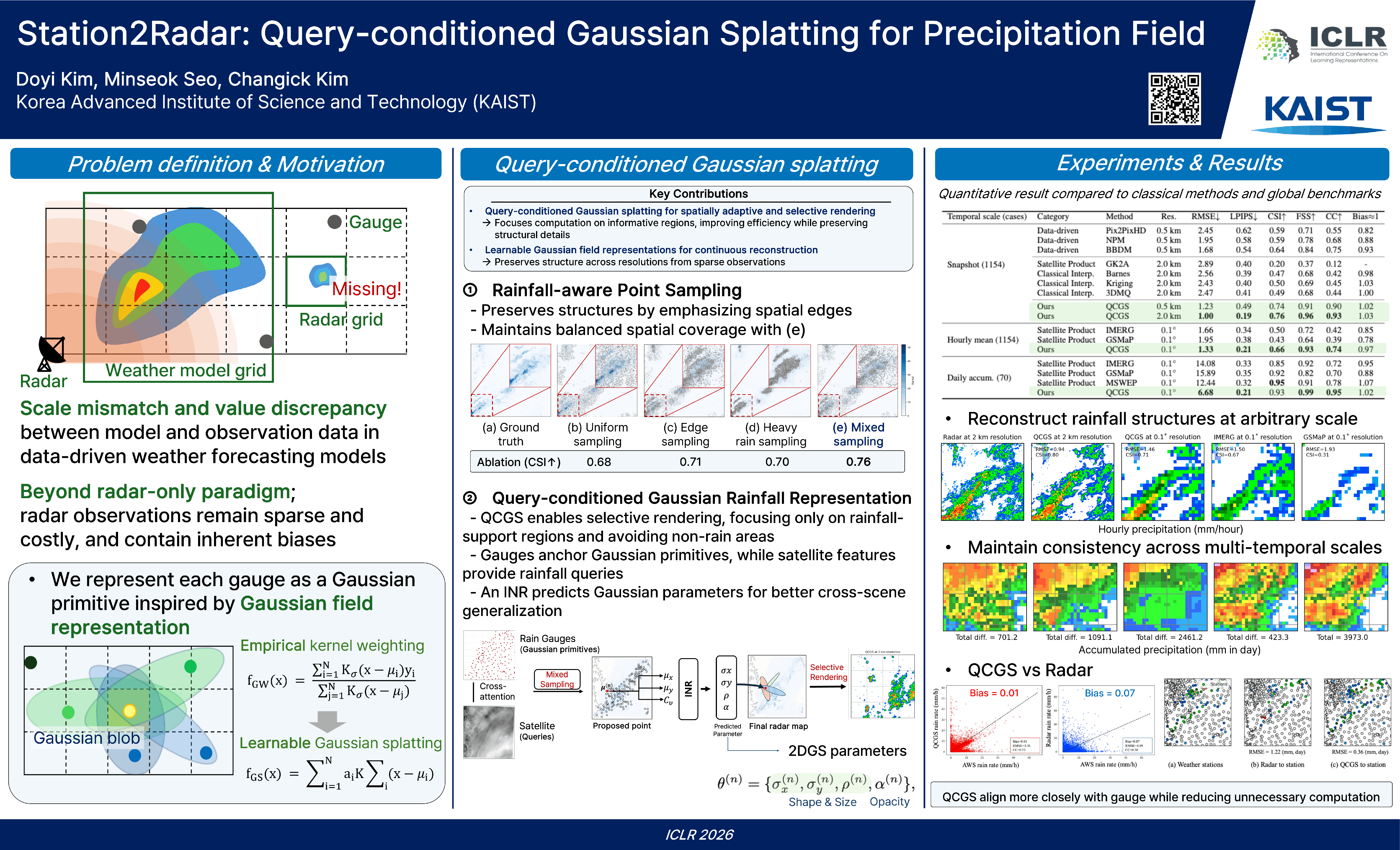
Precipitation forecasting relies on heterogeneous data sets. Weather radar is accurate, but coverage is geographically limited and costly to maintain. Weather stations provide accurate but sparse point measurements, while satellites offer dense, high-resolution coverage without direct rainfall retrieval. To overcome these limitations, we propose Query-Conditioned Gaussian Splatting (QCGS), the first framework to fuse automatic weather station (AWS) observations with satellite imagery for generating radar-like rainfall fields. Unlike conventional 2D Gaussian splatting, which renders the entire image plane, QCGS selectively renders only queried rainfall regions, avoiding unnecessary computation in non-precipitating areas while preserving sharp precipitation structures. The framework combines a radar point proposal network that identifies rainfall-support locations with an implicit neural representation (INR) network that predicts Gaussian parameters for each point. QCGS enables efficient, resolution-flexible rainfall field generation in real time. Through extensive evaluation with benchmark precipitation products, QCGS demonstrates over 50\% improvement in RMSE compared to conventional gridded rainfall products, and consistently maintains high performance across multiple spatiotemporal scales.