
Fractional-Order Spiking Neural Network
Abstract
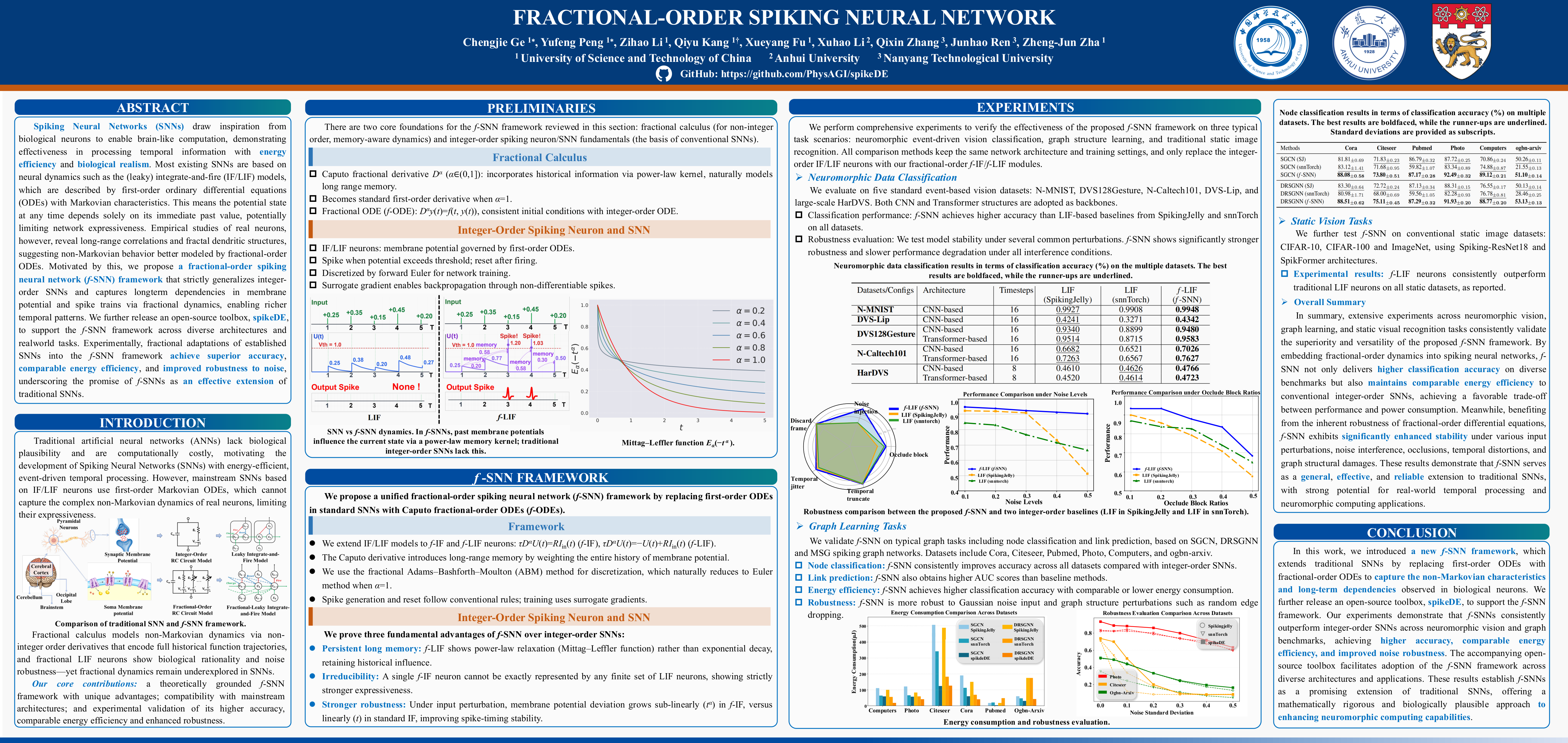
Spiking Neural Networks (SNNs) draw inspiration from biological neurons to enable brain-like computation, demonstrating effectiveness in processing temporal information with energy efficiency and biological realism. Most existing SNNs are based on neural dynamics such as the (leaky) integrate-and-fire (IF/LIF) models, which are described by first-order ordinary differential equations (ODEs) with Markovian characteristics. This means the potential state at any time depends solely on its immediate past value, potentially limiting network expressiveness. Empirical studies of real neurons, however, reveal long-range correlations and fractal dendritic structures, suggesting non-Markovian behavior better modeled by fractional-order ODEs. Motivated by this, we propose a fractional-order spiking neural network (f-SNN) framework that strictly generalizes integer-order SNNs and captures long-term dependencies in membrane potential and spike trains via fractional dynamics, enabling richer temporal patterns. We also release an open-source toolbox to support the f-SNN framework, applicable to diverse architectures and real-world tasks. Experimentally, fractional adaptations of established SNNs into the f-SNN framework achieve superior accuracy, comparable energy efficiency, and improved robustness to noise, underscoring the promise of f-SNNs as an effective extension of traditional SNNs.