
Efficient Audio-Visual Speech Separation with Discrete Lip Semantics and Multi-Scale Global-Local Attention
Kai Li ⋅ Kejun Gao ⋅ Xiaolin Hu
Abstract
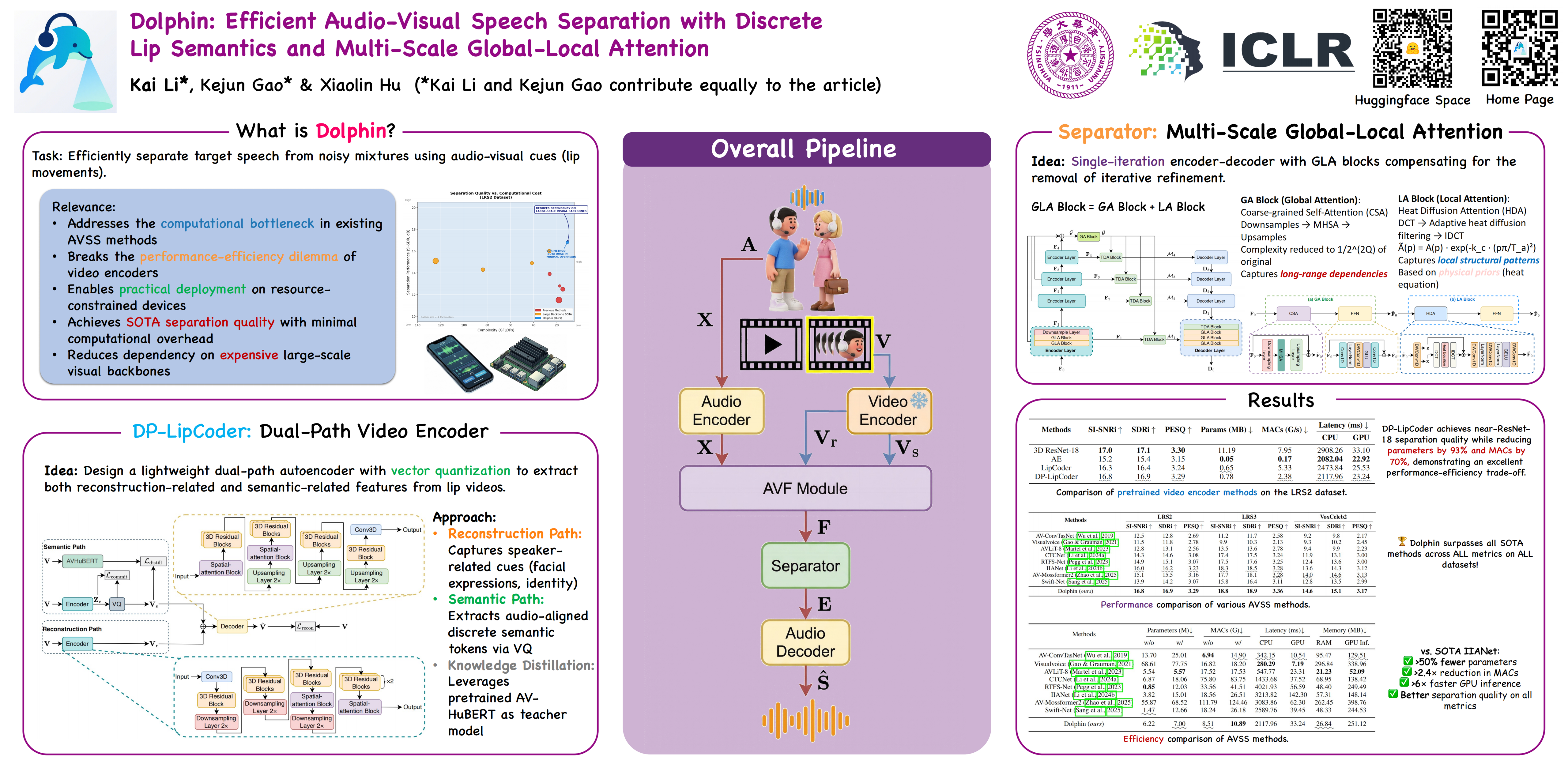
Audio-visual speech separation (AVSS) methods leverage visual cues to extract target speech and have demonstrated strong separation quality in noisy acoustic environments. However, these methods usually involve a large number of parameters and require high computational cost, which is unacceptable in many applications where speech separation serves as only a preprocessing step for further speech processing. To address this issue, we propose an efficient AVSS method, named **Dolphin**. For visual feature extraction, we develop **DP‑LipCoder**, a dual‑path lightweight video encoder that transforms lip‑motion into discrete audio‑aligned semantic tokens. For audio separation, we construct a lightweight encoder–decoder separator, in which each layer incorporates a global–local attention (GLA) block to efficiently capture multi-scale dependencies. Experiments on three benchmark datasets showed that Dolphin not only surpassed the current state-of-the-art (SOTA) model in separation quality but also achieved remarkable improvements in efficiency: over 50\% fewer parameters, more than 2.4$\times$ reduction in MACs, and over 6$\times$ faster GPU inference speed. These results indicate that Dolphin offers a practical and deployable solution for high-performance AVSS in real-world scenarios. Our code and demo page are publicly available at https://cslikai.cn/Dolphin.
Video
Chat is not available.
Successful Page Load