
Look Carefully: Adaptive Visual Reinforcements in Multimodal Large Language Models for Hallucination Mitigation
Abstract
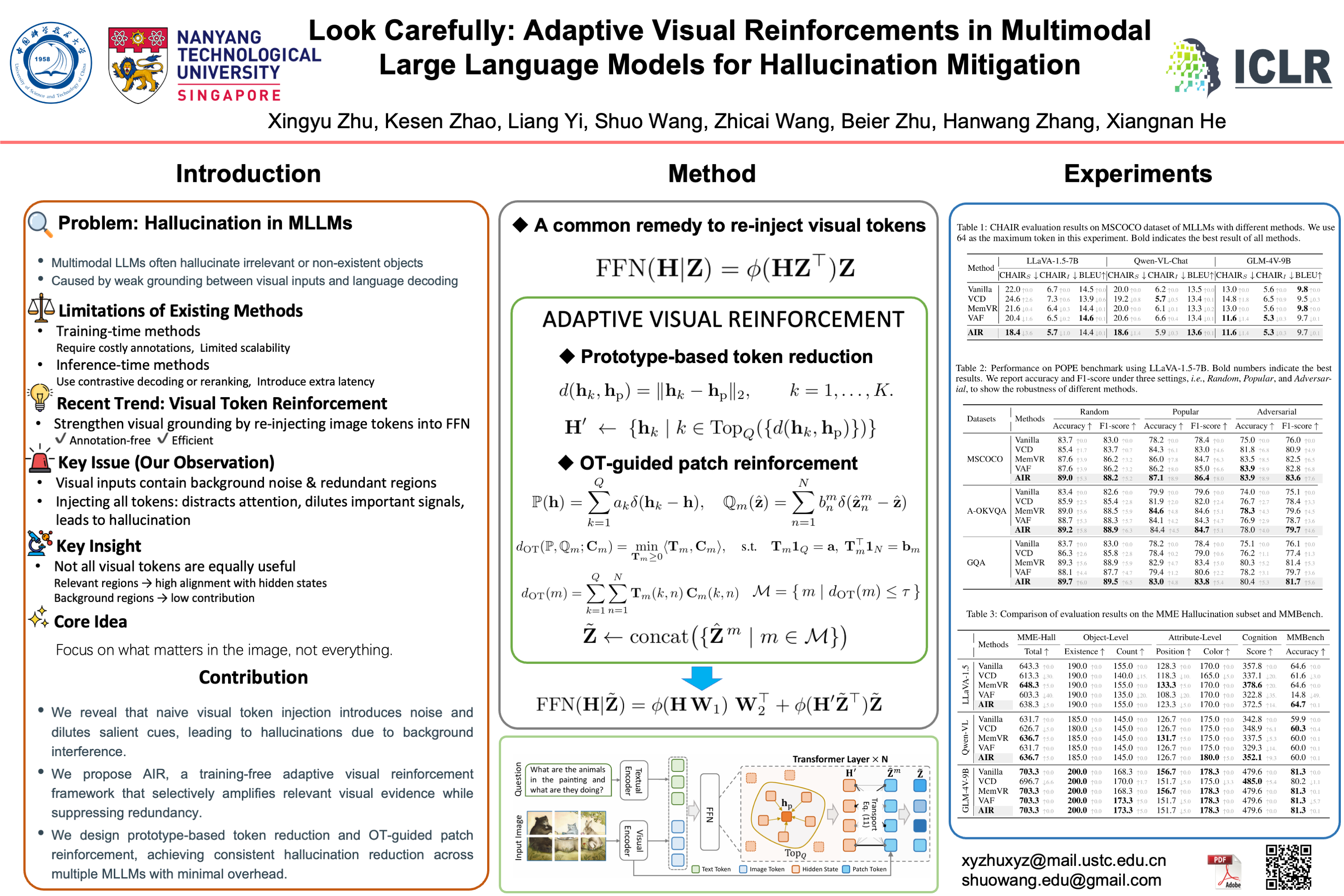
Multimodal large language models (MLLMs) have achieved remarkable progress in vision–language reasoning, yet they remain vulnerable to hallucination, where generated content deviates from the visual evidence. Existing mitigation strategies either demand costly supervision during training or introduce additional latency at inference. Recent vision-enhancement methods attempt to address this by reinforcing visual tokens during decoding, but they typically inject all tokens indiscriminately, leading to interference from background regions and distracting the model from critical cues. To overcome this challenge, we propose an Adaptive vIsual Reinforcement framework for MLLMs, dubbed as AIR. AIR consists of two main components: prototype-based token reduction, which condenses the large pool of visual tokens into a compact subset to suppress redundancy, and OT-guided patch reinforcement, which quantifies the alignment between hidden state and patch embeddings to selectively integrate the most consistent patches into the feed-forward layers. As a result, AIR enhances the model’s reliance on salient visual information and effectively mitigates hallucination. Extensive experiments across representative MLLMs demonstrate that AIR substantially reduces hallucination while preserving general capabilities, establishing it as an effective and independent solution for building reliable MLLMs.