
Improving Extreme Wind Prediction with Frequency-Informed Learning
Abstract
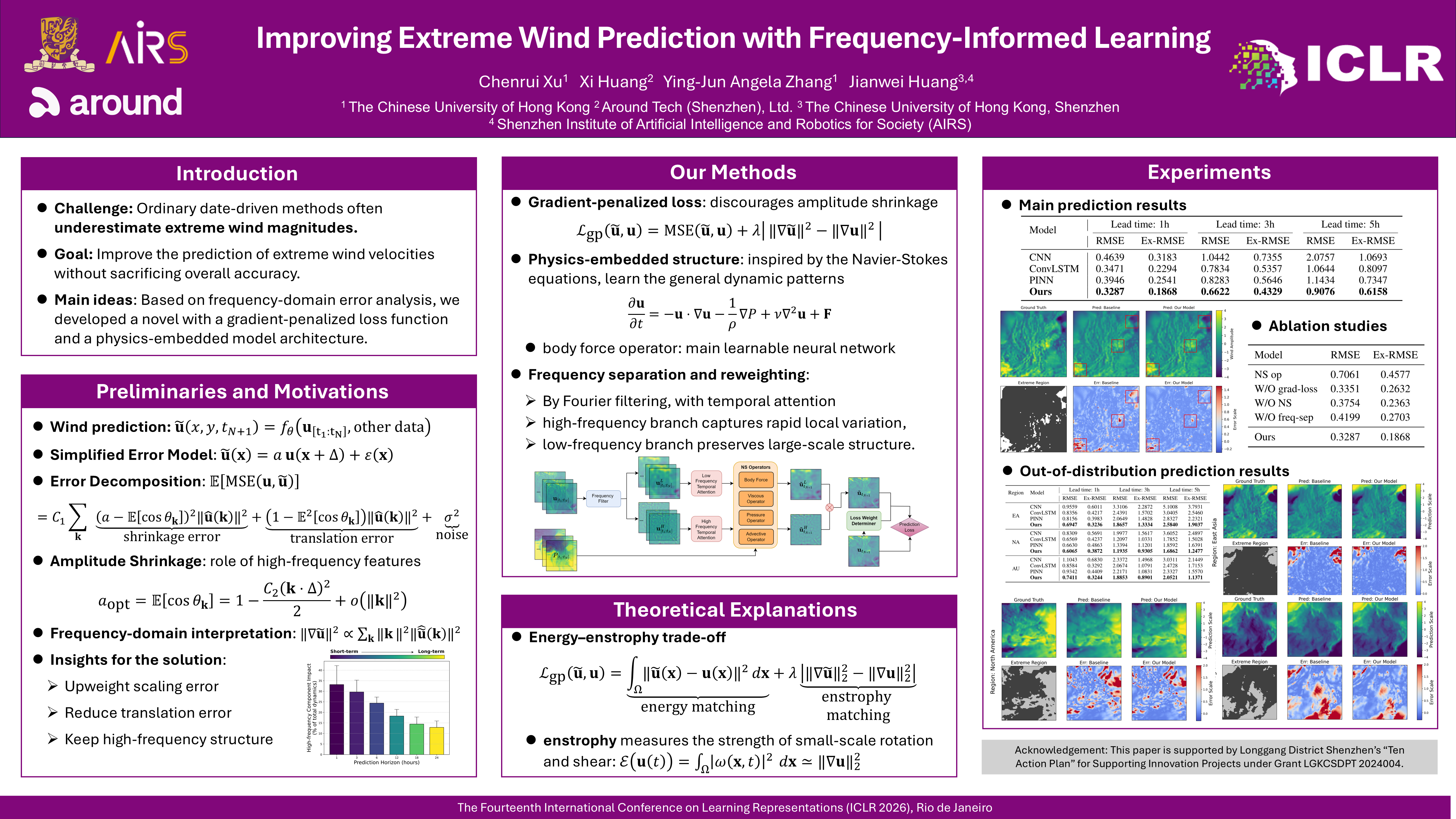
Accurate prediction of extreme wind velocities has substantial significance in industry, particularly for the operation management of wind power plants. Although the state-of-the-art data-driven models perform well for general meteorological forecasting, they may exhibit large errors for extreme weather—for example, systematically underestimating the magnitudes and short-term variation of extreme winds. To address this issue, we conduct a theoretical analysis of how the data frequency spectrum influences errors in extreme wind prediction. Based on these insights, we propose a novel loss function that incorporates a gradient penalty to mitigate the magnitude shrinkage of extreme weather, and we theoretically justify its effectiveness via a PDE-based energy–enstrophy analysis. To capture more precise short-term wind velocity variations, we design a novel structure of physics-embedded machine learning models with frequency reweighting. Experiments demonstrate that, compared to the baseline models, our approach achieves significant improvements in predicting extreme wind velocities while maintaining robust overall performance.