
Learning Human Habits with Rule-Guided Active Inference
Abstract
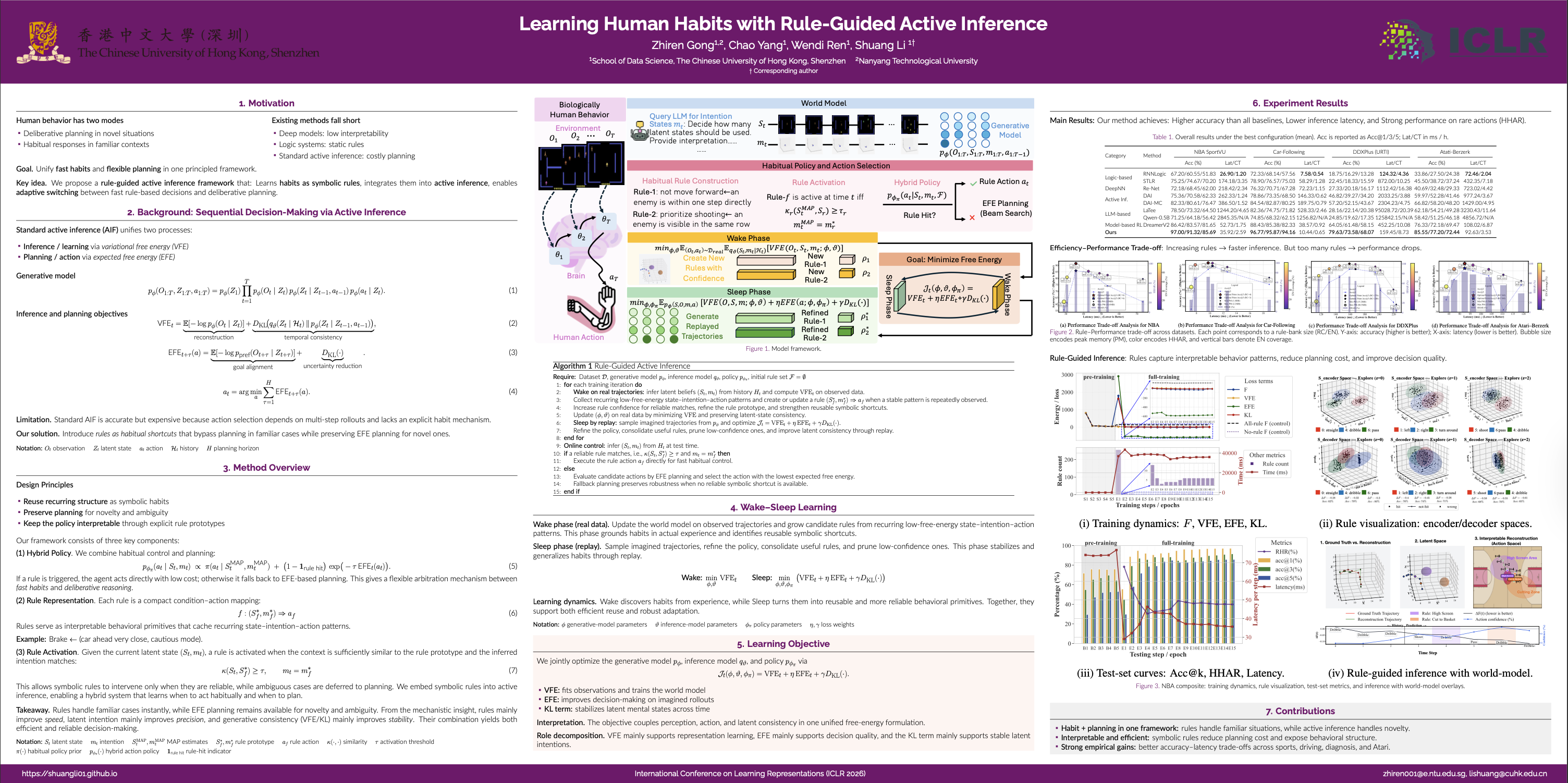
Humans navigate daily life by combining two modes of behavior: deliberate planning in novel situations and fast, automatic responses in familiar ones. Modeling human decision-making therefore requires capturing how people switch between these modes. We present a framework for learning human habits with rule-guided active inference, extending the view of the brain as a prediction machine that minimizes mismatches between expectations and observations, and computationally modeling of human(-like) behavior and habits. In our approach, habits emerge as symbolic rules that serve as compact, interpretable shortcuts for action. To learn these rules alongside the human models, we design a biologically inspired wake--sleep algorithm. In the wake phase, the agent engages in active inference on real trajectories: reconstructing states, updating beliefs, and harvesting candidate rules that reliably reduce free energy. In the sleep phase, the agent performs generative replay with its world model, refining parameters and consolidating or pruning rules by minimizing joint free energy. This alternating rule–model consolidation lets the agent build a reusable habit library while preserving the flexibility to plan. Experiments on basketball player movements, car-following behavior, medical diagnosis, and visual game strategy demonstrate that our framework improves predictive accuracy and efficiency compared to logic-based, deep learning, LLM-based, model-based RL, and prior active inference baselines, while producing interpretable rules that mirror human-like habits.