
Tractability via Low Dimensionality: The Parameterized Complexity of Training Quantized Neural Networks
Abstract
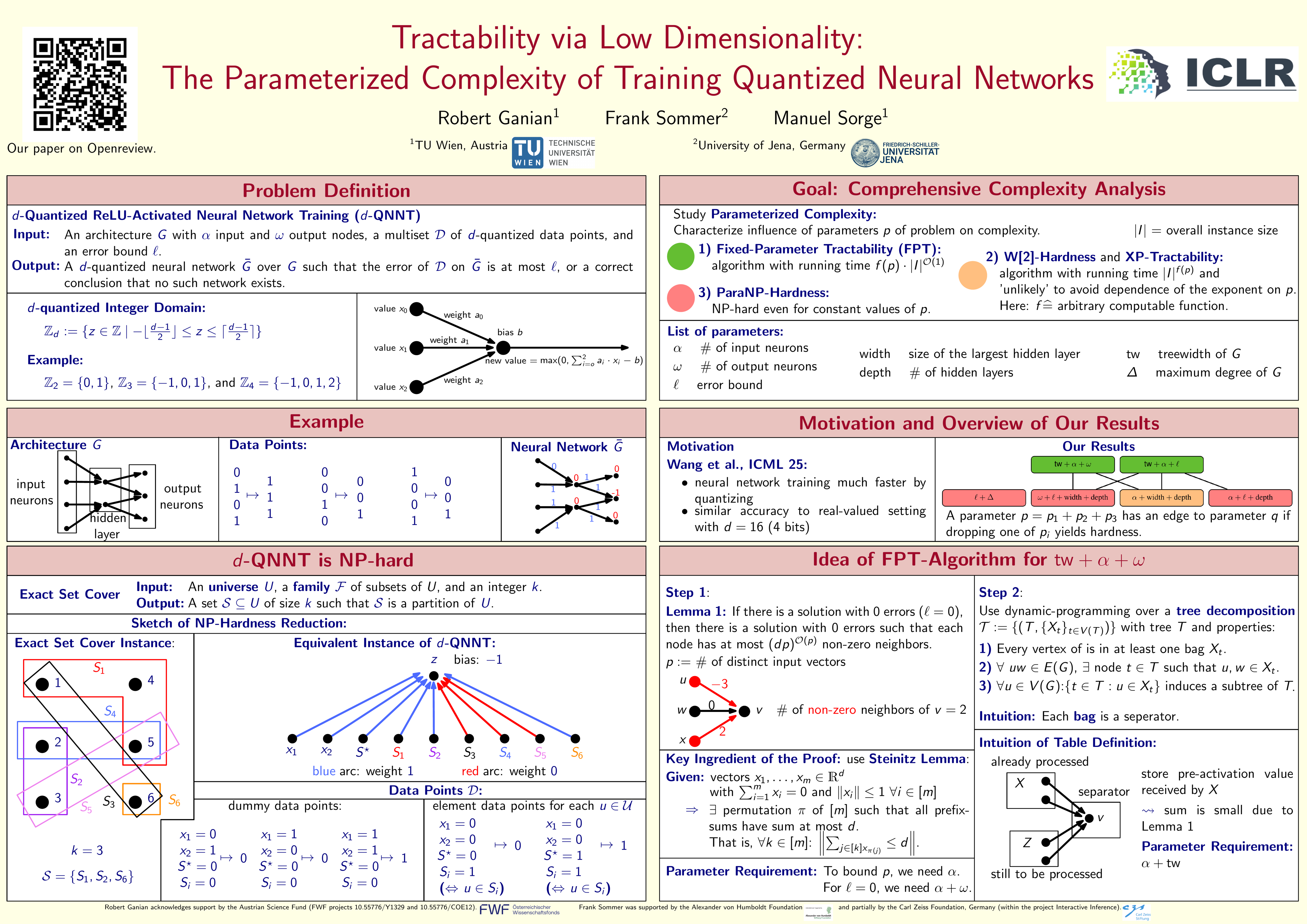
The training of neural networks has been extensively studied from both algorithmic and complexity-theoretic perspectives, yet recent results in this direction almost exclusively concern real-valued networks. In contrast, advances in machine learning practice highlight the benefits of quantization, where network parameters and data are restricted to finite integer domains, yielding significant improvements in speed and energy efficiency. Motivated by this gap, we initiate a systematic complexity-theoretic study of ReLU Neural Network Training in the full quantization mode. We establish strong lower bounds by showing that hardness already arises in the binary setting and under highly restrictive structural assumptions on the architecture, thereby excluding parameterized tractability for natural measures such as depth and width. On the positive side, we identify nontrivial fixed-parameter tractable cases when parameterizing by input dimensionality in combination with width and either output dimensionality or error bound, and further strengthen these results by replacing width with the more general treewidth.