
Moving Beyond Diffusion: Hierarchy-to-Hierarchy Autoregression for fMRI-to-Image Reconstruction
Xu Zhang ⋅ Ruijie Quan ⋅ Wenguan Wang ⋅ Yi Yang
Abstract
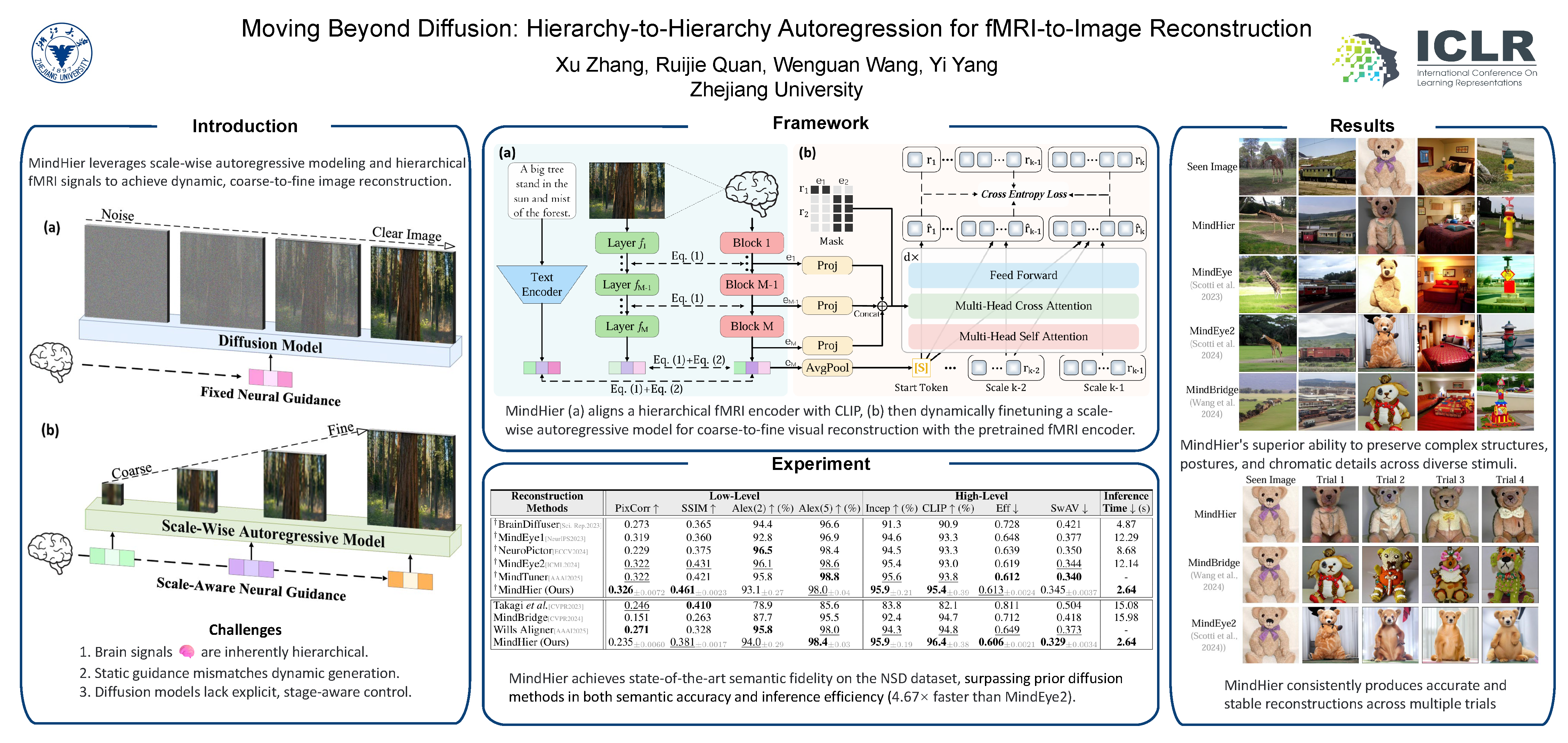
Reconstructing visual stimuli from fMRI signals is a central challenge bridging machine learning and neuroscience. Recent diffusion-based methods typically map fMRI activity to a single neural embedding, using it as static guidance throughout the entire generation process. However, this fixed guidance collapses hierarchical neural information and is misaligned with the stage-dependent demands of image reconstruction. In response, we propose MindHier, a coarse-to-fine fMRI-to-image reconstruction framework built on scale-wise autoregressive modeling. MindHier introduces three components: a Hierarchical fMRI Encoder to extract multi-level neural embeddings, a Hierarchy-to-Hierarchy Alignment scheme to enforce layer-wise correspondence with CLIP features, and a Scale-Aware Coarse-to-Fine Neural Guidance strategy to inject these embeddings into autoregression at matching scales. These designs make MindHier an efficient and cognitively aligned alternative to diffusion-based methods by enabling a hierarchical reconstruction process that synthesizes global semantics before refining local details, akin to human visual perception. Extensive experiments on the NSD dataset show that MindHier achieves superior semantic fidelity, 4.67$\times$ faster inference, and more deterministic results than the diffusion-based baselines.
Video
Chat is not available.
Successful Page Load