
Learnable Sparsity for Vision Generative Models
Abstract
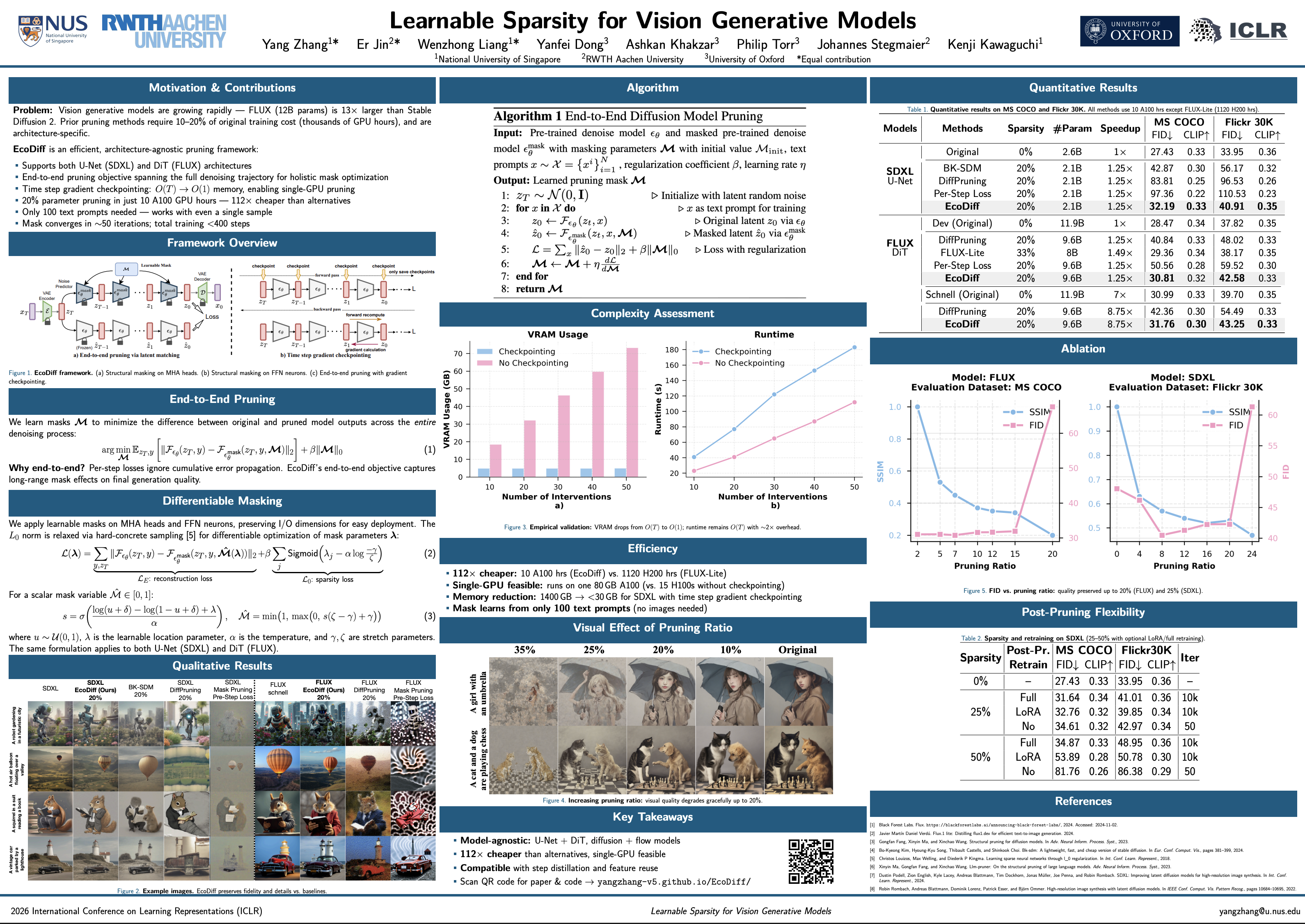
Generative models have achieved impressive advancements in various vision tasks. However, these gains often rely on increasing model size, which raises computational complexity and memory demands. The increased computational demand poses challenges for deployment, elevates inference costs, and impacts the environment. While some studies have explored pruning techniques to improve the memory efficiency of diffusion models, most existing methods require extensive retraining to maintain model performance. Retraining a large model is extremely costly and resource-intensive, which limits the practicality of pruning methods. In this work, we achieve low-cost pruning by proposing a general pruning framework for vision generative models that learns a differentiable mask to sparsify the model. To learn a mask that minimally deteriorates the model, we design a novel end-to-end pruning objective that spans the entire generation process over all steps. Since end-to-end pruning is memory-intensive, we further design a time step gradient checkpointing technique for the end-to-end pruning, a technique that significantly reduces memory usage during optimization, enabling end-to-end pruning within a limited memory budget. Results on the state-of-the-art U-Net diffusion models Stable Diffusion XL (SDXL) and DiT flow models (FLUX) show that our method efficiently prunes 20% of parameters in just 10 A100 GPU hours, outperforming previous pruning approaches.