
Fastcar: Cache Attentive Replay for Fast Auto-Regressive Video Generation on the Edge
Abstract
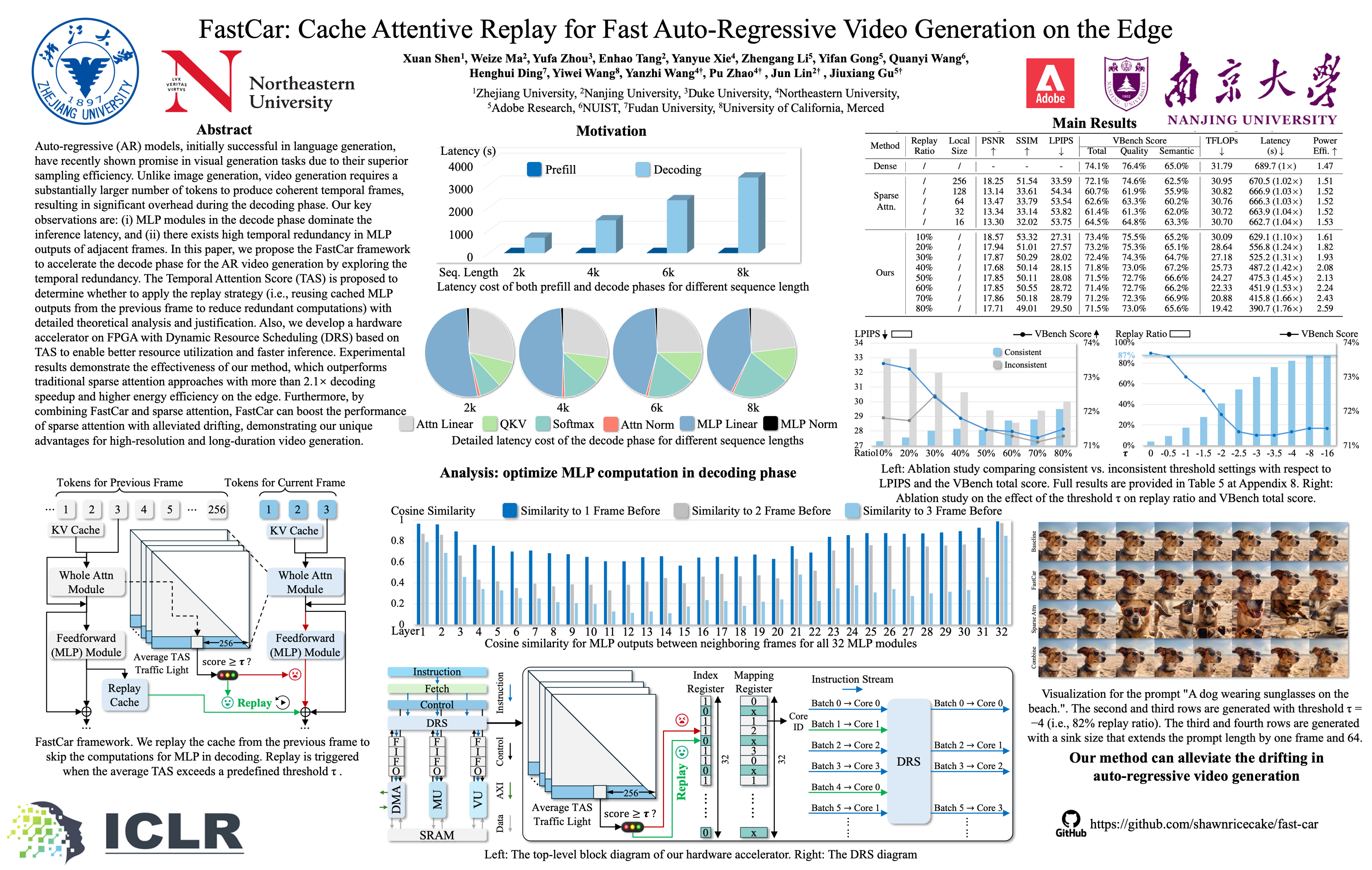
Auto-regressive (AR) models, initially successful in language generation, have recently shown promise in visual generation tasks due to their superior sampling efficiency. Unlike image generation, video generation requires a substantially larger number of tokens to produce coherent temporal frames, resulting in significant overhead during decoding. We first make specific key observations: (i) MLP modules in the decode phase dominate the inference latency, and (ii) there exists high temporal redundancy in MLP outputs of adjacent frames. With the insights, we propose FastCar to accelerate the decode phase for the AR video generation by exploring the temporal redundancy. The Temporal Attention Score (TAS) is proposed to determine whether to apply the replay strategy (i.e., reusing cached MLP outputs from the previous frame to reduce redundant computations) with detailed theoretical analysis and justification. Furthermore, we develop a hardware accelerator on FPGA with Dynamic Resource Scheduling based on TAS to enable better resource utilization and faster inference. Experimental results demonstrate the effectiveness of our method, which outperforms traditional sparse attention approaches with more than 2.1x decoding speedup and higher energy efficiency on the edge. Furthermore, by combining FastCar and sparse attention, FastCar can boost the performance of sparse attention with alleviated drifting, demonstrating our unique advantages for high-resolution and long-duration video generation. Code: https://github.com/shawnricecake/fast-car