
MicroVerse: A Preliminary Exploration Toward a Micro-World Simulation
Abstract
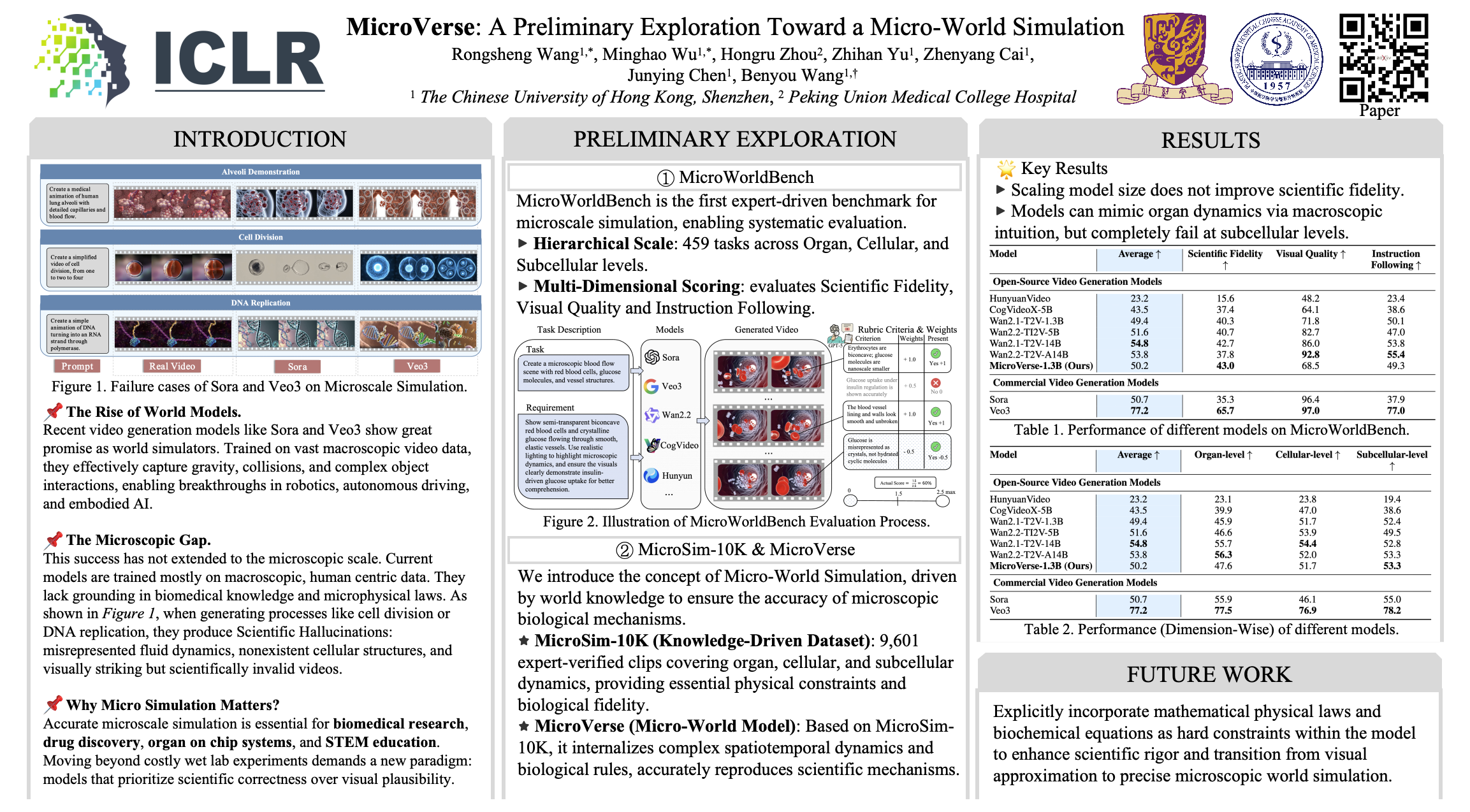
Recent advances in video generation have opened new avenues for macroscopic simulation of complex dynamic systems, but their application to microscopic phenomena remains largely unexplored. Microscale simulation holds great promise for biomedical applications such as drug discovery, organ-on-chip systems, and disease mechanism studies, while also showing potential in education and interactive visualization. In this work, we introduce MicroWorldBench, a multi-level rubric-based benchmark for microscale simulation tasks. MicroWorldBench enables systematic, rubric-based evaluation through 459 unique expert-annotated criteria spanning multiple microscale simulation task (e.g., organ-level processes, cellular dynamics, and subcellular molecular interactions) and evaluation dimensions (e.g., scientific fidelity, visual quality, instruction following). MicroWorldBench reveals that current SOTA video generation models fail in microscale simulation, showing violations of physical laws, temporal inconsistency, and misalignment with expert criteria. To address these limitations, we construct MicroSim-10K, a high-quality, expert-verified simulation dataset. Leveraging this dataset, we train MicroVerse, a video generation model tailored for microscale simulation. MicroVerse can accurately reproduce complex microscale mechanism. Our work first introduce the concept of Micro-World Simulation and present a proof of concept, paving the way for applications in biology, education, and scientific visualization. Our work demonstrates the potential of educational microscale simulations of biological mechanisms.